



Use Wozber and land your dream job
Create Resume
No registration required
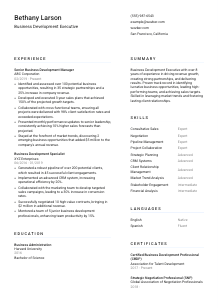
Growing client networks, but your resume lacks connections? Check out this Business Development Executive resume example, created with Wozber free resume builder. Learn how to highlight your strategic acumen and relationship-building prowess to match job requirements, giving your career trajectory a sales pitch that seals the deal!
Business Development Executive hiring usually turns on one question fast: can you open revenue opportunities and move them through a credible, consultative sales process? Titles alone do not answer that. Your resume needs to show how you built pipeline, shaped partnerships, influenced stakeholders, and turned market insight into signed business.
Early resume screening often separates general sales backgrounds from business development candidates who can spot white-space opportunities, build strategic plans, and report pipeline health with discipline. Wozber's free resume builder helps you tailor that story into an ATS-compliant resume, so hiring teams can quickly see the mix of prospecting, partnership development, forecasting, and cross-functional execution that this work demands.
Personal details seem simple, but they still shape the first read. For business development roles, this section should make you easy to contact, easy to place, and immediately aligned with the position you want.
Place your name at the top in a clean, readable format. Keep it visually prominent so the recruiter can anchor your application right away, especially when reviewing multiple sales and business development profiles in one sitting.
Use the job title directly under your name when it reflects the role you are pursuing. If the posting is for a "Business Development Executive," using that exact title helps frame your background before the reader reaches your experience section.
Your phone number and email should be accurate, current, and professional. Business development work depends on responsiveness and communication, so even this section should reflect polish and reliability.
Some openings have a location requirement tied to client access, internal collaboration, or market coverage. Here, San Francisco, California is explicitly requested, so listing that location removes a basic screening hurdle immediately.
Include LinkedIn or a professional website if it supports your candidacy. For a Business Development Executive, that profile should reinforce your sales record, industry exposure, partnerships, and progression in revenue-facing roles.
This section does not need flair. It needs accuracy, professionalism, and the right signals for the role, including title alignment and any stated location requirement. Make it easy for the employer to move on to the commercial story you are about to tell.




Experience carries the most weight in business development hiring. Employers want to see how you found opportunities, advanced deals, worked across teams, and converted effort into revenue, retention, or strategic partnerships.
Review the posting and pull out the commercial priorities behind it. For this kind of role, that usually means new business generation, consultative selling, strategic planning, partnership development, and internal coordination. Then shape each job entry around those outcomes instead of listing general duties.
List roles in reverse chronological order with company name, title, and dates. This straightforward format works well for ATS parsing and also helps hiring managers quickly trace your progression from supporting sales activity to owning pipeline, partnerships, and growth targets.
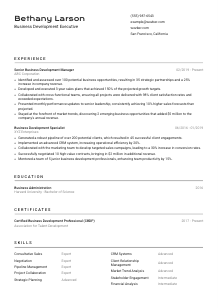
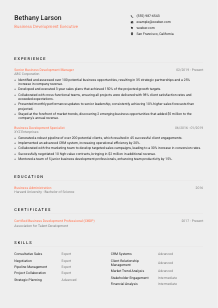
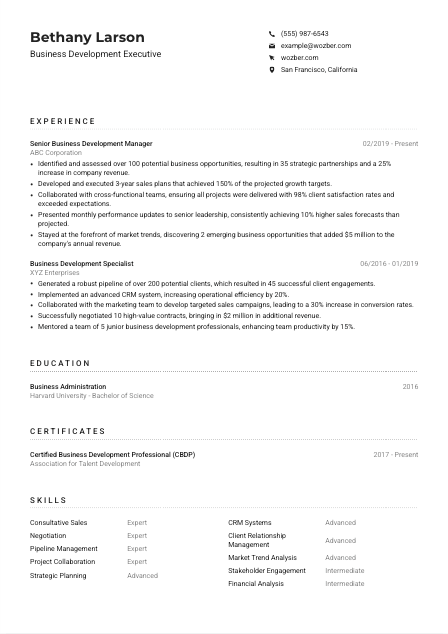
Every bullet should show action and result. Good business development bullets often include pipeline volume, partnership count, contract value, growth against target, forecast accuracy, or client satisfaction. The sample resume does this well with lines like identifying 100+ opportunities, building 35 partnerships, and exceeding projected growth targets.
Metrics give context to your contribution. Use numbers that are native to the role, such as revenue gained, conversion rate lift, deal count, contract value, forecast performance, satisfaction scores, or pipeline growth. A statement like "increased revenue by 25%" or "closed 10 high-value contracts worth $2 million" tells a much stronger story than "responsible for business growth."
If an older bullet does not help prove prospecting ability, partnership development, consultative selling, market analysis, negotiation, or cross-functional execution, trim it. Business development resumes work best when each line reinforces commercial judgment and measurable contribution.
A hiring team should be able to scan your experience and understand your market exposure, deal impact, and planning discipline without guessing. When your bullets show revenue results, partnership wins, and strong collaboration with delivery or marketing teams, your experience starts reading like a business case.
Education will not outweigh performance in a business development search, but it still matters when the posting names a degree requirement. Present it clearly so the recruiter can confirm the foundation and move on to your commercial results.
If the role asks for a bachelor's degree in Business Administration, Marketing, or a related field, make sure that information is obvious. A degree that closely matches the posting, such as Business Administration in the example, should be easy to spot at a glance.
List your degree, field of study, school, and graduation year. This is enough for most business development applications and keeps the section clean for ATS readability and recruiter review.
Name the degree accurately rather than shortening it too much. "Bachelor of Science in Business Administration" gives a clearer hiring signal than a vague reference to undergraduate study, especially when the job description calls out the academic background directly.
Relevant coursework, honors, or projects can support earlier-career candidates, especially if they connect to market analysis, sales strategy, or negotiation. If you already have 4+ years in business development, those details usually matter less than your pipeline, partnerships, and revenue results.
If you hold certifications or notable training tied to sales strategy or business development, mention them in the appropriate certification section rather than overloading education. That keeps your academic foundation clear while still showing continued professional growth.
For this role, the education section mainly needs to answer one question quickly: do you meet the degree expectation? Once that is clear, your experience and commercial results can carry the application.
Certifications are rarely the deciding factor for a Business Development Executive, but the right ones can sharpen your profile. They work best when they support how you sell, negotiate, plan accounts, or develop partnerships.
Start with certifications that connect directly to the role's language. Here, the employer notes that credentials such as Certified Business Development Professional (CBDP) are a plus, so that certification deserves strong placement if you have it.
Choose certifications that reinforce your business development capability rather than listing every course you have completed. A short list tied to consultative sales, negotiation, account growth, or strategic planning will read much stronger than a scattered collection.
Certification dates show recency and continued engagement with the field. That is especially useful in commercial roles where sales methods, CRM practices, and market approaches keep evolving.
Business development shifts with buying behavior, market conditions, and go-to-market strategy. Relevant certifications, workshops, and negotiation training can signal that you keep refining how you prospect, position value, and build long-term client relationships.
Use this section to reinforce the kind of business development professional you are becoming. When the credentials support consultative selling, strategic growth, or negotiation strength, they complement your experience instead of repeating it.
A Business Development Executive skills section should read like a commercial operating toolkit. The strongest mix combines sales execution, strategic thinking, relationship management, and the systems you use to keep opportunities moving.
Start with the capabilities the role depends on day to day. In this posting, consultative sales, negotiation, strategic planning, communication, and interpersonal strength are central. You can also infer related skills such as pipeline management, stakeholder engagement, forecasting, and market research.
Use the same terminology the job description uses when it matches your background. That helps both ATS screening and human review. The sample resume does this effectively with skills like "Consultative Sales," "Negotiation," and "Pipeline Management," all of which support the stated responsibilities.
Put the most relevant commercial and strategic skills first. For many business development roles, that means leading with prospecting, consultative selling, negotiation, pipeline development, strategic planning, CRM usage, and client relationship management before lower-priority supporting skills.
This section should echo the way you actually win business. When your skills line up with the role's sales approach, partnership focus, and reporting expectations, the rest of the resume becomes easier to believe.
Language skills matter in business development when they affect client communication, presentations, negotiations, or regional coverage. Even when only one language is required, list proficiency clearly so the employer can confirm it fast.
Some roles treat language as a preference. Others make it mandatory. Here, English fluency is explicitly required, so your resume should show it clearly rather than assuming it will be inferred.
If English is your working language at a native or fluent level, say so plainly. Business development work relies on persuasive communication, proposal discussions, and relationship management, so language strength affects core performance.
Extra languages can be valuable if they support client development in broader markets or improve communication with diverse stakeholders. In the example, Spanish adds useful range without distracting from the English requirement.
Stick with clear levels such as Native, Fluent, Intermediate, or Basic. Inflated language claims can quickly become a problem in interviews, client-facing scenarios, or presentation-heavy roles.
If multilingual communication is central to the market you serve, give this section more prominence. If the role mainly requires strong English communication, list other languages as an advantage while keeping the main focus on your sales and partnership track record.
Handled well, this section confirms that you can communicate at the level the role demands. For business development hiring, that matters most when it supports prospecting, relationship building, and clear commercial conversations.
The summary is where you frame your value before the recruiter reaches the detail. For a Business Development Executive, it should quickly establish your level, your market contribution, and the kind of growth work you have handled.
Before writing, identify the themes that matter most in the posting. Here, those include new business generation, consultative sales, strategic planning, partnership development, and performance reporting. Your summary should reflect that mix in a compact way.
Lead with your title or close equivalent, followed by years of experience and your main area of impact. A line such as "Business Development Executive with 8+ years of experience driving revenue growth and strategic partnerships" gives immediate context and credibility.
Include two or three specifics that support your positioning, such as exceeding growth targets, building high-value partnerships, improving conversion rates, or managing strong client satisfaction. The sample summary works because it ties revenue growth, partnerships, and results into one clear opening statement.
Aim for a short paragraph that can be read in seconds. Three to five lines is usually enough to show your commercial profile, especially if the rest of the resume backs it up with metrics, deal outcomes, and strategic sales experience.
By the time someone finishes this paragraph, they should understand what kind of growth professional you are and what business outcomes tend to follow your work. That is the right setup for the experience section to do the heavy lifting.
A Business Development Executive resume works when it makes revenue creation, partnership judgment, and consultative selling easy to see. Every section should reinforce that through clear titles, relevant skills, solid credentials, and experience bullets with real commercial outcomes.
Use Wozber's free resume builder to shape that story in an ATS-friendly resume format, then strengthen alignment with its ATS resume scanner and AI-powered tailoring features. The finished resume should make one conclusion easy for the hiring team: you know how to find opportunities, build trust, and turn strategy into growth.




