



Use Wozber and land your dream job
Create Resume
No registration required
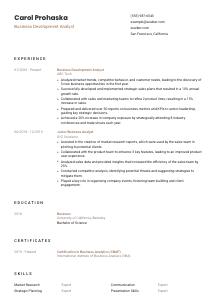
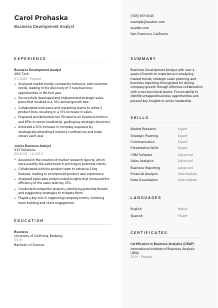
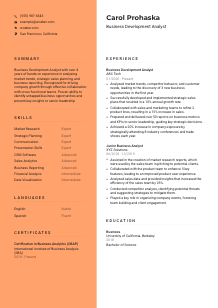
Analyzing growth strategies, but your resume isn't expanding its reach? Check out this Business Development Analyst resume example, created with Wozber free resume builder. It shows how to clearly present your analytical acumen to match job projections, driving your career as dynamically as your data!
Business Development Analysts are usually hired when a company needs sharper commercial judgment, not just more reporting. Your resume should show how you turn market research, sales data, and customer patterns into decisions that influence growth plans, product direction, or pipeline strategy.
A tailored resume helps hiring teams quickly separate general analysts from candidates who can support revenue decisions. Using Wozber's free resume builder and an ATS-friendly resume format makes it easier to align your language with the posting, surface terms like CRM, market trends, and KPIs, and show that your analysis can travel all the way to senior leadership recommendations.
This section is simple, but it still carries screening weight. For a Business Development Analyst, clean contact details and an accurate title tell the employer they are looking at someone who understands business-facing professionalism and can meet basic requirements without friction.
Use your full name as the visual header of the resume in a clean, readable font. It should stand out more than the body text so hiring teams can immediately connect your application to interview notes, CRM records, or ATS search results.
Place "Business Development Analyst" under your name if that is the role you are pursuing. This keeps your positioning clear and avoids looking too broad, especially if your background includes related titles like Sales Analyst, Market Research Analyst, or Junior Business Analyst.
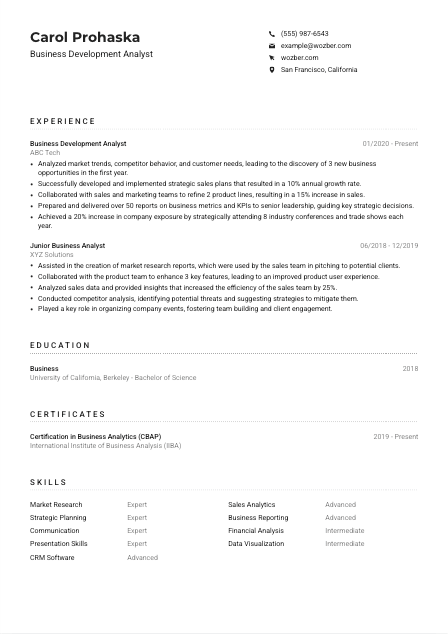
Include a reliable phone number and a professional email address. If the posting includes a location requirement, reflect that clearly. In the example, listing "San Francisco, California" supports the employer's stated location need and removes an early screening question.
A LinkedIn profile or personal website can help if it supports your business development story with consistent titles, measurable results, or industry activity. Keep it current. If your profile shows market analysis projects, conference participation, or sales strategy work, it strengthens the same themes already on your resume.
Skip details such as marital status, date of birth, or unrelated personal facts. For this role, the space is better used on information that supports business credibility, such as location, a polished online profile, or contact details that make follow-up easy.
Your personal details should remove doubt, not create it. Clear contact information, the right target title, and any required location detail help the employer move straight to the parts of your resume that show market insight and growth potential.




This is the section most likely to decide whether you move forward. Business Development Analyst experience needs to show how you researched markets, supported growth strategy, worked with sales or marketing, and translated findings into actions, reports, or revenue opportunities.
Before you write or revise bullet points, identify the work the employer cares about most. In this case, that includes market trend analysis, competitor research, customer needs, strategic sales planning, KPI reporting, and cross-functional collaboration. Your experience bullets should reflect those same work streams using language that matches how the business describes them.
List your positions in reverse chronological order with company name, title, and dates. Under each role, focus on achievements that show opportunity identification, sales support, reporting, or product-market insight. The example does this well by centering the current role on new business opportunities, sales plan execution, product-line refinement, and leadership reporting rather than generic analyst duties.
Numbers matter here because business development work is judged through commercial outcomes. Use figures tied to growth rates, number of opportunities identified, sales lift, reporting cadence, conversion improvement, event ROI, or team efficiency. The sample bullets use metrics such as 10% annual growth, 15% sales increase, 50+ KPI reports, and eight conferences per year, which make the impact much easier to understand.
Prioritize experience that shows market research, sales analytics, CRM-driven insight, stakeholder presentations, and strategic planning. If you have unrelated responsibilities, trim them unless they support the story. Even earlier-career roles can earn space when they show useful overlap, such as competitor analysis, sales team support, or product feedback based on customer data.
The best bullets do more than name responsibilities. They show the workflow. Mention whether you analyzed customer behavior, built strategic sales plans, collaborated with marketing on positioning, or presented KPI trends to senior leaders. Specifics like these tell hiring teams how close your past work is to the reporting, planning, and cross-functional execution they need.
A Business Development Analyst resume should read like a record of commercial decisions informed by analysis. When your experience section shows measurable outcomes, useful collaboration, and clear reporting scope, it becomes much easier for an employer to picture you supporting revenue and strategy.
Education is usually a baseline screen for this role, but it still matters how you present it. Hiring teams often look for business, economics, or related academic grounding because the work sits at the intersection of analysis, market understanding, and revenue planning.
If you hold a bachelor's degree in Business, Economics, or a related field, state it directly and clearly. The example's Bachelor of Science in Business aligns closely with the posting and immediately checks off a stated requirement.
List your degree, field of study, school name, and graduation year in a clean format. This role does not usually require a long academic narrative. What matters is that the information is easy to scan and confirms the academic foundation behind your market and sales analysis work.
If your degree title is adjacent rather than exact, use the field of study, coursework, or projects to show relevance. Subjects such as market research, business analytics, economics, statistics, finance, or consumer behavior can help bridge the connection to business development work.
Early-career candidates can gain value from adding a capstone, research project, or analytics-heavy coursework if it relates to opportunity analysis, business strategy, forecasting, or customer insight. Once you have several years of relevant experience, these details should stay brief unless they are especially strong.
Academic distinctions, scholarships, or standout projects can help if they reinforce your analytical ability or business focus. Keep them relevant. For this profession, a market analysis project or a business case competition result adds more value than unrelated campus activity.
Keep this section concise, accurate, and tied to the role's analytical foundation. Once the degree requirement is easy to confirm, the rest of the resume can do the heavier work of proving commercial impact.
Certifications carry extra weight when they reinforce how you analyze markets, interpret business data, or support growth strategy. They are especially useful when a posting names analytics credentials as preferred rather than required.
When a posting mentions a credential such as CBAP or a similar business analytics certification, move any related certification into clear view. In the example, listing a Business Analytics certification directly supports the employer's preference and adds another layer of role alignment.
Choose certificates tied to business analysis, CRM platforms, sales analytics, market research, reporting, or data tools. A short, relevant list is stronger than a long mixed list that dilutes your positioning.
Add the completion or active date range, especially for recent certifications or credentials that signal continuing development. For analytical and business-facing roles, recent learning can support your familiarity with current reporting practices, data tools, or commercial frameworks.
If you are still developing your profile, pursue certifications that deepen your ability to interpret data and influence growth decisions. Training in business analytics, CRM reporting, data visualization, or sales operations can all strengthen your resume when they connect to work you have actually done.
Relevant certifications help round out your story when they connect directly to market analysis, reporting, or growth planning. They are most effective when they support the same strengths already visible in your experience section.
For a Business Development Analyst, the skills section should look grounded in actual commercial analysis. Employers want to see the mix of research, planning, reporting, and communication skills that support opportunity discovery and strategic decision-making.
Start with the skills named or implied in the job description. Here, that includes CRM software, business analytics tools, analytical ability, communication, presentation, market research, and sales planning. Mirroring that language supports ATS optimization and makes your profile easier to map to the role.
Combine hard skills and interpersonal skills in a way that reflects how the work is done. Skills such as Market Research, Sales Analytics, CRM Software, Business Reporting, Strategic Planning, Communication, and Presentation Skills create a more realistic picture than a list made up only of soft traits or only of tools.
Avoid long skill inventories that include every platform or vague trait you have touched. Prioritize the capabilities most relevant to pipeline growth, market insight, stakeholder reporting, and cross-functional work. The example's mix of market research, strategic planning, CRM software, business reporting, and data visualization is a solid model because each item supports the core responsibilities of the role.
A well-built skills section should make it obvious that you can investigate opportunities, support sales strategy, and communicate findings clearly. Relevance matters more than volume here.
Language skills matter most when they affect communication with clients, partners, or target markets. In business development work, they can strengthen your ability to build relationships, present insights, or support expansion into specific regions.
If the posting asks for strong English proficiency, include English clearly in this section with an honest level such as Native or Fluent. That requirement often matters because the role includes reporting, presentations, and collaboration with leadership and go-to-market teams.
Additional languages can be valuable when the business serves multilingual customers, attends international events, or explores new markets. They are not mandatory for every Business Development Analyst role, but they can strengthen your profile when they connect to commercial reach.
Use clear labels such as Native, Fluent, Conversational, or Basic. Business development often involves live discussions, presentations, and written follow-up, so accuracy matters. Overstating a language skill can become obvious very quickly in an interview or client-facing setting.
If a second language has practical value, let the rest of your resume support that story. For example, language skills can complement experience in client outreach, international market research, conference attendance, or regional sales support.
Ongoing language development can be useful when your target companies work across regions or customer segments where communication access matters. It is an advantage when it supports real business activity, not when it appears as a disconnected extra.
For this profession, language skills are most persuasive when they support communication, market access, or stakeholder engagement. Present them clearly and only at the level you can use confidently in real business settings.
The summary sits at the top of the resume, so it needs to establish your commercial focus quickly. For a Business Development Analyst, that means combining years of experience with the kind of analysis, planning, and reporting work that supports revenue growth.
Read the posting closely before writing the summary. Identify the work that defines the role, such as market analysis, strategic sales planning, KPI reporting, and collaboration with sales and marketing. Your summary should reflect that mix rather than giving a generic analyst introduction.
Lead with a direct statement that names your profession and years of experience. A line such as "Business Development Analyst with 4+ years of experience" works because it gives immediate context and matches how employers typically scan the top of a resume.
Use the next sentences to name the capabilities that matter most for the target role, then tie them to results. The example summary works because it mentions market trends, strategic sales planning, business reporting, and cross-functional collaboration while also pointing to company growth and opportunity identification.
Aim for a short paragraph of three to five lines. Focus on what you analyze, what business decisions your work supports, and what results tend to follow. Save the finer detail for the experience section, where you can show the metrics and scope behind those claims.
When this section is tailored well, the reader immediately understands that your background is tied to growth strategy, market insight, and leadership reporting. That framing helps the rest of the resume land with much more clarity.
A Business Development Analyst resume should make three things easy to see: how you find opportunities, how you support growth decisions, and how you communicate results through reports, presentations, and cross-functional work.
Wozber can help you tighten that story with an ATS-compliant resume, role-specific wording, and faster tailoring through its ATS resume scanner and AI resume builder tools. The final result should make it easy for a hiring team to picture you turning market insight into measurable business action.




