




Use Wozber and land your dream job
Create Resume
No registration required
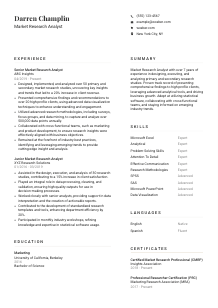
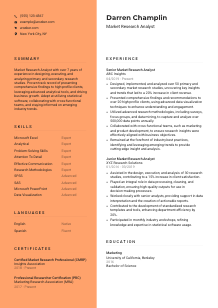
Poking around for insights, but your resume feels hidden? Check out this Market Research Analyst resume example, put together with Wozber free resume builder. Learn how to slice and dice your data talents to match the job criteria, making your career journey as illuminating as your findings!
Market research teams are hired to reduce uncertainty. That means your resume has to show more than an interest in data. It needs to show how you turn surveys, secondary sources, focus groups, or large datasets into findings that influence pricing, product direction, campaign strategy, or client recommendations. Hiring managers look for analysts who can move from methodology to insight without losing accuracy.
When that story is tailored well, the first scan of your resume quickly separates general analysts from candidates who actually know research design, statistical tools, and stakeholder reporting. Wozber's free resume builder helps you shape that into an ATS-compliant resume by aligning your wording with the posting's methods, software, and business context, so the hiring team can immediately see whether you can run credible studies and present usable conclusions.
This section is simple, but it still does screening work. For a Market Research Analyst, clear contact details and role alignment matter because employers often move fast from title match to experience depth, tool familiarity, and location requirements.
Place your name at the top in a clean, readable format. Keep it more prominent than the rest of the header so your application is easy to identify in a recruiter inbox, interview schedule, or exported ATS file.
Add the job title directly under your name when it matches your background. If you are applying for a "Market Research Analyst" opening, using that same title helps frame the rest of the resume around research design, analysis, and insight delivery instead of broader marketing or business analysis work.
Include a current phone number and a professional email address you check regularly. Use a straightforward format such as firstname.lastname@email.com. A missed callback because of old contact information is an avoidable problem.
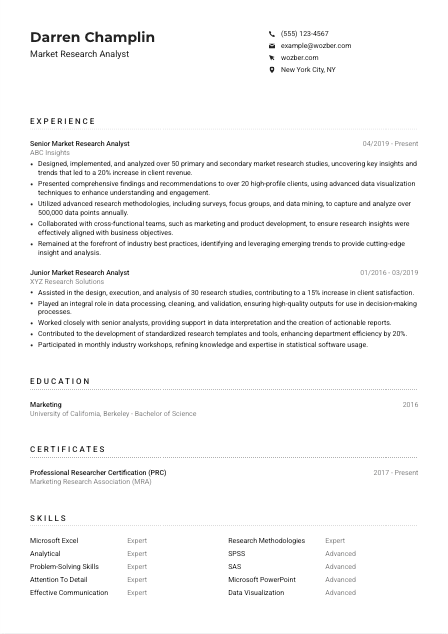
Some employers filter early on logistics. If a posting requires candidates to be based in a specific city, reflect that clearly in your header. In the example, listing New York City, NY directly supports a stated requirement. If you are relocating, say so plainly.
Include LinkedIn or a professional website if it supports your candidacy. For market research roles, that might mean a profile with research projects, reporting samples, dashboard work, or presentations that show how you communicate findings to clients or internal stakeholders.
Keep this section precise and easy to scan. It should confirm who you are, what role you are targeting, and whether you meet any practical filters before the reader gets into your research experience.




This is where employers look for proof that you can plan studies, work with data, and translate findings into decisions. In market research, vague bullets disappear fast. Specific methodology, scale, tools, audience, and outcomes are what make experience persuasive.
Read the job description for the work patterns behind the title. For this role, the priorities include primary and secondary research, surveys and focus groups, data mining, statistical software, data visualization, and presenting recommendations to stakeholders. Those are the themes your bullets should echo when they match your actual work.
Use reverse chronological order so the employer sees your current methods, industries, and level of responsibility first. If your latest role includes study design, client presentations, or cross-functional work with marketing and product teams, that should appear before earlier support-level research tasks.
Each role should show what you researched, how you did it, and what changed because of it. Strong market research bullets mention study type, sample or dataset size, analysis method, and the business use of the findings. The example does this well by tying research studies to revenue growth and client recommendations rather than stopping at task descriptions.
Numbers carry weight in research roles because they show scope and credibility. Use counts of studies completed, volume of data analyzed, client presentations delivered, response rates improved, reporting time reduced, or revenue and satisfaction impact where you can support it. Metrics like "50 studies," "500,000 data points," or "20% increase in client revenue" make the work easier to evaluate.
Prioritize roles and bullets that reinforce market research judgment. General administrative work, unrelated sales tasks, or broad marketing duties should only stay if you can connect them to consumer insight, data analysis, reporting, segmentation, or decision support. Every line should help the reader picture you running research work with confidence.
Your experience section should make it easy to follow the line from methodology to recommendation. If the reader can see what you studied, how you analyzed it, and what the business gained, you are giving them the right reasons to keep you in the process.
For many Market Research Analyst openings, education is a baseline qualifier before your experience gets full attention. A clearly listed degree in a related field immediately supports your grounding in research, statistics, marketing, or business analysis.
If the posting asks for a bachelor's degree in Marketing, Business, Statistics, or a related field, make sure your degree is easy to find and worded clearly. A relevant degree, such as the example's Bachelor of Science in Marketing, should not be buried or abbreviated beyond recognition.
List degree, field of study, school, and graduation year in a consistent format. Hiring teams do not need extra design here. They need to confirm your academic background quickly before moving on to your research experience and software skills.
If your field of study is directly tied to consumer behavior, statistics, marketing analytics, or business research, state it clearly. That small detail helps explain why you are prepared for survey design, data interpretation, and presenting findings to stakeholders.
Early-career candidates can strengthen this section with relevant coursework such as statistics, consumer behavior, research methods, quantitative analysis, or data visualization. Keep it selective and include only courses that reinforce the work described elsewhere on the resume.
Projects, thesis work, honors, or competition teams can help if they demonstrate questionnaire design, sampling logic, data cleaning, segmentation analysis, or presentation of findings. This matters most when you need additional proof of research ability beyond limited job experience.
Education does not need a lot of space, but it should confirm that your analytical foundation fits the role. Make the connection to market research obvious and move the reader smoothly into your professional work.
Certifications are not required for every Market Research Analyst role, but they can strengthen your profile when they reflect recognized research standards or ongoing professional development. In this field, the value comes from relevance, not volume.
If the posting mentions PRC or CMRP as a plus, list those certifications prominently when you have them. In the example, both are included, which immediately supports professional commitment and familiarity with industry standards.
Choose credentials that strengthen your case as a researcher, analyst, or data storyteller. Research certifications, analytics training, survey methodology coursework, or recognized software credentials are usually more useful here than broad business certificates with little connection to the role.
Include issue or renewal dates when they help demonstrate that the certification is active or recently maintained. In research roles, current knowledge matters because tools, privacy expectations, and methodology standards continue to evolve.
Ongoing learning carries weight when it sharpens your ability to run studies, interpret data, or present findings. If you are currently completing a relevant course in advanced analytics, consumer insights, or a statistical platform, that can reinforce your trajectory when presented clearly.
Certifications work best when they support the same story as your experience and skills. Keep this section focused on research capability, analytical development, and professional standards.
A Market Research Analyst is usually evaluated on a mix of analytical tools, research methods, and communication ability. Your skills section should reflect that full workflow, from collecting and analyzing data to presenting a recommendation that others can act on.
Pull out the specific skills the employer names. Here, that includes SPSS or SAS, Excel, PowerPoint, analytical thinking, problem-solving, attention to detail, and communication. Use those exact terms when they accurately describe your background so both ATS screening and human review connect your experience to the role.
List hard skills such as statistical software, survey design, focus groups, data mining, and data visualization alongside skills that matter in client-facing or cross-functional settings, such as presenting insights and translating findings for non-technical teams. The example's mix of SPSS, SAS, Excel, PowerPoint, and communication is a solid model.
Do not overload this section with every platform or soft skill you have ever used. Put the most role-relevant items first, especially the tools and methods that appear in the job description. A focused list tells the employer faster whether you can step into their research process and reporting cadence.
This section should read like the operating toolkit of a market researcher, not a generic keyword block. Prioritize the software, methods, and communication strengths that match how the role actually gets done.
Language ability can matter in market research when you are writing reports, moderating or supporting interviews, analyzing audience feedback, or working with diverse consumer groups. Even when only one language is required, this section should still be clear and accurate.
If the job description explicitly requires English reading and writing, list English clearly with your proficiency level. That matters for survey wording, report writing, slide development, and presenting findings to clients or internal teams.
Other languages can be valuable when research touches multilingual audiences, regional markets, or international stakeholders. They are especially worth listing if they connect to the markets you have studied or the customer groups you have worked with.
Additional language skills can support qualitative research, respondent communication, and local market understanding. For example, Spanish may be useful in studies involving bilingual populations, even when the core role is still centered on English-language reporting.
Be precise about your level. Terms such as "Native," "Fluent," or "Conversational" give a realistic picture of what you can handle in interviews, written reporting, or stakeholder discussions. Overstating fluency is risky in roles that depend on exact wording and nuance.
If a language strengthens your ability to research a target audience, mention it. If not, you can still include it, but do not give it more space than your analytical tools or research accomplishments. For most market research roles, languages are supportive, not central.
This section should quickly tell the employer whether you can communicate in the languages their research environment requires. Keep it truthful, concise, and connected to real reporting or audience needs.
The summary is your opening argument. For a Market Research Analyst, it should quickly communicate experience level, research scope, analytical tools, and the type of business questions you help answer.
Your summary should reflect the role you are targeting, not a generic analyst profile. If the employer emphasizes primary and secondary research, statistical software, data visualization, and stakeholder presentations, those themes should shape the opening language.
Start with your title and years of relevant experience. That immediately frames your level. A line such as "Market Research Analyst with 7+ years of experience" works because it sets context before you move into methods, sectors, or achievements.
Use one or two sentences to connect your research work to business results. Mention the kinds of studies you run, the tools you use, and the decisions you support. The example summary works because it combines research design, client presentation, analytical tools, and business growth in a compact space.
Aim for three to five lines with no filler. Skip broad claims like being passionate or hardworking unless they are backed by something concrete. This section should read like a concise professional snapshot of someone who can design studies, interpret findings, and communicate recommendations clearly.
A well-written summary should make the reader expect strong methodology, sharp analysis, and useful recommendations in the sections that follow. Keep it brief, tailored, and grounded in the actual work of market research.
A Market Research Analyst resume works when it shows how you investigate a market question, analyze the evidence, and deliver conclusions that people can use. Every section should support that story, from your degree and software skills to your study metrics and presentation experience.
Use Wozber's free resume builder to organize that story in an ATS-friendly resume format, then refine it with the ATS resume scanner and AI-powered tailoring tools so your methods, tools, and business impact line up with the role you want. The final read should make it easy to judge whether you can produce reliable research and turn it into action.




