



Use Wozber and land your dream job
Create Resume
No registration required
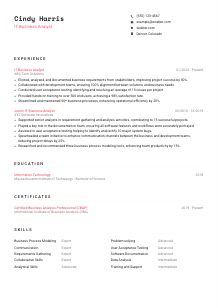
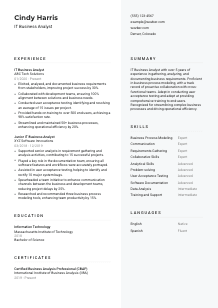
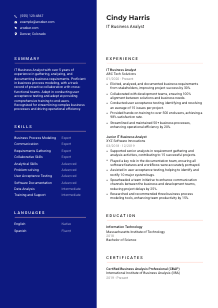
Decoding tech and trends, but your resume doesn't meet the interface? Unravel this IT Business Analyst resume example, created with Wozber free resume builder. Learn how to present your analytical acumen and system savvy in a way that resonates with business needs, ensuring your career trajectory stays in sync with digital landscapes!
IT Business Analysts sit at the point where business needs become system changes, so hiring teams look for resumes that show how you turn messy stakeholder input into clear requirements, workable process maps, and release-ready documentation. Generic project language falls flat here. Your resume should make it easy to see how you gather requirements, support solution design, manage UAT, and help users adopt new systems.
Screening for this role often narrows quickly around one question: can this person translate between business stakeholders and technical teams without losing detail or momentum? That is where tailored phrasing matters. Using Wozber's free resume builder to align your wording with the posting and keep an ATS-compliant resume structure helps surface the right terms, from requirements elicitation to business process modeling, so reviewers can quickly recognize the kind of analyst work you actually do.
For IT Business Analyst roles, the header needs to confirm a few basics fast: who you are, how to reach you, and whether you match any practical hiring constraints such as location. Keep it clean and factual so the reader can move straight into your requirements, systems, and process work.
Place your full name at the top in a clear, readable format. Keep the styling professional rather than decorative. IT Business Analyst hiring often moves quickly from header to summary, so your name should be easy to spot without distracting from the content that follows.
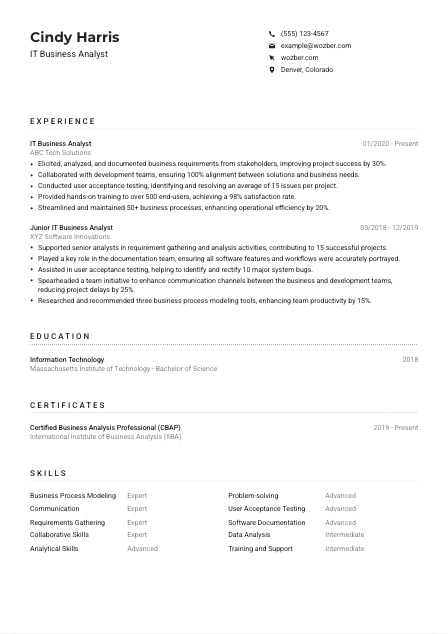
Put "IT Business Analyst" under your name if that is the role you are pursuing. This removes ambiguity, especially if your previous title was broader, such as Business Analyst or Junior IT Business Analyst. In the example resume, that direct title immediately aligns the candidate with the opening's stated need.
Include a reliable phone number and a professional email address. If you also list a website or LinkedIn profile, make sure it reflects the same projects, titles, and dates shown on your resume. Inconsistencies around employment history or credentials can create unnecessary friction before anyone even reviews your requirements work.
Some IT Business Analyst roles are tied to a business unit, implementation site, or hybrid collaboration model. If a posting specifies a location requirement, answer it in the header. Here, Denver, Colorado is a stated condition, so listing Denver, Colorado in the sample makes the application easier to move forward.
A current LinkedIn profile can support your resume well, especially if it expands on business systems work, stakeholder-facing projects, or software rollouts. Keep the language aligned with your resume, including requirements gathering, process documentation, UAT, and training support where those are part of your background.
This section is simple, but it clears early screening hurdles. When your title, contact details, and any stated location requirement are easy to confirm, the reader can focus on whether you can handle analysis, documentation, and cross-functional delivery.




This is the section that carries the most weight for an IT Business Analyst. Hiring teams want to see how you handled requirements, worked with developers, supported testing, improved processes, and influenced delivery outcomes. Your bullets should read like analyst work, not like a generic project support history.
Start by marking the core duties in the job description and reflect that language where it matches your actual work. For this role, terms such as "elicited," "analyzed," "documented business requirements," "collaborated with development teams," and "conducted user acceptance testing" are central. Using that wording naturally helps both reviewers and ATS systems connect your background to the job.
List your most recent position first, then work backward with title, employer, and dates shown consistently. That structure matters when employers want to understand how your analyst scope has grown, for example from supporting senior analysts to owning requirements sessions, process updates, or end-user training.
Each bullet should show a recognizable IT Business Analyst contribution. Prioritize work such as stakeholder interviews, requirement documentation, gap analysis, process mapping, solution alignment, UAT coordination, issue resolution, and user training. The example does this well by centering bullets on business requirements, UAT findings, and maintained process documentation rather than broad team participation.
Numbers work best when they show outcomes tied to analyst work. That might include project success rate, issue volume found during UAT, reduction in delays, adoption levels after training, or efficiency gains from process changes. In the sample, figures like improving project success by 30 percent, resolving an average of 15 issues per project, and training 500+ end-users make the scope and business value much clearer.
If a bullet does not strengthen your case for IT business analysis, remove it or rewrite it. Space is better used on requirements quality, process improvement, test support, documentation control, stakeholder coordination, and system rollout support. Even when your background includes broader operations or project work, frame it through the analyst lens that the employer is hiring for.
A strong experience section makes your day-to-day analyst work visible in business terms. Focus on requirements quality, process improvements, testing results, and collaboration with technical teams. By the end of this section, a hiring manager should be able to picture you in discovery sessions, documentation reviews, UAT cycles, and implementation follow-through.
Education usually will not win the role on its own, but for IT Business Analyst positions it does establish whether you have the formal grounding many employers ask for. Present it clearly, especially when the posting names a preferred field such as Information Technology, Computer Science, or a related discipline.
If the job asks for a bachelor's degree in Information Technology, Computer Science, or a related field, make that match easy to see. The sample resume does this directly with a Bachelor of Science in Information Technology, which mirrors the requirement without extra explanation.
List your degree, field of study, school, and graduation year in a straightforward format. Recruiters and hiring managers should be able to confirm your academic background in seconds, especially when education is a stated requirement rather than a bonus.
For this profession, the subject area matters because it suggests familiarity with systems, data structures, software environments, or technical problem-solving. If your degree is in a related area, name it precisely rather than relying on an abbreviation or a generic title.
Relevant coursework can help if you are early in your career or moving into a more technical IT Business Analyst role. Include classes tied to systems analysis, databases, process modeling, software engineering, or information systems only if they add something your experience section cannot yet prove.
Honors, projects, or student leadership belong here only when they support your target role. A capstone on systems implementation or process redesign may be worth keeping. General campus activities usually are not needed once you have several years of analyst experience.
This section should confirm that you meet the baseline academic requirement and, where relevant, reinforce your technical footing. Clear degree details are enough in most cases. Let experience carry the heavier proof of requirements work, systems collaboration, and delivery support.
Certifications matter more in business analysis than in many adjacent roles because they signal familiarity with established frameworks, documentation discipline, and structured requirements practice. When a posting mentions CBAP or CCBA, bring those credentials forward if you have them.
If the posting prefers CBAP, CCBA, or another recognized business analysis credential, list it prominently. That is especially useful when several candidates have similar project experience. In the sample, both CBAP and CCBA immediately reinforce the business analysis focus of the resume.
Choose certifications that support core IT Business Analyst responsibilities such as requirements management, process analysis, Agile delivery, testing, or systems work. A shorter list of highly relevant credentials carries more weight than a long list of unrelated courses.
Include issue or validity dates when the credential is current, renewed, or tied to ongoing professional standing. This helps the reviewer understand whether the certification reflects active knowledge rather than a one-time course taken years ago.
As tools, methodologies, and delivery models change, updated credentials can sharpen your profile. Focus on learning that supports the actual work of IT business analysis, such as advanced BA certifications, Agile analysis, process modeling, or product and systems delivery practices.
Certifications work best when they support the kind of analyst work the employer needs done. Relevant credentials can strengthen your case for requirements ownership, process discipline, and stakeholder-facing delivery work, especially when paired with measurable experience.
An IT Business Analyst skills section should show both the analytical methods and the collaboration strengths behind successful delivery. Hiring teams expect to see more than soft skills. They want to know whether you can model processes, document requirements, support testing, and work effectively with technical and business stakeholders.
Start with the skills named in the posting, then add closely related capabilities you genuinely use. For this role, that includes business process modeling, analytical problem-solving, communication, requirements gathering, user acceptance testing, and software documentation. These are not generic strengths. They point to the day-to-day mechanics of the job.
Order the list so the most relevant capabilities appear early. If a role emphasizes process modeling and stakeholder requirement gathering, those should come before broader entries. The sample resume does this well by leading with business process modeling, communication, and requirements gathering rather than less central skills.
Group or sequence skills in a way that reflects the role. You might cluster business analysis methods, testing and documentation work, and collaboration skills. Avoid padding the section with every tool or trait you have ever used. Precision helps more than volume, especially in ATS screening and quick human review.
Your skills list should echo the work proven in your experience section. When the same themes appear across both sections, such as requirements elicitation, process modeling, UAT, and stakeholder communication, your profile reads as consistent and credible.
Language proficiency matters in IT Business Analyst work because so much of the job depends on interviews, workshops, documentation, testing feedback, and end-user communication. If the posting specifies a required language, make it easy to find.
If English proficiency is mandatory, list English first and state your level clearly. For a role that includes stakeholder meetings, requirements documentation, training, and UAT coordination, weak or vague language labeling can create unnecessary doubt.
Use clear labels such as Native, Fluent, Advanced, or Intermediate. The sample resume handles this cleanly with English as Native. That kind of specificity is more useful than a vague statement about being "good with languages."
Extra languages can strengthen your profile if you support multinational teams, diverse user groups, or cross-border implementations. They are especially worth listing when your analyst work involves training, support, or stakeholder communication across regions.
Do not overstate fluency. If you can read business documentation but not lead workshops in a language, rate yourself accordingly. IT Business Analysts are often trusted to clarify requirements and resolve misunderstandings, so credibility matters here.
For some positions, language breadth is a bonus. For others, it directly affects your ability to gather requirements or train users effectively. Read the job context and decide how much emphasis your language section deserves based on the actual communication demands.
This section is most useful when it supports the kind of stakeholder and user interaction the job involves. Clear language details help employers understand whether you can document, explain, test, and train in the environments they operate in.
For an IT Business Analyst, the summary should quickly establish your analyst identity, your level of experience, and the kind of delivery work you handle well. It should sound grounded in requirements, process, systems, and stakeholder collaboration, not like a generic introduction copied from any business role.
Before writing the summary, pick the two or three themes the job stresses most. In this posting, that is requirements elicitation and documentation, collaboration with development teams, business process modeling, UAT, and end-user support. Your summary should reflect the priorities that define the role, not try to cover every detail from your career.
Start with a direct line that states who you are professionally and how long you have been doing the work. The sample summary does this effectively with "IT Business Analyst with over 5 years of experience," which gives immediate context before moving into requirements and process strengths.
Use the next lines to highlight capabilities that matter most for the target role, such as process modeling, stakeholder collaboration, UAT, documentation, or business process improvement. If possible, tie one of those strengths to a result, such as operational efficiency gains, smoother implementations, or stronger solution alignment.
Aim for a short paragraph that can be scanned in seconds. Four to five lines is usually enough. Every phrase should earn its place by clarifying your analyst scope, technical-business bridge role, or delivery impact. Leave the detailed examples and metrics for the experience section.
A well-written summary tells the reader what kind of IT Business Analyst they are about to review. Keep it focused on requirements, systems, process work, and delivery support. When that framing is clear, the experience and skills sections have a much easier job proving the match.
An effective IT Business Analyst resume makes your value visible through clear requirements work, process analysis, testing support, documentation quality, and collaboration with technical teams. When each section reinforces those themes, the reader can quickly connect your background to real delivery needs.
Use Wozber's free resume builder to organize that experience into an ATS-friendly resume format, refine wording with role-specific terminology, and check alignment with an ATS resume scanner before you apply. The final result should make one thing easy to judge: you can turn business needs into clear, usable technical outcomes.




