



Use Wozber and land your dream job
Create Resume
No registration required
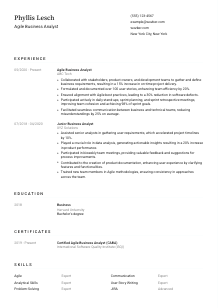
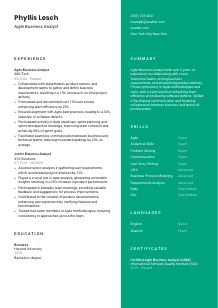
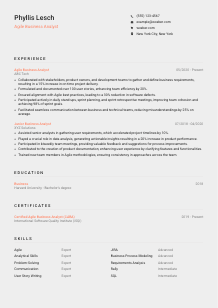
Sprint through project stories, but your resume feels stuck in a backlog? Check out this Agile Business Analyst resume example, built with Wozber free resume builder. It shows how to present your iterative insights to match job outcomes, propelling your career into a continuous value-adding stream!
Agile Business Analysts are often judged by how well they turn messy stakeholder input into user stories a delivery team can actually build from. A resume for this role needs to make that translation work visible. Show how you clarified requirements, supported sprint execution, and kept business goals connected to development decisions in an Agile setting.
Screening gets much easier when your resume uses the same delivery language the team uses every day. Wozber's free resume builder helps you shape an ATS-compliant resume around terms like backlog grooming, acceptance criteria, sprint planning, and cross-functional collaboration, so hiring teams can quickly see whether you can step into product conversations and keep work moving.
This section is simple, but it still does real work. For an Agile Business Analyst, clean contact details and a clear title help position you correctly before the reader reaches your backlog, requirements, or sprint examples.
Use your full name in a larger, readable font so it is easy to find at a glance. Keep the presentation straightforward and professional, the same way strong requirements documentation is easy for both business and technical teams to follow.
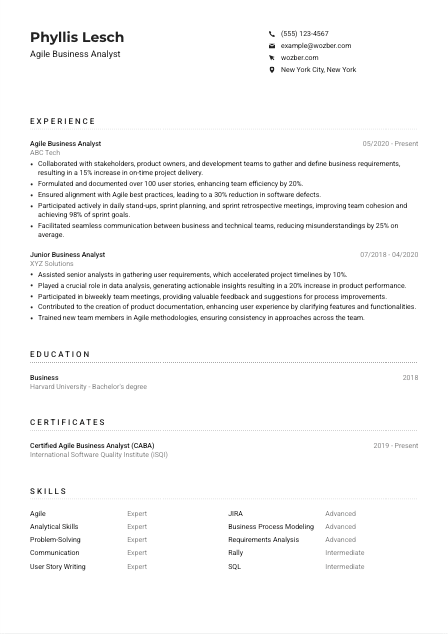
Place "Agile Business Analyst" directly beneath your name if that matches the role you are pursuing. This immediately connects your resume to the posting and helps ATS matching. In the example, using the exact title removes any doubt about whether the candidate comes from a product-facing Agile analysis background rather than a broader BA track.
Include a reliable phone number and a professional email address, ideally in a simple firstname.lastname format. If a recruiter wants to schedule an interview around sprint ceremonies or stakeholder availability, they should be able to reach you without friction.
If the job asks for a specific location, list it clearly. Here, "New York City, New York" matters because the employer states it as a requirement. That is a tailoring move tied to this opening, not something every Agile Business Analyst resume needs to emphasize.
A LinkedIn profile or professional website can support your application if it reinforces the same story as your resume. Make sure titles, dates, Agile tools, and project language match. Inconsistent digital profiles can raise questions about your actual scope of work.
Your personal details should confirm who you are, what role you are targeting, and whether you meet any practical filters such as location. Get those basics right, and the hiring team can move straight to your requirements, delivery work, and Agile collaboration record.




This is where hiring managers look for proof that you can turn requirements into delivery-ready work. For Agile Business Analysts, experience matters most when it shows collaboration with product owners, developers, and stakeholders, plus a clear record of writing user stories, refining backlog items, and helping teams hit sprint goals.
Read the posting and highlight the responsibilities that define day-to-day execution. In this case, that includes gathering business requirements, documenting user stories and acceptance criteria, refining backlog items, participating in sprint ceremonies, and facilitating communication between business and technical teams. Those are the themes your bullet points should mirror if they reflect your real work.
List roles in reverse chronological order and give the most space to the positions closest to the target role. If you have experience as both a general Business Analyst and an Agile Business Analyst, show how your work evolved toward Scrum or other Agile delivery environments, especially where you owned requirements refinement and sprint support.
Do not stop at task lists. Show what changed because of your work. Good bullets for this profession connect analysis work to delivery metrics such as on-time completion, lower defect rates, smoother sprint execution, or fewer requirement misunderstandings. The sample resume does this well by tying requirement gathering to a 15% increase in on-time project delivery and linking Agile alignment to a 30% reduction in defects.
Mention the workflows and artifacts that matter in the role, such as backlog grooming, sprint planning, daily stand-ups, retrospectives, user stories, acceptance criteria, and functional specifications. That language helps both ATS systems and hiring teams understand your actual operating environment. Use these terms where they describe what you did, not as a keyword pile.
Choose bullets that show you bridging stakeholder needs and development execution. That may include clarifying requirements, resolving ambiguity, facilitating refinement sessions, or documenting edge cases developers can build against. If older experience is less relevant, trim it so your recent Agile delivery work stays in focus.
A hiring team should be able to scan your experience section and quickly see how you support Agile execution. When your bullets show clear requirements work, collaboration across functions, and measurable delivery results, your experience starts reading like someone who can contribute from the first sprint.
Education usually is not the deciding factor for an experienced Agile Business Analyst, but it still matters when the posting asks for a specific degree background. Present it clearly so the reviewer can confirm the requirement and move on to your delivery experience.
If the employer asks for a Bachelor's degree in Business, Management Information Systems, or a related field, make that information easy to spot. The example resume does this directly with a Bachelor's degree in Business, which closely aligns with the posting language.
List degree, field of study, school, and graduation year in a simple order. Hiring teams are not looking for creative formatting here. They want a quick confirmation that your academic background supports work in business analysis, systems thinking, or product delivery.
When your degree aligns closely with the posting, use the same field name the employer uses if it is accurate. That helps with ATS matching and reduces ambiguity. For example, "Bachelor's degree in Business" is stronger than a vague shorthand if Business is the exact field.
Early-career candidates can include coursework, capstone projects, or university work related to requirements analysis, information systems, process modeling, or Agile project work. For someone with several years of professional experience, that extra detail is usually less important than recent sprint and stakeholder work.
Honors, project teams, or research work can support your resume when they show structured problem-solving, collaboration, or business systems analysis. Include them if they add relevant context, especially when your professional history is still growing.
Your education section should confirm that you meet the degree requirement without slowing down the resume. Once that baseline is covered, your experience with user stories, backlog refinement, and cross-functional delivery should do the heavier lifting.
Certifications are often secondary to hands-on delivery work, but they can still reinforce your credibility in Agile analysis. Use this section to show continued development in frameworks, analysis practices, or tools that support product teams.
If you hold credentials in Agile business analysis, Scrum, product delivery, or requirements management, list the most relevant ones first. The sample includes Certified Agile Business Analyst, which works because it directly supports the target role, even though the posting does not require a certification.
A short, focused list is stronger than a long catalog of unrelated courses. Prioritize certifications that support backlog refinement, stakeholder communication, Agile delivery, or business analysis over general professional development items that do not add role-specific value.
Add earned dates and renewal ranges when relevant, especially for credentials that require ongoing maintenance. That helps the reader understand whether your knowledge is current, which matters in roles shaped by changing Agile practices, product tooling, and team workflows.
If you are actively building skills in areas such as advanced Agile practices, product analytics, SQL, or tooling used by delivery teams, this section can help round out your profile. Keep it tied to work you can apply in backlog definition, reporting, or decision support.
Certifications should support the story your experience already tells. When they connect clearly to Agile analysis, delivery collaboration, or requirements work, they add useful depth without distracting from your day-to-day impact.
The skills section should read like the toolkit of someone who can work inside a product team, not a generic list of soft skills. For Agile Business Analysts, that usually means a mix of analysis methods, Agile practices, collaboration strengths, and delivery tools.
Start with the actual requirements listed by the employer. Here, Agile methodologies, cross-functional teamwork, analytical ability, problem-solving, communication, and tools such as JIRA or Rally all deserve attention. These are the terms most likely to shape both ATS screening and human review.
Show both how you think and how you work. A balanced list might include requirements analysis, user story writing, acceptance criteria, business process modeling, backlog refinement, stakeholder communication, JIRA, Rally, and SQL if it supports your analysis work. The example resume handles this well by mixing Agile, user story writing, business process modeling, JIRA, Rally, and SQL.
Group or order skills so the most relevant ones appear first and the section stays easy to scan. Avoid padding the list with every platform you have touched once. A tighter list built around actual delivery work is better for ATS optimization and more convincing to a hiring manager reviewing sprint-focused roles.
Your skills should support the story told in your experience section. When the same themes appear across both sections, requirements analysis, Agile ceremonies, stakeholder collaboration, and tools like JIRA become much easier to trust.
Language fluency matters in this role because Agile Business Analysts spend so much time clarifying requirements, facilitating conversations, and reducing misunderstanding across business and technical groups. Present language ability in a way that reflects how communication actually affects delivery.
If English fluency is listed as a prerequisite, show it clearly. In this case, placing English at Native or Fluent level near the top addresses a stated requirement and supports the communication-heavy nature of backlog discussions, stakeholder interviews, and sprint ceremonies.
Extra languages can be useful if you work with distributed teams, multilingual stakeholders, or international product groups. They are usually not the main hiring factor, but they can strengthen your profile when collaboration spans regions or user communities.
Use clear levels such as Native, Fluent, Intermediate, or Basic. Agile work depends on precise communication, so this is not a place to overstate ability. Accurate language ratings set realistic expectations for meetings, workshops, and documentation.
Even when the job posting only mentions English, another language can still round out your profile. Just keep it in proportion. For most Agile Business Analyst roles, stakeholder management, requirement quality, and delivery collaboration will carry more weight than multilingual ability alone.
For this profession, language ability is most valuable when it helps reduce friction between people working toward the same release goal. If you list multiple languages, present them as part of your communication toolkit, alongside facilitation, documentation, and stakeholder alignment.
A concise language section can reinforce one of the most important parts of the role: keeping conversations, documentation, and decisions clear across different audiences. That matters in Agile environments where small misunderstandings can quickly affect scope or sprint progress.
The summary is your fastest chance to tell the hiring team what kind of Agile Business Analyst you are. Focus on your level of experience, the environments you have worked in, and the kinds of outcomes you help teams achieve.
Before writing the summary, identify the few points the employer cares about most. In this posting, that means Agile experience, cross-functional collaboration, requirements definition, communication, and familiarity with tools like JIRA or Rally. Use those themes to shape the paragraph, not to create a keyword list.
Start with a direct line such as "Agile Business Analyst with 5+ years of experience" if it is accurate. That immediately frames your level and relevance. The sample summary does this effectively and then builds on it with delivery-focused detail.
Mention the parts of your work that matter most in Agile teams, such as translating business needs into user stories, improving team efficiency, reducing defects, supporting sprint delivery, or facilitating communication between stakeholders and developers. Pick two or three points you can back up elsewhere in the resume.
Aim for a short paragraph that reads clearly in under half a minute. Skip generic claims about being hardworking or results-driven. A sharper summary names your Agile context, your analysis strengths, and the delivery outcomes you influence, then lets the experience section provide the proof.
A well-written summary tells the reader, early and clearly, that you understand Agile delivery from both the business and product side. When it aligns with the rest of the resume, it helps position you as someone who can clarify requirements, support the team, and keep work moving through the sprint.
Once every section points to the same story, your resume becomes much easier to trust. Hiring teams should be able to see your experience with requirements gathering, user story creation, backlog refinement, sprint participation, and cross-functional communication without having to infer it from vague BA language.
Wozber's free resume builder and ATS resume scanner can help you tighten that alignment, surface missing terms from the job description, and organize your content in an ATS-friendly resume format. The result should make one thing clear fast: you can translate business needs into delivery-ready work for an Agile team.




