



Use Wozber and land your dream job
Create Resume
No registration required
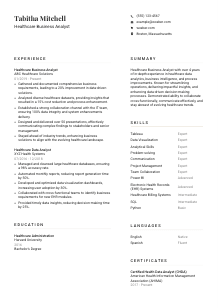
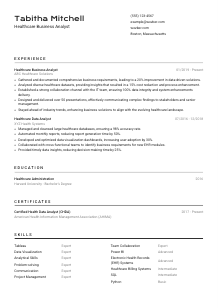
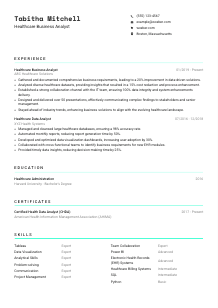
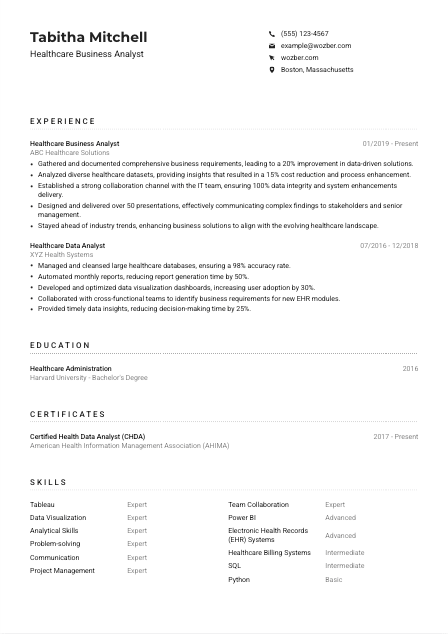
Decoding healthcare info, but your resume's a head-scratcher? Check out this Healthcare Business Analyst resume example, created with Wozber free resume builder. It shows how to blend your data analysis chops with health industry insights so your career pulse stays strong and steady!
Healthcare Business Analysts sit at the point where clinical operations, financial performance, and system data meet. Hiring teams want to see whether you can turn messy reporting, EHR workflows, and stakeholder requests into usable analysis that improves decisions, process efficiency, or cost control. Your resume should make that operational impact visible early.
When the resume is tailored to the posting, the reader can quickly separate general analysts from candidates who understand healthcare data, business requirements, and system constraints. Wozber's free resume builder helps you shape that experience into an ATS-compliant resume by aligning phrasing with the job description, so your background in areas like dashboards, billing data, or EHR-related analysis is easier to recognize.
Healthcare Business Analyst hiring often starts with practical checks before anyone gets to your dashboards or project outcomes. Your header should confirm who you are, how to reach you, and whether you meet straightforward requirements such as location and professional presentation.
Use your full name in a larger, clean font so it is easy to spot at the top of the page. This sounds basic, but in analyst hiring, clarity matters. A resume packed with technical detail should still open with a polished identity block that looks deliberate and professional.
Place "Healthcare Business Analyst" under your name when that is the role you are pursuing. Matching the title helps frame the rest of the resume around healthcare analytics, business requirements gathering, process improvement, and stakeholder reporting instead of leaving the reader to infer your direction from past roles alone.
List a reliable phone number and a professional email address, ideally in a straightforward format such as firstname.lastname@email.com. This role often involves presenting findings to senior management and collaborating with IT, finance, and operations teams, so even the basics should reflect good professional judgment and attention to detail.
If the employer specifies a location, reflect that clearly in your header. Here, Boston, Massachusetts is named as a requirement, so listing Boston shows immediate alignment and removes a common point of uncertainty. Only do this when it is true and relevant to the role you are targeting.
A LinkedIn profile or professional website can strengthen your application if it supports your resume with the same career story. For a Healthcare Business Analyst, this might reinforce your work with reporting tools, healthcare systems, project outcomes, or presentations. Make sure dates, titles, and achievements match what appears on the resume.
Your personal details should quickly answer the practical questions. Can this person be contacted easily, do they present themselves professionally, and do they meet basic requirements such as location? Once those boxes are clear, the hiring team can focus on your analytical work.




This section carries the most weight for a Healthcare Business Analyst. Employers want to see more than generic analysis experience. They want examples of requirement gathering, healthcare data interpretation, reporting improvements, system collaboration, and measurable business results tied to operational or financial outcomes.
Start by marking the verbs and domain terms in the description. For this role, that includes gathering business requirements, analyzing healthcare data, working with IT on data integrity, presenting findings, and staying current with healthcare trends and regulations. Those themes should shape your bullets so the employer sees familiar language connected to real accomplishments.
List your positions in reverse chronological order and give priority to jobs involving healthcare analytics, business intelligence, EHR-related work, billing analysis, or operational reporting. A title like "Healthcare Data Analyst" can still support a Healthcare Business Analyst application if the bullets show stakeholder collaboration, dashboard development, and process improvement work.
Each bullet should show what you did, what business problem it addressed, and what changed because of your work. The sample resume does this well with lines such as improving data-driven solutions by 20% and reducing costs by 15%. That is stronger than simply saying you analyzed data or supported business decisions.
Use metrics that make sense for this field. Good examples include reporting turnaround time, cost reduction, data accuracy, user adoption, decision speed, billing process efficiency, or dashboard usage. In the example, automated monthly reports cut generation time by 50% and database work improved accuracy to 98%, both of which are easy for a hiring manager to value.
Keep the focus on work that supports this kind of role. If a bullet does not connect to analytics, healthcare operations, business requirements, system improvement, or stakeholder communication, trim it or rewrite it. Your experience section should read like someone who can move comfortably between data, healthcare context, and business action.
After reading your experience section, the employer should be able to picture you collecting requirements, analyzing healthcare data, partnering with IT, and presenting recommendations that improve process or cost performance. That is the standard this section needs to meet.
Education matters here because the role sits between healthcare operations and business analysis. Your degree helps establish that you understand the environment you are analyzing, whether that foundation comes from healthcare administration, business, information systems, or a related field.
If you have a bachelor's degree in Business, Healthcare Administration, or a related discipline, list it clearly. When a posting names the degree requirement directly, do not make the reader search for it. In the example, a Bachelor's Degree in Healthcare Administration is a close match and deserves clear placement.
Include the school, degree, field of study, and graduation year or date. That is usually enough for an experienced Healthcare Business Analyst. Keep the formatting easy to scan so the reader can confirm the qualification quickly and move on to your more role-defining sections.
Do not stop at "Bachelor's Degree" if your major strengthens your case. A field such as Healthcare Administration signals familiarity with provider environments, healthcare processes, and industry pressures. A business or analytics-related field can do the same if the rest of the resume supports the healthcare connection.
If you are early in your career, relevant coursework, capstone projects, or academic research can support your resume. Focus on topics such as healthcare informatics, statistics, business intelligence, process improvement, or healthcare finance. For experienced candidates, this usually becomes optional unless the project is unusually relevant.
Activities outside the classroom can help if they reinforce your direction, especially when you are newer to the field. Student work tied to healthcare organizations, data competitions, research assistance, or industry conferences can add context. Keep these details brief and only include them when they strengthen your healthcare analytics profile.
Your education section should confirm that you have the academic foundation to work across healthcare operations and business analysis. It does not need to be long. It needs to be clear, relevant, and easy to verify.
Certifications are especially useful in healthcare analytics because they show continued development in a field shaped by changing reporting needs, regulations, reimbursement models, and data standards. They can also add credibility when your resume leans heavily on technical or analytical work.
The job posting does not require a certification, so relevance matters more than volume. Prioritize credentials connected to health data, analytics, business intelligence, or healthcare information management. A certification like CHDA fits naturally because it reinforces specialized work with healthcare data.
Choose certifications that support the role you want now. For a Healthcare Business Analyst, that usually means health data analysis, reporting, BI platforms, project work, or healthcare systems knowledge. Leave out certificates that do not help explain your ability to improve decisions, reporting, or operations in a healthcare setting.
Add the earned date or renewal period if it helps show that the certification is current. In regulated and data-sensitive environments like healthcare, recency can matter. It signals that your knowledge has been maintained rather than left to age in a fast-moving field.
Healthcare business analysis changes with reimbursement models, compliance expectations, EHR capabilities, and reporting practices. Certifications and renewals can show that you stay engaged with those changes. That matters when the role asks you to keep solutions aligned with industry trends and best practices.
A focused certifications section can strengthen your credibility in healthcare analytics without taking much space. It works best when every credential points back to the same story: you understand healthcare data, you keep your knowledge current, and you can apply it in business decisions.
This section should read like a practical toolkit for the job, not a catch-all inventory. Employers scanning for Healthcare Business Analysts look for a mix of analytics tools, healthcare systems exposure, and communication skills that support business requirements, reporting, and stakeholder decisions.
Start with the skills named in the posting and nearby terms that mean the same work. Here, that includes Tableau or Power BI, healthcare data analytics, EHR systems, healthcare billing systems, analytical thinking, problem-solving, and communication. These should appear naturally in your skills section if they reflect your experience.
Lead with the capabilities that make you immediately credible for the role. In many Healthcare Business Analyst resumes, that means data visualization, analytics, requirements gathering, EHR familiarity, SQL, reporting, and stakeholder communication before broader traits such as teamwork. The sample skills list does this reasonably well by surfacing Tableau, Data Visualization, and Analytical Skills early.
Do not overload the section with every platform or soft skill you have ever used. Choose skills that support the actual workflow of the role, such as dashboard creation, healthcare data interpretation, billing system knowledge, business intelligence tools, and presentation of findings. A shorter list with stronger alignment usually performs better for both ATS screening and human review.
This section should make it obvious that you can work with healthcare data, translate business needs into analysis, and communicate results to stakeholders. If those capabilities are easy to spot, the section is doing its job.
Language skills are usually a supporting detail for this role, but they can still add value. Healthcare organizations often serve diverse patient populations and cross-functional teams, so language ability can strengthen communication, reporting context, or stakeholder support when it is relevant.
Always check the posting for language expectations. Here, effective communication in English is required, so English should appear clearly in your language section. If English is your working language, label it accurately as Native or Fluent.
Order matters. Place English first so the employer can confirm the requirement immediately. This role involves presentations, business documentation, and conversations with stakeholders, so written and spoken clarity in English is part of the core job, not a minor detail.
Additional languages can be valuable, especially in healthcare systems that serve multilingual communities or operate across diverse internal teams. In the example, Spanish adds useful context because it may support broader communication, even though it is not a stated requirement for every Healthcare Business Analyst role.
Use clear proficiency labels such as Native, Fluent, Advanced, or Conversational. Avoid vague wording. Accuracy matters on a resume for an analyst role, and language proficiency should be presented with the same care you would use for reporting metrics or technical tools.
If another language has supported your work, show that benefit elsewhere in the resume through experience bullets or summary wording. For instance, it may have helped with stakeholder communication, community health reporting, or collaboration across departments. If there is no real work connection, listing the language alone is enough.
Language skills will rarely drive the decision on their own, but they can add useful context in healthcare environments where communication matters across many audiences. Keep the section accurate, concise, and aligned with the role's actual needs.
Your summary should quickly position you within healthcare analytics and business decision support. In a few lines, it needs to tell the reader what kind of analyst you are, how much relevant experience you bring, and what outcomes your work tends to influence.
Use the job description to identify the themes your summary should reflect. For this role, that means healthcare data analytics, business intelligence, requirement gathering, process improvement, collaboration with IT, and communication with stakeholders. You do not need to list every requirement, but the summary should clearly belong to this profession.
A direct first line works well here. Something like "Healthcare Business Analyst with 4+ years of experience in healthcare data analytics and business intelligence" immediately gives the reader role identity and seniority. The sample summary uses this approach effectively and keeps the focus on relevant experience.
Follow the opening with concrete strengths tied to the job, such as improving reporting processes, identifying cost-saving opportunities, building dashboards, or translating stakeholder requirements into actionable analysis. This is the right place to mention process improvement or cross-functional collaboration if those are recurring strengths in your background.
Aim for a compact paragraph of about 3 to 5 lines. Skip broad claims and generic adjectives unless they are backed by substance. A hiring manager should be able to read the summary in a few seconds and understand your healthcare context, analytical scope, and likely business contribution.
Your summary should set the frame for the rest of the resume. By the time the reader reaches your experience section, they should already expect to see healthcare data analysis, business problem-solving, stakeholder communication, and measurable operational impact.
A well-targeted Healthcare Business Analyst resume shows how you work with healthcare data, business requirements, and operational priorities. Every section should support that story, from a location-aware header to experience bullets that show cost reduction, reporting improvement, data accuracy, or stronger decision support.
Wozber's free resume builder helps you organize that story in an ATS-friendly resume format, and the ATS resume scanner can surface missing keywords, healthcare terminology, and requirement gaps before you apply. Use those tools to tighten alignment, then make sure the final resume clearly shows the healthcare business problems you can solve.




