



Use Wozber and land your dream job
Create Resume
No registration required
Deciphering data, but your resume doesn't compute? Check out this Financial Business Analyst resume example, created with Wozber free resume builder. Learn how to align your analytical acumen with job specifics, creating a career narrative that adds up to success!
Financial Business Analysts are hired to turn raw numbers into decisions. Hiring teams want to see whether you can build reliable forecasts, explain variance in business terms, and give senior leaders recommendations they can actually use. Your resume should make that analytical judgment clear through budgeting work, financial modeling scope, reporting cadence, and the business outcomes tied to your analysis.
When that detail is tailored to the job description, the resume is easier to sort in both human review and ATS screening. Wozber's free resume builder helps you align your language with the posting, keep an ATS-friendly resume format, and surface the financial tools, metrics, and planning work that show you can support management decisions from day one.
This section is simple, but it still carries practical weight. For a Financial Business Analyst, clean contact details, the right title, and any location requirement can remove friction before your modeling or reporting experience is even reviewed.
Place your full name at the top in a clear, readable style. In finance hiring, resumes often move quickly from recruiter to hiring manager to team lead, so your document should be easy to identify in a saved PDF, printed packet, or interview notes.
Add the job title directly under your name when it matches your background. Using "Financial Business Analyst" helps frame the rest of the resume around planning, forecasting, budgeting, and decision support rather than a broader analyst profile.
List a phone number you answer, a professional email, and only links that support your candidacy. Accuracy matters here. A typo in your email is a very avoidable way to miss an interview request for a role that already expects precision in reports and financial data.
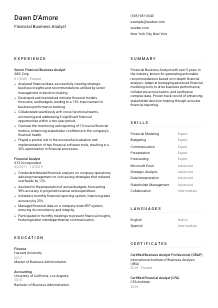
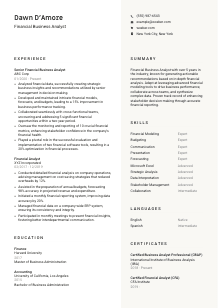
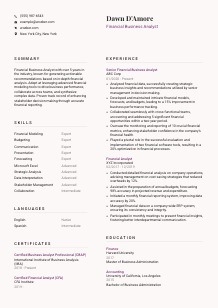
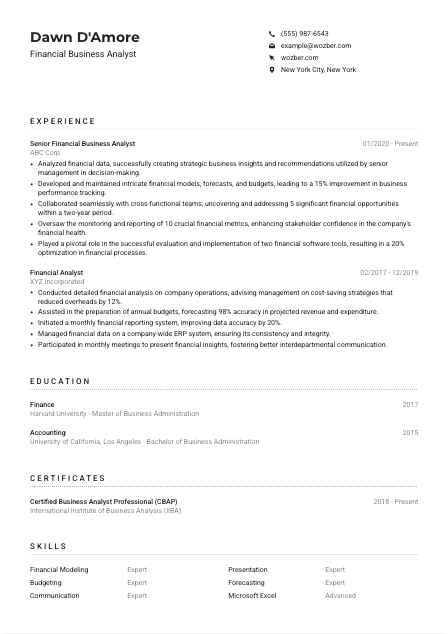
If a role requires a specific city or relocation, state that clearly in your personal details. In the example, listing New York City, New York directly addresses a stated requirement and removes uncertainty about availability for a local finance team.
A LinkedIn profile can help if it mirrors your resume and adds useful context, such as software implementation work, business analysis projects, or cross-functional finance support. Keep titles, dates, and major achievements consistent across both.
Your personal details should answer the practical basics without distraction. Once that is clear, the reader can focus on whether your financial analysis, forecasting, and stakeholder communication match the role.




This section carries the most weight for a Financial Business Analyst. Employers want to understand the scale of your analysis, the models you owned, the reporting you supported, and whether your work influenced budgets, forecasts, or management decisions.
Read the job description closely and mark the recurring work: financial analysis, forecasting, budgeting, model building, stakeholder reporting, and collaboration with business partners. Those terms should shape which bullets you keep, what you cut, and how you describe your contribution.
List roles in reverse chronological order with title, company, and dates. For finance positions, this layout helps reviewers quickly spot advancement from analyst work into broader ownership of forecasts, business performance tracking, or senior-management support. It also keeps the resume ATS-compliant and easy to parse.
Focus each bullet on what you analyzed, what you built, and what changed because of it. Strong Financial Business Analyst bullets mention forecast models, budget ownership, variance reporting, KPI monitoring, cost analysis, or recommendations adopted by leadership. The example does this well by tying financial models to a 15% improvement in business performance tracking.
Use numbers that belong naturally in finance work: forecast accuracy, cost reduction, process efficiency, reporting volume, business units supported, or number of metrics tracked. The sample resume includes 12% overhead reduction, 98% forecasting accuracy, and a 20% process optimization after software implementation. Metrics like these tell hiring teams how your analysis performed in real operating conditions.
Prioritize experience that reflects planning cycles, business reviews, model maintenance, and cross-functional financial support. If a past achievement does not help explain your strength in budgeting, forecasting, reporting, or strategic analysis, leave it out and make room for work that does.
Your experience should show that you do more than handle numbers. It should show that your analysis improves forecasting, sharpens business decisions, and gives stakeholders a clearer view of performance and risk.
Education matters here because the role sits at the intersection of finance, business analysis, and management reporting. Your degree should be easy to scan and clearly connected to the analytical training behind your budgeting and forecasting work.
If you hold a Bachelor's or Master's degree in Finance, Accounting, Business Analytics, or a related field, present it clearly. This role specifically asks for that academic background, so there is no need to bury it behind other credentials.
List degree, field of study, school, and graduation year in a consistent format. Hiring teams reviewing finance resumes often move quickly, and a clean structure makes it easy to confirm that you meet the educational baseline.
Be specific about the discipline. "MBA in Finance" or "BBA in Accounting" immediately connects your academic training to forecasting, financial statement analysis, and business performance review. The example uses both clearly, which reinforces fit without extra explanation.
If you are earlier in your career, relevant coursework in corporate finance, managerial accounting, valuation, business analytics, or financial modeling can help fill out your profile. For experienced candidates, this is usually less important than work achievements unless the course work is unusually relevant to the target role.
Honors, finance competitions, capstone projects, or analytical student work can add value when professional experience is limited. Once you have several years of forecasting, budgeting, and reporting experience, these details should stay brief so your resume remains focused on business impact.
This section should quickly show that you have the formal grounding expected for finance and analytical work. Then your experience section can carry the heavier proof of how you apply that knowledge in business settings.
Certifications are not always required for Financial Business Analyst roles, but they can strengthen your profile when they reinforce analytical rigor, financial judgment, or business analysis discipline. The key is relevance, not volume.
When a posting mentions credentials such as CBAP or CFA as a plus, list any matching or closely related certifications prominently. For this role, those credentials support two useful angles: structured business analysis and deeper financial expertise.
Prioritize certifications tied to financial analysis, planning, systems, or business analysis. A shorter list of relevant credentials is stronger than a broad list that does not connect to forecasting, budgeting, reporting, or decision support.
Add the year earned or active date range so employers can see how current the credential is. In finance and analytics roles, recent certification activity can suggest that your technical knowledge and framework-based thinking are still current.
If you are actively maintaining a certification or working through a recognized program, include that when it is accurate and relevant. Ongoing learning matters in roles that increasingly touch ERP systems, financial software tools, dashboarding, and process improvement.
Relevant certifications can reinforce the parts of your resume that point to disciplined analysis, stronger business partnering, and up-to-date financial practice. They work best when they support the responsibilities already shown in your experience.
A Financial Business Analyst skills section should look like a working toolkit, not a generic list. Hiring managers expect to see a mix of technical finance capability, reporting tools, and the communication skills needed to explain findings to non-finance stakeholders.
Pull the core skills directly from the role when they match your experience. For this job, that includes financial modeling, forecasting, budgeting, Microsoft Excel, communication, presentation, and cross-functional collaboration. These terms matter for both ATS optimization and recruiter review.
Show the full range of the role by combining hard skills with execution skills. A solid mix might include financial modeling, variance analysis, budgeting, forecast planning, KPI reporting, Excel, stakeholder management, and presentation. The sample resume reflects this balance well by pairing modeling and budgeting with communication and strategic analysis.
Do not overload this section with every tool or soft skill you have ever used. Keep the emphasis on capabilities that support management reporting, financial planning, business insights, and collaboration with operating teams. A tighter list reads as more credible and makes the core strengths easier to spot.
Your skills should quickly confirm that you can build the numbers, interpret them, and present them in a way business leaders can act on. That combination is central to Financial Business Analyst work.
Language ability matters in this role because financial analysis does not stay inside spreadsheets. You may need to explain budget variance, present forecasts, or answer questions from stakeholders with different levels of financial fluency.
If the job requires proficient English, list English clearly and give your level. For a role that involves reporting and presentations to management, this is not a minor detail. It speaks directly to your ability to communicate analysis accurately.
Put the required or strongest language first, then add others that could support collaboration with broader teams or international business groups. In the example, English appears first and Spanish adds useful secondary value without distracting from the role requirement.
Extra languages are worth listing if they could help in multinational reporting environments, cross-border operations, or wider stakeholder communication. They are a bonus, not a substitute for the finance skills the role depends on.
Choose straightforward labels such as Native, Fluent, Intermediate, or Basic. Precision matters. Overstating proficiency can become a problem quickly in interviews, presentations, or stakeholder-facing work.
For some Financial Business Analyst positions, multilingual ability can support work with regional teams, vendor groups, or global reporting cycles. Include it when it adds real context, but keep the emphasis on your finance and analysis capability first.
Language skills should support your profile as someone who can explain financial performance clearly across teams and contexts. Keep them accurate, relevant, and secondary to the core analytical requirements of the role.
The summary needs to establish your level, your finance focus, and the kind of business impact your work supports. For this role, a few well-chosen lines about modeling, forecasting, reporting, and decision support will do more than broad claims ever could.
Review the posting before you write. If the role centers on financial analysis, forecasting, budgeting, and senior-management recommendations, those themes should appear naturally in your opening lines when they reflect your experience.
Open with a direct description of who you are and how much experience you bring. "Financial Business Analyst with 5+ years of experience" works because it immediately anchors the reader in your seniority and function.
Choose strengths that define your value in this profession, such as complex financial modeling, business performance tracking, cross-functional planning, or translating data into executive recommendations. The sample summary is effective because it connects in-depth analysis with stakeholder decision-making instead of listing generic traits.
Aim for a short paragraph that can be scanned quickly. Skip broad adjectives and focus on what you analyze, what you build, and the kind of decisions your work supports. In finance hiring, clarity and specificity read better than hype.
A strong summary should make the reader expect solid forecasting, disciplined analysis, and useful management insight from the rest of the resume. If those themes are clear in a few lines, the section is doing its job.
Your resume should now show the parts of Financial Business Analyst work that matter most in hiring: forecasting accuracy, model ownership, budgeting support, reporting discipline, and recommendations that influenced business decisions. Keep every section aligned with the target role so the reader can follow that story without guessing.
Use Wozber's free resume builder to tighten structure, tailor language to the posting, and produce an ATS-compliant resume that presents your finance experience clearly. With focused edits and the right metrics, your resume can show exactly where you add value in planning, performance analysis, and strategic decision support.




