




Use Wozber and land your dream job
Create Resume
No registration required
Guiding green initiatives, but your resume doesn't look eco-friendly? Check out this Environmental Manager resume example, created with Wozber free resume builder. Learn how to match your sustainability skills to job criteria, making your career as clean and captivating as a carbon-neutral cityscape!
Environmental Managers are trusted with work that carries operational, legal, and public consequences. A hiring team wants to see more than broad commitment to sustainability. Your resume needs to show how you handle compliance programs, environmental risk, impact assessments, and cross-functional decisions that affect sites, projects, and reporting obligations.
Early screening often turns on whether your background clearly maps to regulatory scope and environmental management work, not whether your resume sounds passionate. Wozber's free resume builder helps you shape that experience into an ATS-compliant resume that mirrors the posting's language and surfaces the right details fast, so employers can quickly see your command of regulations, mitigation planning, and team leadership.
For an Environmental Manager, the header should read like the top line of a professional compliance document. Keep it clean, accurate, and aligned with the position so the hiring team can immediately place you in the right functional track.
Use your full name in a clear, readable format at the top of the page. This is basic, but it matters. Environmental leadership roles often move through HR, operations leaders, and compliance stakeholders, so your resume should look formal and easy to reference in internal discussions.
Place the job title directly under your name if it reflects the role you are pursuing. Using "Environmental Manager" immediately connects your resume to the position and helps distinguish you from adjacent profiles such as consultant, specialist, EHS coordinator, or sustainability analyst.
List a reliable phone number and a professional email address. Use a format based on your name whenever possible. If you include a website or LinkedIn profile, make sure it supports your environmental management background with relevant projects, certifications, regulatory work, or leadership experience.
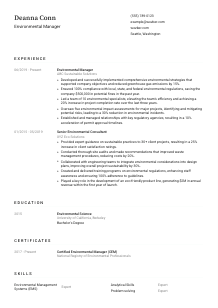
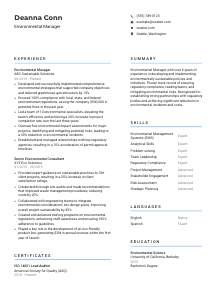
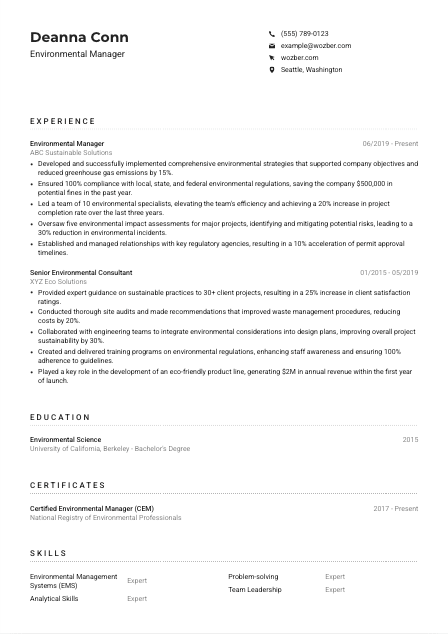
If the posting specifies a location requirement, address it directly in your header. In this example, listing "Seattle, Washington" helps remove friction because the employer asked for candidates located there. For other jobs, include your city and state when location affects eligibility, site access, or regional regulatory familiarity.
A professional profile can strengthen your application if it expands on field audits, permitting work, ISO 14001 exposure, impact assessments, or major environmental initiatives. Skip personal links that do not support the role. Every item in this section should reinforce your credibility as someone trusted with environmental performance and compliance.
This section should answer the first operational questions quickly: who you are, what role you are targeting, how to reach you, and whether any location requirement is already covered.




This section carries the most weight because Environmental Managers are hired on track record. Employers want to see where you owned compliance, how you handled risk, what programs you led, and what changed because of your work.
Read the job description as a checklist of work you need to reflect back with real examples. For this role, that includes environmental strategy, regulatory compliance, permitting and reporting, impact assessments, team leadership, and risk mitigation. Build bullets around those priorities so your resume speaks the same operational language as the opening.
Start with your most recent position and work backward. That format makes it easier to follow the progression from specialist or consultant work into management responsibility, especially if your recent roles show broader ownership of sites, teams, environmental programs, or agency relationships.
Avoid generic statements like "responsible for compliance" or "managed environmental programs." Show what you actually led and what happened. The sample does this well with bullets such as developing environmental strategies tied to company objectives and overseeing impact assessments that reduced incidents. That kind of phrasing shows execution, not just assignment.
Quantify outcomes where the measure is meaningful to the role. Good examples include reduced emissions, fewer incidents, permit turnaround improvements, avoided fines, audit performance, remediation savings, training completion, or project delivery rates. In the example resume, "100% compliance," "$500,000 in potential fines avoided," and a "30% reduction in environmental incidents" all give a hiring manager concrete operating results to evaluate.
Prioritize experience that shows regulatory knowledge, environmental planning, cross-functional leadership, and business impact. If an older bullet does not help prove those areas, trim it or rewrite it. A focused set of accomplishments is more persuasive than a long history of loosely related tasks.
The strongest experience section makes your management scope easy to understand. A reader should be able to see the regulations you handled, the programs you led, the risks you reduced, and the outcomes you delivered.
Most Environmental Manager postings use education as an early qualification screen. Keep this section straightforward and make the relevance of your degree obvious at a glance.
If the posting asks for a bachelor's degree in Environmental Science, Environmental Engineering, or a related field, make sure your degree title and field are listed clearly. In the example, "Bachelor's Degree" in "Environmental Science" directly answers that requirement without forcing the reader to infer it.
List school, degree, field of study, and graduation year or date in a consistent structure. Environmental roles are often reviewed quickly alongside compliance-heavy experience, so this section should confirm qualifications without slowing down the read.
When your education directly supports environmental regulation, science, engineering, ecology, or sustainability work, that alignment strengthens your profile immediately. You do not need extra explanation if the degree already speaks clearly to the role.
Recent graduates or candidates shifting into environmental management may benefit from listing coursework in environmental policy, impact assessment, hazardous waste management, GIS, remediation, or environmental law. If you already have more than 5 years of relevant experience, formal work history usually does more of the selling.
Honors, research projects, capstones, or student leadership can help if they connect to field investigations, environmental analysis, sustainability initiatives, or regulatory topics. Keep them only if they add something your professional experience does not already show.
Your education section does not need elaborate detail. It needs to confirm that you have the academic base expected for environmental management and let the reader move quickly to your applied experience.
Certifications can meaningfully strengthen an Environmental Manager resume, especially when they point to systems knowledge, audit capability, or recognized environmental standards. They are particularly useful when the posting mentions EMS or treats certification as a plus.
Prioritize credentials tied to environmental management systems, compliance oversight, auditing, or regulatory practice. In this case, certifications such as Certified Environmental Manager and ISO 14001 Lead Auditor directly support the role because the job description values EMS knowledge and environmental management experience.
Order certifications by relevance, not by prestige alone. A hiring manager reviewing environmental roles will care more about certifications that connect to permitting, management systems, audits, or risk control than unrelated general business credentials.
List issue dates, renewal windows, or active status when that helps show your knowledge is current. Regulations, standards, and reporting expectations shift over time, so recent or actively maintained credentials can add confidence.
Environmental management changes with new regulations, reporting frameworks, audit expectations, and operational standards. Keeping certifications active or adding new ones shows that you stay current on the tools and requirements that shape real environmental programs.
Certifications work best when they strengthen what your experience already shows. On an Environmental Manager resume, they should reinforce your ability to run compliant systems, guide audits, and lead programs with current technical judgment.
Environmental Managers need a mix of technical knowledge, risk judgment, and leadership ability. Your skills section should reflect the work itself, not read like a generic leadership list.
Pull the required skills directly from the job description when they reflect your real background. Here, environmental regulations, policies, permitting processes, analytical ability, problem-solving, and project management all belong in the skills section because they are central to how the role is performed and screened.
Include hard skills such as Environmental Management Systems, regulatory compliance, impact assessment, permitting, auditing, and risk assessment alongside management skills like team leadership, stakeholder communication, and strategic planning. The sample resume handles this balance well by pairing EMS and compliance capabilities with leadership and project management strengths.
Put the skills most tied to the target role near the top. For an Environmental Manager, that usually means compliance, EMS, risk assessment, project management, reporting, and leadership before broader traits. Keep the list tight enough that each item supports the role clearly.
A hiring manager should be able to scan this section and immediately understand your operating strengths. Focus on capabilities that show you can manage environmental programs, navigate regulations, and lead implementation across teams or sites.
Language is rarely the main differentiator for an Environmental Manager, but it can matter when the role involves training, reporting, regulatory communication, or coordination across diverse teams and communities. Present it clearly and without overstatement.
If the job posting requires effective communication in English, make that visible. This role does, so English should appear clearly in your languages section or elsewhere on the resume. It confirms that you can handle reporting, training, policy communication, and interactions with regulators and internal stakeholders.
If you speak other languages, include them when they could support field communication, community outreach, cross-border projects, supplier engagement, or multicultural team leadership. Extra language ability is useful when it expands your ability to operate in real environmental settings.
Choose straightforward labels such as Native, Fluent, Intermediate, or Basic. Avoid vague descriptions. Environmental roles often involve technical communication, so accuracy matters here just as it does in compliance reporting.
Do not give this section more weight than it deserves unless languages are central to the role. If English is the stated requirement and you also speak another language fluently, that is enough. The section should support your profile, not distract from your environmental management qualifications.
Additional languages can help with international standards work, multilingual training, or coordination with varied communities and project partners. Include them when they are a genuine asset, not as filler. In the example, Spanish adds useful range without overshadowing the candidate's compliance and leadership experience.
This section should quickly confirm that you can communicate in the required language and note any additional capability that would help in training, stakeholder communication, or broader environmental program work.
The summary sits at the top of the resume, so it should establish your level, scope, and strongest value fast. For an Environmental Manager, that usually means years of experience, regulatory command, leadership background, and a few measurable outcomes or areas of impact.
Start by identifying what the target position emphasizes most. In this job description, the key themes are environmental strategy, compliance, impact assessment, team leadership, and risk mitigation. Your summary should bring those themes together in a few lines rather than offering a generic statement about sustainability.
Lead with your title and years of experience. A line such as "Environmental Manager with 6+ years of experience" immediately sets your level. If your background is more mixed, you can still anchor it in environmental management, consulting, permitting, or compliance leadership, depending on what best matches the role.
Use the next lines to show what you actually deliver. Strong examples include maintaining compliance across jurisdictions, leading environmental specialists, reducing incidents, improving permit timelines, or implementing strategies tied to business and sustainability goals. The sample summary works because it combines leadership, compliance, and measurable risk reduction in a compact space.
Aim for 3 to 5 lines with no filler. Skip soft claims that are not backed up elsewhere. A hiring manager should finish this section with a clear picture of your environmental management scope and the outcomes you are known for delivering.
An Environmental Manager resume works best when every section supports the same message: you can run environmental programs, keep operations compliant, and reduce risk in measurable ways. Wozber's free resume builder, ATS-friendly resume templates, and ATS resume scanner make it easier to align your wording with the job description, surface missing requirements, and present your background in a clean ATS-friendly resume format that hiring teams can review quickly.
Before you apply, read your resume once through as if you were hiring for environmental leadership. Can you quickly find regulatory expertise, program ownership, impact assessment work, team leadership, and measurable outcomes such as reduced incidents, avoided fines, improved approvals, or stronger environmental performance?
If any of those points are buried, revise them. Wozber's AI resume builder and ATS optimization tools can help you sharpen role-specific language and align your experience to the posting, so your resume makes your environmental management scope easy to judge from the first scan.




