



Use Wozber and land your dream job
Create Resume
No registration required
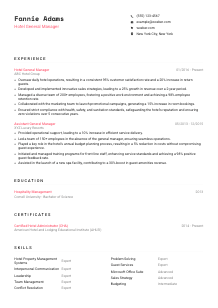
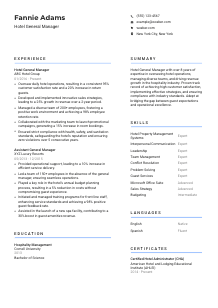
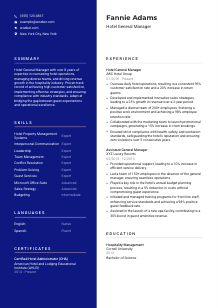
Juggling guest requests, but your resume feels unoccupied? Check out this Hotel General Manager resume example, created with Wozber free resume builder. Learn how to highlight your leadership strengths and hospitality know-how to match job criteria, and make your career as remarkable as a five-star stay!
Hotel General Managers are trusted with the full operating rhythm of a property. The work sits at the intersection of guest experience, team leadership, revenue performance, and compliance, so a resume needs to show how you run a hotel day to day while improving the numbers that owners and executives watch closely.
Hiring teams often need to separate senior operators from candidates whose experience is narrower, such as front office or departmental leadership alone. A tailored resume, built in Wozber's free resume builder and shaped for ATS optimization, makes your scale of responsibility easier to read quickly, from property performance and staff oversight to the systems and standards you manage.
For a Hotel General Manager, the header should do more than identify you. It should immediately position you as an operational leader who is reachable, professionally credible, and available for the role's location requirements when those matter.
Your name should be the most visible element on the page, set apart from the rest of the contact details so the document reads like a leadership resume, not an entry-level application. Clean formatting matters here because hotel leadership hiring often involves ownership groups, regional leaders, and HR reviewers who may scan dozens of resumes across multiple properties.
Use "Hotel General Manager" directly under your name when that reflects your current or target position. This helps immediately frame your background around full-property leadership rather than a narrower operations track. It also supports ATS alignment when the job description uses that exact title, as this one does.
Use a professional email address and a phone number you answer reliably. If you include LinkedIn or a professional website, make sure the content supports a hospitality leadership profile with consistent titles, dates, and experience across operations, revenue growth, and team management. Broken links or outdated profiles create unnecessary doubt.
Some hotel leadership searches are location-sensitive because the role requires on-site oversight, local market knowledge, and immediate availability for operational issues. Here, New York City is specifically mentioned, so listing New York City, New York, or stating willingness to relocate removes a practical barrier early in the review process.
A website is optional for this profession. Add it only if it reinforces your value through hospitality credentials, speaking engagements, property launches, industry associations, or leadership visibility. In most cases, a strong LinkedIn profile is enough. Keep the focus on operating results, guest satisfaction, and leadership scope rather than personal branding for its own sake.
This section should confirm who you are, what level you operate at, and whether you meet practical requirements such as location. Keep it clean, credible, and easy to scan.




This is the section most likely to decide whether you move forward. Hotel General Manager experience needs to show command of property operations, revenue performance, team leadership, and guest outcomes in language that reflects how hotels are actually run and measured.
Before you rewrite a single bullet, identify the performance areas the employer is emphasizing. In this posting, the priorities are daily operations, customer satisfaction, profitability, staff leadership, sales collaboration, and compliance. Those themes should guide which achievements you surface first, especially if your background spans different property types or management levels.
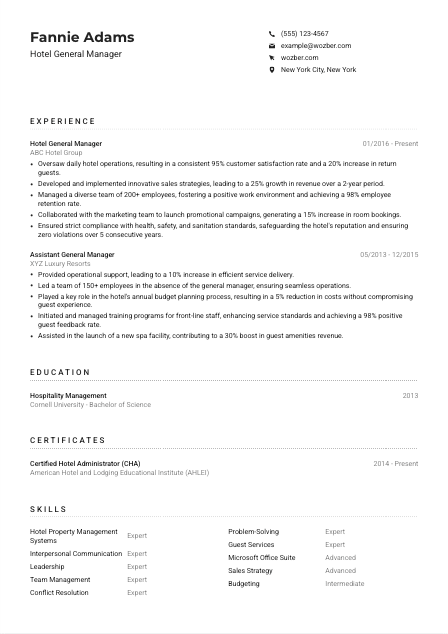
List your most recent hotel leadership role first, then work backward. For each job, include employer, title, and dates in a format that makes your progression easy to follow. The example does this well by moving from Hotel General Manager to Assistant General Manager, which quickly shows advancement into broader property responsibility.
Numbers matter in hospitality because they show whether you improved the business, not just maintained it. Use metrics tied to guest satisfaction, repeat stays, revenue growth, bookings, retention, cost control, or compliance outcomes. The sample resume is effective here because it pairs leadership claims with results such as 95% customer satisfaction, 25% revenue growth, and zero violations across five years.
A General Manager resume should emphasize outcomes that cut across departments. Strong bullets may reference leading front office, housekeeping, food and beverage coordination, staffing levels, budgeting, guest issue resolution, or promotional strategy with sales and marketing. For example, managing 200+ employees or collaborating on campaigns that increased room bookings speaks more directly to hotel-wide oversight than isolated departmental tasks would.
Replace generic statements like "responsible for daily operations" with what changed under your leadership. Show the action, the area of responsibility, and the result. "Implemented sales strategies that grew revenue by 25% over two years" tells a hiring team far more than a broad line about supporting hotel growth. In this field, outcome-based bullets make it easier to distinguish experienced operators from candidates who mainly assisted senior leadership.
When this section is working, a hiring team can quickly see your property scope, your leadership level, and the business results you delivered. That is the core of a Hotel General Manager application.
Education will rarely outweigh operating experience at this level, but it still matters. For Hotel General Manager roles, your degree helps confirm formal training in hospitality, business, or related management disciplines, especially when the posting names a bachelor's degree as a requirement.
If the employer asks for a bachelor's degree in Hospitality Management, Business Administration, or a related field, list your degree, school, and field clearly. Do not bury the major. A direct entry such as Bachelor of Science in Hospitality Management immediately answers a requirement and supports ATS matching.
Some hospitality programs carry strong recognition in the industry, and that can strengthen your profile when presented without overplaying it. A degree from a school such as Cornell can add useful context because hiring teams in hospitality understand the rigor and relevance of that training. Keep the emphasis on the qualification itself, not prestige alone.
Your education should connect naturally to the role's operational and commercial demands. Hospitality Management is an obvious fit, but related business degrees can work just as well when your experience covers hotel operations, financial performance, and staff leadership. The key is to show the academic background that supports how you manage a property.
If you are earlier in your career, relevant coursework, hospitality internships, student leadership, or industry conference participation can help. For a senior Hotel General Manager, keep these details brief and include them only if they add something meaningful, such as leadership development or early exposure to hotel operations.
Academic honors can stay on the resume when they support your profile without distracting from your operating record. For senior candidates, they should be secondary to experience, but distinctions tied to hospitality or leadership can still add polish, especially if your education is a visible part of your professional story.
This section should confirm that you meet the degree requirement and support your hospitality management background without competing with your operations record for attention.
Certifications matter most when they show recognized hospitality leadership training or up-to-date operational knowledge. For General Manager roles, they can add weight when the employer prefers formal industry credentials beyond experience alone.
When a posting calls out a credential such as the Certified Hotel Administrator from AHLEI, make it easy to find. If you hold it, place it prominently and use the full title. In this case, CHA directly matches a preferred qualification, so it deserves visible placement rather than being buried after unrelated certificates.
Choose credentials tied to hotel operations, hospitality administration, safety, revenue management, or leadership development. A short, relevant list reads better than a long inventory of minor training sessions. For a General Manager, each certificate should reinforce your ability to run a property, lead teams, or maintain standards.
Certifications that require renewal or continuing education should show dates so the employer can see they are current. The example handles this well by showing the CHA credential as active over time. That kind of detail is useful because it signals continued professional engagement in the field.
Hospitality leaders are expected to stay current on guest expectations, operational standards, and regulatory requirements. If you are pursuing recent coursework in areas like sanitation compliance, revenue strategy, or executive leadership, include it when it adds relevant depth. Keep the list selective and tied to the role you are targeting.
The best certification section tells a hiring team that your experience is backed by recognized industry training and that you stay current in a business where standards, service expectations, and compliance requirements keep moving.
A Hotel General Manager skill section should read like the toolkit of someone who can run a property, lead department heads, and keep both guests and financial targets on track. Keep the list tightly tied to hotel operations rather than broad management buzzwords.
Start with the skills the employer explicitly values, then add closely related strengths you genuinely use. Here, that includes hotel property management systems, Microsoft Office Suite, leadership, interpersonal communication, and team management. Mirroring those terms helps with ATS matching and makes your relevance clear without forcing keywords unnaturally.
General Managers are expected to handle both the technical side of the property and the human side of service delivery. A good mix may include property management systems, budgeting, sales strategy, guest services, conflict resolution, and leadership. The sample resume gets this balance right by combining systems knowledge with team and guest-facing strengths.
Keep the section focused on capabilities that reflect senior hotel oversight. Skills like revenue strategy, compliance management, staff development, property management systems, and cross-functional coordination usually add more value here than generic terms such as "hardworking" or "organized." Order the list so the most role-relevant capabilities appear first.
A focused skills list should reinforce that you can manage operations, guide teams, use the core systems, and support revenue goals. If a skill does not help prove that, it probably does not belong here.
Language ability can matter in hospitality because service, staff leadership, and guest recovery often happen in real time. For a Hotel General Manager, language details should support operational communication and guest experience, not simply fill space on the resume.
When the posting specifies strong English communication, list English clearly with an honest proficiency level. For a General Manager, this is not a minor point. English fluency affects staff communication, guest issue handling, vendor coordination, reporting, and interaction with ownership or corporate leadership.
Additional languages can be valuable when they help you serve a broader guest base or lead multilingual teams. In the example, Spanish is a practical addition because it can support communication with both guests and staff in many hotel markets. Include extra languages when they are real working strengths, not casual familiarity.
Use labels such as Native, Fluent, Advanced, or Intermediate in a way that reflects what you can actually do in meetings, guest interactions, and problem resolution. In hospitality leadership, overstating a language skill can become obvious very quickly when the role involves live communication under pressure.
If you speak more than one language, that can support smoother service recovery, stronger team communication, and a more welcoming guest environment. This is especially useful in hotels serving international travelers or employing culturally diverse teams. Keep the implication practical rather than symbolic.
If you are actively improving a language that is useful in your market, you may include it at a modest proficiency level. Just be selective. The section should stay relevant to hotel operations and communication, not turn into a list of every language you have studied briefly.
Handled well, this section shows that you can communicate where it counts most in hospitality: with guests, staff, and stakeholders during everyday operations and high-pressure moments alike.
Your summary should quickly establish the level of hotel leadership you bring. For a General Manager, that means years of experience, property-wide responsibility, and a clear record of guest, team, and financial performance in just a few lines.
Read the posting closely and identify the themes that belong in your opening paragraph. Here, those include hotel operations, customer satisfaction, growth, profitability, team leadership, and compliance. Your summary should reflect the priorities most central to the role you are targeting, not try to cover every detail of your career.
Lead with a concise line that establishes your seniority. Something like "Hotel General Manager with 8+ years in hotel operations and senior property leadership" tells the reader where you operate right away. The sample summary does this effectively by combining title, tenure, and hospitality focus in the first sentence.
After the opening, include the results you are known for. That could be high guest satisfaction, revenue growth, strong employee retention, or compliance success across audits and inspections. Pick outcomes that match the employer's priorities. For this posting, a mix of customer satisfaction, profitability, and leadership results would be especially relevant.
Aim for a short paragraph with enough detail to establish your value without repeating the entire experience section. Avoid soft claims that could apply to any manager. Terms like guest satisfaction, property operations, revenue growth, team leadership, and sanitation compliance are more credible when tied to your actual background and written in clear, direct language.
A well-written summary should make one thing clear fast: you know how to run a hotel, lead a team, and deliver the business and guest outcomes the role depends on.
A Hotel General Manager resume should leave very little ambiguity about your scope. The reader should be able to see the size of the team you led, the business results you influenced, the standards you maintained, and the systems and communication skills that support daily operations.
Use Wozber to tighten that alignment from top to bottom. Its resume tools help you organize achievements, match the posting's terminology, and build an ATS-compliant resume that presents your leadership record clearly. When the tailoring is done well, the hiring team can quickly judge whether you are ready to run the property they need.




