



Use Wozber and land your dream job
Create Resume
No registration required
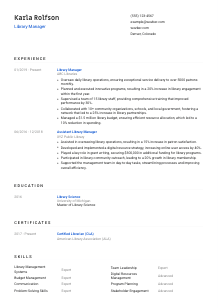
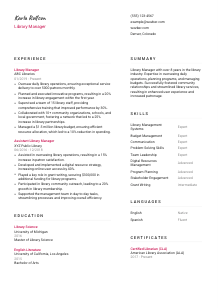
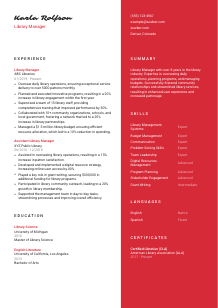
Presiding over books, but your resume chapter seems overdue? Leaf through this Library Manager resume example, created with Wozber free resume builder. Learn how to organize your library leadership to match job criteria, helping your career story check out and never be marked as "lost."
Library Manager hiring usually turns on a practical question: can you run a public-facing service smoothly while improving how the library serves its community. That means your resume needs to show more than a love of books. It should make your operational control, staff leadership, program development, and stewardship of resources visible through real examples from library work.
Hiring teams often scan first for proof that you can handle the mix of service delivery, supervision, and administrative oversight the role requires. Using Wozber's free resume builder helps you shape that experience into an ATS-compliant resume with the right library terminology and structure, so the reader can quickly see whether you have managed staff, budgets, systems, and patron-facing services at the level the job demands.
For a Library Manager, the header should do one job well: confirm who you are, what role you are targeting, and whether basic hiring requirements are covered. Keep it clean and professional so the hiring team can move straight to your library leadership background.
Use your full name in the largest text on the page so it is easy to spot during a quick review. Library leadership roles often involve community visibility and internal credibility, so present your name the same way you would in official communications, staff directories, or public program materials.
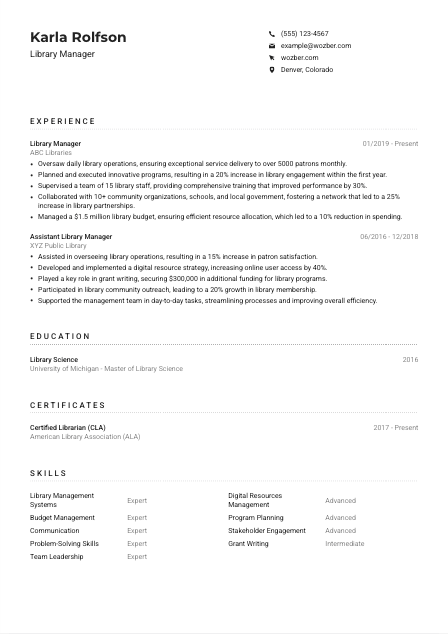
Place "Library Manager" directly beneath your name if that is the role you are pursuing. Matching the posted title helps position you correctly in ATS searches and avoids confusion with adjacent roles such as Branch Librarian, Assistant Library Manager, or Director. In the example, using the exact title immediately aligns the resume with the opening.
Include a current phone number, professional email address, and, if relevant, a website or LinkedIn profile that reflects your library career. Check every detail carefully. A missed digit or outdated profile can interrupt follow-up for interviews, especially when employers are moving quickly through shortlisted candidates.
If a job specifies that you must live in a certain city or be willing to relocate, include that clearly in your header. Here, Denver, Colorado matters because location is part of eligibility for the role. Stating it directly removes a common screening question early.
Link to a polished LinkedIn profile or professional site only if it reinforces your experience with library operations, programs, partnerships, or professional associations. If that profile includes the same leadership history, certifications, and measurable results as your resume, it adds useful depth.
This section should answer logistical questions fast and leave no doubt about the role you want. Once those basics are clear, your resume can focus on the library management work that matters most.




This is where Library Manager resumes are usually won or lost. Hiring teams look for a record of overseeing daily operations, leading staff, improving patron experience, working with community partners, and managing budgets or resources without losing sight of service quality.
Before you edit anything, mark the operational themes in the job description. For this role, that includes daily service delivery, staff supervision, training, programs, community partnerships, budget management, digital resources, and problem-solving. Your experience bullets should answer those priorities directly instead of describing library work in broad terms.
List your most recent library position first, then work backward. For each role, include title, organization, and dates. This format helps the reader track your progression from support or assistant management work into full leadership responsibility, which matters when the posting asks for 5+ years in a library setting and at least 2 years in management.
Each bullet should show what you owned and what changed because of your work. Focus on outcomes tied to library performance: patron volume, circulation or engagement growth, staff development, program participation, partnership expansion, process improvements, or budget control. The sample resume does this well by showing monthly patron service volume, staff team size, and partnership growth instead of stopping at generic management duties.
Quantify results whenever the measure is meaningful. Percent growth in engagement, patron satisfaction, additional grant funding, team size, budget size, training impact, or spending reductions all help hiring teams understand scale. A bullet such as managing a $1.5 million budget or increasing digital resource access by 40% gives far more hiring value than saying you were "responsible for budgeting" or "supported digital services."
Prioritize experience that connects to management, public service operations, staff supervision, resource planning, outreach, and library systems. If you have older or less relevant roles, trim them back so the section stays centered on the work that qualifies you to lead a library team and improve patron experience.
A strong experience section makes it easy to see how you have run services, developed people, and managed resources in a library setting. When those points are specific and measurable, your readiness for the role is much easier to judge.
For many Library Manager roles, education is a formal checkpoint, not a background detail. When a posting requires a Master of Library Science from an ALA-accredited institution, your education section needs to present that credential clearly and without delay.
Put the most relevant degree first, especially when the job has a non-negotiable educational requirement. In this case, a Master of Library Science should appear before undergraduate study because it is one of the first qualifications the hiring team will look for.
List school, degree, field of study, and graduation year. Keep the formatting simple so the credential is easy to scan in both ATS and human review. For library leadership roles, clarity matters more than decorative detail.
If your degree meets the listed requirement, reflect that clearly in the wording. Here, "Master of Library Science" aligns directly with the posting. If the institution is ALA-accredited and that detail strengthens your application, make sure it is visible elsewhere if your resume format allows.
Most experienced Library Managers do not need to list coursework, but it can be useful if you are earlier in your career or want to reinforce strengths in areas like information management, digital services, archives, youth services, or public administration. Include these only when they support the target role.
Honors, leadership activities, or relevant academic projects can stay if they reinforce long-term commitment to library science or management. If you already have substantial supervisory and operational experience, keep the focus on the degrees themselves and let your work history carry more weight.
When education is a stated requirement, do not make the reader search for it. A clearly presented MLS or equivalent library science degree clears an important screening step and supports the rest of your management story.
Certifications are usually not the main deciding factor for a Library Manager, but they can strengthen your profile when they support leadership, professional standards, or specialized library expertise. Keep this section relevant and current.
Review the posting for any required or preferred certifications, then list the ones that genuinely add value to your candidacy. This role does not name a required credential, but a certification such as Certified Librarian can still reinforce your professional standing in the field.
Choose certifications connected to library science, public service, leadership, digital resource management, archives, or related professional practice. Avoid filling the section with unrelated training that does not help explain your ability to run operations, supervise staff, or improve service delivery.
If a certification is active, renewed, or time-bound, show the relevant date range. This is especially useful when the credential reflects current standards or continuing professional engagement. The sample's active certification format works well because it shows the credential is still current.
Libraries continue to evolve through digital lending, online databases, programming models, accessibility expectations, and community partnerships. Updated certifications or continuing education can show that your management approach keeps pace with those shifts, especially if your recent work includes digital services or staff training.
This section works best when it adds another layer of credibility to your library management background. A focused, current credential list supports your leadership profile without distracting from experience and education.
A Library Manager skills section should reflect the real mix of operational, technical, and people-facing work the job involves. That usually means balancing systems knowledge with budgeting, team leadership, communication, public service judgment, and community engagement.
Pull skills directly from the job description first, then add closely related terms you can back up in your experience. For this opening, that includes library management systems, digital resources, communication, organization, problem-solving, grant writing, budget management, and supervisory ability.
Library management is not only about patron service or only about administration. Show both sides. Pair operational tools and systems, such as library management systems or digital resource platforms, with leadership capabilities like team training, stakeholder engagement, budgeting, and program planning. The example resume balances these categories effectively.
Keep the section tight and targeted. A shorter list of well-matched skills is more persuasive than a long inventory of vague strengths. Include the capabilities most likely to matter in hiring decisions for library leadership, then make sure your experience section proves them through real outcomes.
Your skill list should read like the profile of someone who can run services, lead staff, and manage library resources with confidence. When the wording matches the posting and the claims are supported elsewhere, the section does its job well.
Language ability matters differently across library roles, but for management positions it often supports public communication, community outreach, and service accessibility. Present languages in a way that reflects actual proficiency and the needs of the position.
If the posting specifies a language requirement, place it first and state your level clearly. Here, strong English communication is required, so English should appear prominently with an accurate proficiency label.
Extra languages can be valuable when libraries serve multilingual communities, support outreach programs, or work closely with schools and local organizations. In the example, Spanish adds practical relevance because it can support broader patron communication, though it should be presented as an asset rather than a universal requirement.
Only include languages you can actually use in patron interactions, presentations, staff communication, or community engagement. A short, honest list is far more helpful than inflated claims that may not hold up in an interview or public-facing role.
Terms such as "Native," "Fluent," "Professional," or "Conversational" work well when they reflect your real ability. This gives hiring teams a practical sense of how you could use that language in meetings, outreach events, or patron service situations.
For some Library Manager roles, multilingual ability can support inclusive programming, stronger school or community partnerships, and better service for diverse patron groups. If that is true in your background, let the rest of your resume show where those language skills had practical value.
List languages when they help explain how you communicate with patrons, staff, or community partners. For a library leadership role, that context matters more than the number of languages on the page.
The summary sits at the top of the resume, so it needs to establish quickly what kind of Library Manager you are. Focus on scope, strengths, and outcomes that connect directly to the role instead of writing a broad statement about passion or career goals.
Identify the recurring priorities in the posting before you draft the summary. Here, the central themes are library operations, service quality, staff supervision, program development, budgeting, digital resources, and community collaboration. Those should shape what you highlight in the first few lines.
Start with your title and years of relevant experience so the reader immediately understands your level. A line such as "Library Manager with 8+ years in public library operations" gives stronger direction than a generic statement about being a dedicated professional.
Choose two or three strengths that match the posting and connect them to outcomes when possible. The sample summary works because it mentions operations, programs, budgets, community relationships, and service improvements rather than relying on soft claims alone. If you can point to engagement growth, stronger patron access, or improved staff performance, include that concisely.
Aim for a short paragraph that can be read in a few seconds. Avoid repeating every requirement from the job description. Give the hiring team enough information to place you as a credible library leader, then let the experience section provide the detail.
A well-written summary tells the reader what to look for in the rest of your resume: leadership in library operations, sound resource management, and measurable service impact. That is the right frame for a Library Manager application.
Once each section is tailored, your resume should make one thing clear: you can lead library operations, develop staff, manage resources responsibly, and strengthen community engagement. That is what hiring teams need to see when they review a Library Manager application.
Wozber's free resume builder can help you organize that experience in an ATS-friendly resume template, and its ATS resume scanner can highlight where your wording is missing key requirements from the posting. Use those tools to sharpen alignment, keep the structure clean, and submit a resume that shows real readiness for library management work.