



Use Wozber and land your dream job
Create Resume
No registration required
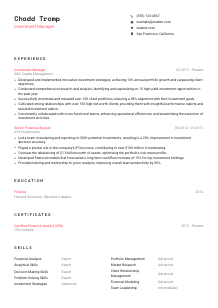
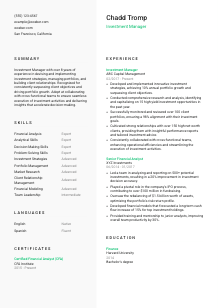
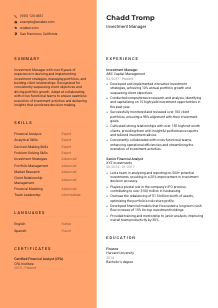
Juggling stocks, but your resume doesn't seem as lucrative? Check out this Investment Manager resume example, created with Wozber free resume builder. It shows how to align your asset management acumen with job specs, positioning your career portfolio for a growth trajectory!
Investment managers are hired on judgment. The resume has to show how you turn research, market movement, and client objectives into portfolio decisions that hold up over time. Generic finance language falls flat here. Hiring teams want to see what you managed, how you analyzed opportunities, how you handled risk, and what results followed.
A tailored resume changes the first read from "finance background" to "can run portfolios and advise clients." Using Wozber's free resume builder helps you shape an ATS-compliant resume around the exact language of the role, from investment strategy and portfolio monitoring to client reporting and cross-functional execution, so your experience reads clearly for both the ATS and the people deciding whether you can manage capital with confidence.
For an Investment Manager, the header should do one thing well: establish that you are easy to contact and already aligned with the practical basics of the role. Leave out anything that distracts. Keep what confirms your professional identity and any requirement the employer needs to see immediately.
Use your full name in a clean, prominent format so it is easy to find at a glance. In finance and investment roles, presentation matters. A straightforward header signals professionalism and attention to detail before the reader reaches your portfolio results.
Place "Investment Manager" directly below your name when that is the role you are pursuing. This is especially useful when your recent background includes adjacent titles such as Senior Financial Analyst, Portfolio Analyst, or Asset Management Associate. It helps the hiring team place you in the right lane immediately.
Include a reliable phone number and a professional email address, ideally in a simple format based on your name. If you add a website or LinkedIn profile, make sure it supports your candidacy with relevant information such as investment experience, market commentary, or career progression, not outdated or inconsistent details.
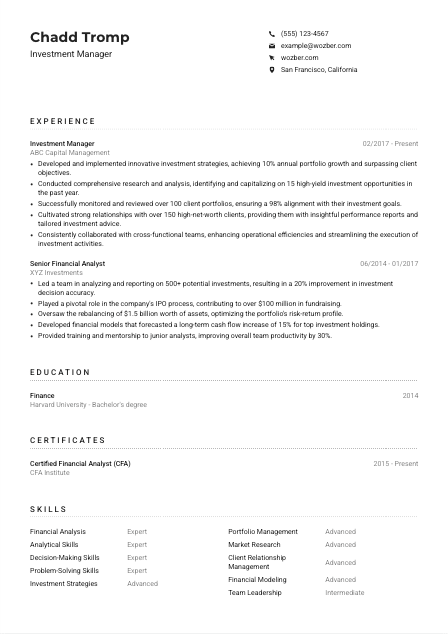
Some investment roles have location requirements tied to office presence, client coverage, or licensing logistics. Here, the San Francisco, California requirement should appear clearly in your personal details if it applies to you. The sample resume handles this well by listing the city and state directly, removing a practical objection early.
A link earns space when it gives the employer more context on your background. For this field, that could be a polished LinkedIn profile with accurate titles, firms, and credentials. Skip social profiles or personal sites that do not support your investment, client advisory, or market analysis experience.
Your header should confirm the basics quickly: who you are, what role you target, how to reach you, and whether a location requirement is already met. That clean start keeps attention on your investment record, not on missing logistics.




This section carries the most weight. Investment management hiring is heavily influenced by the quality of your decision-making, the scale of portfolios or opportunities you handled, and the business outcomes tied to your calls. Your bullets should read like a track record, not a job description.
Before writing bullets, isolate the core work the employer needs done. In this case, that includes building investment strategies, researching opportunities, monitoring portfolios, advising clients, and working with legal, operations, and sales. Your experience should mirror those functions using the same language where it reflects your real work.
List your positions from most recent to oldest, including title, employer, and dates. This format makes it easy to follow your progression from analytical work into portfolio ownership, client responsibility, or broader investment oversight. If your path moved from analyst to manager, that progression itself supports your candidacy.
Each bullet should show what you did, what you influenced, and what happened as a result. For an Investment Manager, that usually means strategy decisions, research depth, asset allocation changes, risk-adjusted returns, client retention, or reporting quality. The sample resume gets this right with bullets like "achieving 10% annual portfolio growth" and "ensuring a 98% alignment" across client portfolios, both of which connect activity to outcome.
Numbers matter in this field because they show judgment under real constraints. Include metrics such as annual growth, assets under management, number of portfolios reviewed, investment opportunities sourced, fundraising supported, or improvements in decision accuracy. The example's references to 100+ portfolios, 15 high-yield opportunities, and $1.5 billion in rebalanced assets show the kind of scale that hiring teams remember.
Prioritize accomplishments that reinforce investment strategy, market analysis, portfolio oversight, client communication, and cross-functional execution. If a bullet could belong to almost any finance role, sharpen it or remove it. Strong Investment Manager resumes stay focused on capital allocation, performance, risk, and client outcomes.
The strongest bullets make your judgment visible. When your experience shows what you analyzed, what you managed, who you advised, and what results you produced, hiring teams can picture you handling portfolios rather than just supporting them.
Education matters in investment management because it helps frame your analytical foundation. This section does not need decoration. It needs to confirm that you have the academic grounding expected for portfolio analysis, financial modeling, and investment decision-making.
If the posting calls for a bachelor's degree in finance, business, economics, or a related field, list that clearly and exactly. A finance degree is a direct match here, as shown in the example resume, and it immediately supports your credibility for investment analysis and portfolio work.
Include degree, field of study, school, and graduation year or date. Hiring teams usually want to confirm qualifications quickly, not read a long academic profile. Clean structure helps this section do its job without slowing down the review.
If your degree is in a related field rather than finance itself, make the connection obvious through the field name or relevant coursework when useful. Economics, business, accounting, or quantitative programs can all support an Investment Manager profile when the rest of the resume shows applied investment work.
Honors, investment competitions, or finance-focused extracurriculars can help if you are earlier in your career or if the achievement is genuinely notable. For experienced candidates, those details are secondary to portfolio, research, and client results, so include them selectively.
Investment management rewards professionals who keep building their technical and market knowledge. If you have relevant continuing education, advanced coursework, or related credentials, include them where they fit naturally. In many cases, the more important proof of continued development will sit in the certifications section, especially with credentials such as the CFA.
This section should confirm the academic base behind your investment work without competing with your experience. Make the degree match easy to see, then let your track record carry the heavier argument.
Certifications are especially important in investment roles because they signal technical depth and professional commitment. When a credential is explicitly required, the resume should make it impossible to miss.
List the certifications most relevant to the target role first. For this posting, the active CFA designation belongs at the top of the section and should be written clearly, including the full name and abbreviation if useful.
This section works best when it stays focused. A small set of high-value certifications in portfolio management, securities analysis, risk, or advisory work carries more weight than a long list of loosely related training courses.
Dates help the employer understand whether a credential is active, recent, or long held. That matters for designations tied to continuing standards or current membership status. The example resume handles this well by showing the CFA as active from 2015 to present.
Markets, products, and regulation change constantly. If you hold additional current certifications or have completed recent advanced training in portfolio construction, risk management, or financial software, include them to show that your knowledge is current, not static.
For investment management roles, certifications often act as a credibility filter early in the review. Put the strongest and most relevant ones where they are easy to find, especially when the employer names a required designation.
A skills section should reflect how you actually operate as an Investment Manager. That means a mix of analytical, portfolio, client, and execution capabilities, not a grab bag of generic finance terms.
Start with the capabilities the posting emphasizes. Here, that includes financial analysis, investment strategy, research, portfolio monitoring, decision-making, problem-solving, and proficiency with investment software and financial tools. Those are the right anchors for your skills section.
If the job description uses phrases such as "investment strategies," "portfolio performance," or "assessing risk factors," use those terms when they match your background. This improves ATS alignment and also makes your profile read as directly relevant rather than broadly financial.
Do not overload this section with every platform, trait, or general business skill you have used. Choose the skills most connected to asset evaluation, portfolio decisions, client reporting, and cross-functional coordination. In the sample resume, skills such as Financial Analysis, Portfolio Management, Market Research, and Client Relationship Management form a much stronger set than a long list of vague competencies would.
Your skills section should reinforce the same picture your experience creates: someone who can analyze opportunities, manage portfolios, advise clients, and execute decisions well. If a skill does not strengthen that picture, leave it out.
Language skills matter most when they affect communication with clients, stakeholders, or cross-border markets. For an Investment Manager, fluency is less about filling space and more about showing you can communicate clearly in the environments the role requires.
If English proficiency is required, list English clearly with an honest proficiency level. This role specifically asks for proficient English speaking skills, so that should be visible without the reader having to infer it elsewhere on the resume.
Place the most important working language first, then any additional languages that support the role. If your client base, market coverage, or internal coordination spans multiple regions, extra language capability can strengthen your profile.
Secondary languages can help in investor relations, regional market coverage, or relationship management with international clients. In the example resume, Spanish is a useful addition because it broadens potential client communication without distracting from the required English proficiency.
Terms such as Native, Fluent, Intermediate, and Basic are easy to understand and more useful than vague descriptions. Accurate labels matter because client-facing roles depend on reliable communication, especially in reporting, advisory conversations, and stakeholder coordination.
Some Investment Manager positions are domestic and only need strong English communication. Others involve international clients, emerging markets, or multilingual investor groups. Include languages based on actual relevance to the work, not simply to make the section look fuller.
For this field, language proficiency matters when it improves communication with clients, colleagues, or markets you cover. Lead with the required language, then add others that genuinely support your investment or advisory scope.
The summary is your opening case for why you belong in front-office investment work. It should quickly establish your level of experience, the kind of investment responsibilities you have handled, and the results or strengths that make you credible for the role.
Review the posting and identify the few elements that define success in the role. For this one, that means investment strategy, market analysis, portfolio monitoring, client reporting, and coordination with internal partners. Your summary should reflect that operating scope in a compact form.
Begin with your title or specialization and your years of relevant experience. "Investment Manager with 8+ years of experience" gives the reader immediate context. If your background is slightly adjacent, clarify the area, such as portfolio management, equity research, or multi-asset strategy.
Use a few carefully chosen wins to give the summary substance. Metrics such as portfolio growth, number of portfolios managed, assets rebalanced, or investment opportunities sourced work well here. The sample summary is effective because it combines strategy, portfolio management, client relationships, and measurable outperformance in a few lines.
Aim for a short paragraph that sounds grounded in real investment work. Avoid broad claims about being results-driven or passionate unless you immediately support them with portfolio, research, or client evidence. The summary should create a clear expectation that the experience section will back up.
A well-written summary tells the reader, within a few seconds, what level of capital, analysis, and client responsibility you are used to handling. That clarity sets up the rest of the resume to read as a proven investment track record.
An effective Investment Manager resume makes your decision-making visible across every section. The header confirms practical fit, the experience section shows strategy and results, the credentials establish technical credibility, and the summary ties it all together around portfolio performance, client advisory work, and risk-aware execution.
Use Wozber's free resume builder to turn that story into an ATS-friendly resume format, refine wording with role-specific terminology, and check alignment with an ATS resume scanner before you apply. When the document is tailored well, hiring teams can quickly see whether you are ready to manage portfolios, advise clients, and execute investment decisions with confidence.




