



Use Wozber and land your dream job
Create Resume
No registration required
Steering business ships, but your resume seems adrift? Chart your course with this Business Manager resume example, created with Wozber free resume builder. Learn how to match your managerial strengths to job prerequisites, setting your career sail smoothly toward success!
Business Managers are often hired to steady operations, sharpen financial decisions, and keep teams moving toward commercial goals at the same time. That mix of operational control, budget ownership, and cross-functional leadership should come through quickly on your resume, because generic management language rarely shows whether you can actually run the business side of an organization.
A tailored resume helps separate broad management experience from business management experience by making your operating scope, financial impact, and planning responsibilities easy to find in both human review and ATS screening. Wozber's free resume builder supports that process by helping you align language with the posting, maintain an ATS-friendly resume format, and surface the work that shows you can lead execution, budgets, and stakeholder relationships with confidence.
This section is simple, but it still shapes the first read. For a Business Manager, contact details should immediately present you as accessible, professional, and logistically aligned with the role, especially when the employer has stated a location or communication requirement.
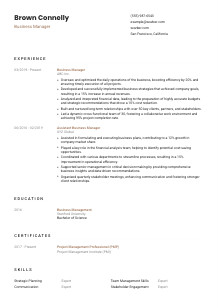
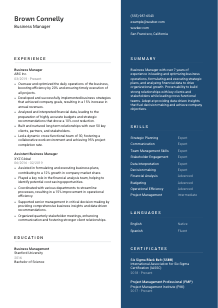
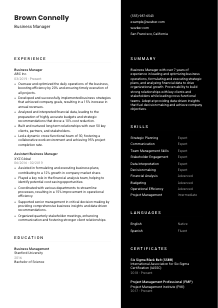
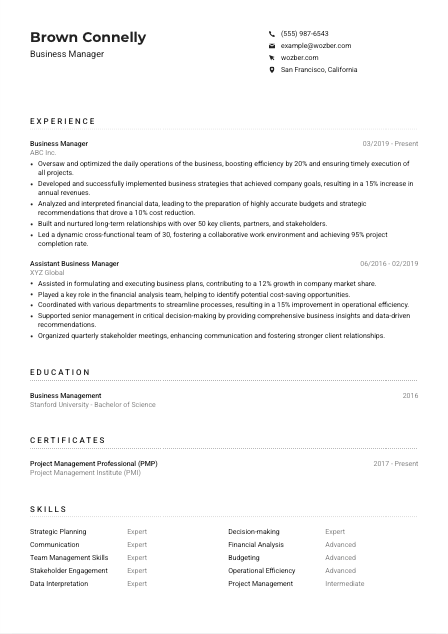
Use your full name as the main heading in a clean, readable format. It should stand out without styling tricks, because this is the identifier attached to your track record in operations, budgeting, and team leadership. In the example, "Brown Connelly" is presented clearly and professionally, which is exactly what you want.
Place "Business Manager" directly below your name if that is the role you are pursuing. This helps frame the rest of the resume around business operations, financial oversight, and strategic execution instead of leaving the reader to guess whether your background is closer to general administration, project coordination, or sales leadership.
Include a reliable phone number and a professional email address that you check regularly. Business Manager hiring often moves through multiple interview stages with HR, senior leadership, and cross-functional stakeholders, so your contact details should support quick scheduling and straightforward communication.
If the posting requires you to be in a specific market, state your city and state clearly. Here, "San Francisco, California" directly answers a listed requirement and removes an early question about availability or relocation. Use this approach when geography is relevant, not as a default rule for every application.
A LinkedIn profile or professional website can help if it reinforces your executive presence, business scope, or career progression. Make sure it matches your resume titles, dates, and accomplishments, especially if it includes leadership responsibilities, board-facing work, or measurable business results.
Keep the personal details section clean and practical. For Business Manager roles, it should confirm who you are, how to reach you, and whether you meet any location or communication basics without slowing down the review.




This is where hiring teams look for operational scope, financial judgment, and leadership range. A Business Manager resume should show how you improved execution, managed budgets, influenced strategy, and coordinated people, not just that you held a management title.
Start by identifying the responsibilities that define the role. In this job description, that includes daily operations, strategic planning, financial analysis, budgeting, stakeholder relationships, and cross-functional team leadership. Those themes should shape which bullets you keep, rewrite, or move higher in each role so the most relevant business outcomes appear first.
List roles in reverse chronological order and make the increase in scope visible. Titles, company names, and dates should be easy to scan, but the real value is in showing progression from support work into ownership of operations, planning, and team performance. The move from Assistant Business Manager to Business Manager in the example does this well.
Choose accomplishments that connect your work to efficiency, revenue, cost control, project delivery, or stakeholder growth. For Business Managers, results such as improving operational efficiency, lifting annual revenue, reducing costs, or raising project completion rates are much more persuasive than broad statements about being responsible for day-to-day management. The sample bullets show this with gains like 20% efficiency improvement and 15% revenue growth.
Numbers give context to management work. Include team size, budget scope, client portfolio size, percentage improvements, savings, growth, or delivery rates wherever you can support them. "Led a cross-functional team of 30" and "built relationships with over 50 key clients" tell the reader far more about business scope than a generic claim about leadership or communication skills.
Use space for work that supports a Business Manager brief. Prioritize operational oversight, financial reporting, strategic recommendations, process improvement, and stakeholder management. Trim bullets that focus on unrelated tasks or low-level administration unless they show a direct contribution to business decisions, cost savings, or team execution.
Your experience section should make it easy to understand the size of the business problems you handled and the results you delivered. When the bullets show operational control, financial discipline, and leadership outcomes, your fit for a Business Manager role becomes much easier to judge.
For Business Manager roles, education usually serves as a baseline qualification rather than the main selling point. It should still be presented clearly, especially when the employer asks for a degree tied to business, finance, or a related field.
If the posting asks for a Bachelor's degree in Business Management, Finance, or a related discipline, list your degree in the same clear terms. In the example, a Bachelor of Science in Business Management directly satisfies the requirement and supports the business-focused nature of the candidate's background.
Include the degree, field of study, institution, and graduation year. Business hiring teams are usually scanning quickly for qualification alignment, so avoid clutter and make the academic basics easy to confirm in one line or two.
Use the official degree and field names rather than loose paraphrases. Accurate wording matters when employers are screening for business, finance, or management education, and it also helps ATS systems recognize the qualification correctly.
Most experienced Business Managers do not need course lists. Add them only if they reinforce a requirement that is central to the role, such as financial analysis, operations management, corporate strategy, or organizational leadership, and only if your work history does not already make that expertise clear.
Honors, leadership roles, or relevant extracurriculars can help if you are earlier in your management career or if they connect directly to business planning, finance, analytics, or team leadership. Once you have several years of business results, keep this section concise and let your experience carry more weight.
Your education section should confirm that you meet the academic foundation for the role without distracting from your management record. Clear degree alignment is usually enough, especially when your experience already shows strategic, financial, and operational responsibility.
Certifications can strengthen a Business Manager resume when they support how the role is performed. They are especially useful when the job values process improvement, project delivery discipline, or structured decision-making beyond general management experience.
When a posting mentions PMP or Six Sigma, list those certifications clearly and use their full names if space allows. In this example, both Project Management Professional and Six Sigma Black Belt directly support the employer's preference and reinforce strengths in execution, process control, and continuous improvement.
Choose credentials that support budgeting, operations, project delivery, quality improvement, or leadership. A shorter list of relevant certifications is more effective than a long list of unrelated training courses, especially for management roles where each credential should connect to business performance.
Add the issuer and the date or active period so the certification is easy to validate. That extra detail matters for well-known credentials like PMP or Six Sigma, and it shows whether the qualification is current enough to support present-day business operations and project governance.
Business environments change quickly, especially around reporting, process improvement, and execution frameworks. If you have recent training in areas like financial modeling, operations improvement, project governance, or change management, include it when it strengthens your case for the target role.
Certifications should reinforce the way you manage business performance, not just decorate the page. When they line up with operational efficiency, structured delivery, and business planning, they add useful depth to your leadership profile.
The skills section should reflect the mix of commercial judgment and people leadership the job requires. For Business Manager roles, that usually means finance, planning, operational improvement, stakeholder management, and the ability to lead teams through execution.
Start with the language used in the posting. Here, financial analysis, budgeting, strategic planning, interpersonal communication, and team management are all explicit priorities. Those belong near the top if they reflect your actual experience, because they map directly to the day-to-day work of the role.
Select skills that support business decisions and execution, not just broad managerial traits. Strategic Planning, Financial Analysis, Budgeting, Stakeholder Engagement, and Team Management are all stronger choices than vague labels like "hardworking" or "results-driven." The example skills list does this well by balancing analytical and leadership capabilities.
Put the most important and best-supported skills first. If your experience bullets show budget recommendations, cost reductions, and operational improvements, then finance and strategy skills deserve top billing. If you manage cross-functional delivery and client relationships, make sure those capabilities are also visible. The list should reflect the work you can prove elsewhere on the resume.
A focused skills section helps the reader quickly connect your background to the actual demands of business management. Keep it centered on the tools, judgment, and leadership abilities that show up in your experience, not on generic descriptors.
Language ability matters in business management when the role involves client relationships, partner communication, or coordination across teams and markets. Even when only one language is required, this section can still reinforce your communication range.
If the job specifies English, list it clearly with an honest proficiency level. That is a core requirement in this posting, so it should appear first. If you speak additional languages that could support client-facing work or multicultural teams, include them after the required language.
Order languages based on their likely value to the role. For many Business Manager positions, English will come first, while a second language can add value in client development, vendor coordination, or regional operations. In the example, Spanish broadens the candidate's communication range without distracting from the required English proficiency.
Terms like "Native," "Fluent," or "Professional Working Proficiency" are easier to interpret than vague claims. Business Managers are often expected to present, negotiate, and communicate across functions, so precision here matters.
Do not overstate language skills if they are not central to your candidacy. Include them when they support the role's communication demands, but keep the focus on the level you can actually use in meetings, reporting, client communication, or cross-border collaboration.
List languages as a practical business asset, not as filler. When they support stakeholder communication or broaden your usefulness across teams and markets, they strengthen the profile in a meaningful way.
The summary needs to establish your management scope fast. For a Business Manager, that usually means showing experience in operations, financial oversight, strategic planning, and team leadership within the first few lines.
Use the posting to decide which themes belong in your opening. In this case, the most important ones are operational oversight, strategic planning, financial analysis, budgeting, stakeholder management, and cross-functional leadership. Your summary should echo those priorities in natural language rather than repeating the job ad word for word.
Start with your title or functional identity, followed by years of experience and core scope. "Business Manager with over 7 years of experience" works because it immediately establishes seniority and relevance. Add the business areas you oversee, such as operations, strategy, finance, or team leadership, so the reader understands your lane right away.
Choose two or three strengths that define your value in business management. Good options include optimizing operations, analyzing financial data, driving organizational growth, leading cross-functional teams, or building durable stakeholder relationships. The example summary succeeds because it ties business analysis and relationship management to measurable organizational outcomes.
Aim for a short paragraph that can be absorbed in seconds. Business Manager hiring often involves fast initial screening, so your summary should quickly answer whether you can run operations, interpret numbers, and support strategic decisions. Cut filler, broad career objectives, and soft claims that are not backed up later in the resume.
Your summary should quickly position you as someone who can manage business performance, not just supervise activity. When it highlights operational leadership, financial judgment, and strategic contribution, it sets up the rest of the resume well.
A Business Manager resume works best when every section points back to the same core strengths: operational control, financial insight, strategic planning, and leadership across teams and stakeholders. When those themes are supported by clear metrics, relevant credentials, and role-specific language, the document reads like a business case for your hire.
Use Wozber's AI resume builder to tighten that alignment, improve ATS optimization, and present your experience in an ATS-compliant resume that keeps the focus on business outcomes. The final version should make it easy to see that you can lead operations, guide decisions, and deliver measurable results from day one.




