



Use Wozber and land your dream job
Create Resume
No registration required
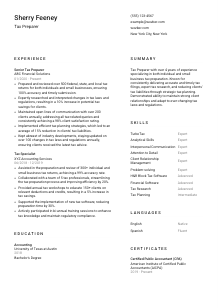
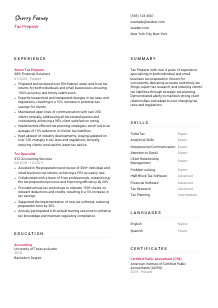
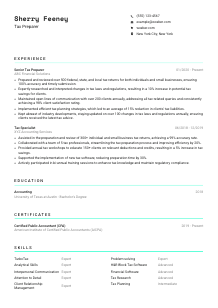
Calculating exemptions, but your resume doesn't quite tally? Check out this Tax Preparer resume example, created with Wozber free resume builder. Learn how to present your financial expertise to match job requirements, ensuring your career adds up to be as rewarding as those well-balanced accounts!
Tax preparation work gets judged quickly by the quality of the details. Hiring teams want to see whether you can handle return volume, interpret changing tax rules, and communicate clearly with clients who need accurate filings for individuals or small businesses. Your resume should make that visible early, especially through the kinds of returns you prepare, the compliance work you manage, and the tax planning results you produce.
A tailored resume changes how your background is read in screening because it brings tax-specific language to the surface instead of burying it under generic accounting wording. Using Wozber's free resume builder helps you shape an ATS-compliant resume around the exact filing, research, software, and client-service terms used in the posting, so the hiring team can quickly recognize your ability to prepare accurate returns and advise clients with confidence.
For Tax Preparers, the top of the resume should feel orderly and dependable. This section is simple, but it still carries practical screening value because employers need a clear contact path and, in some cases, confirmation that you meet a location requirement before they review your tax experience in depth.
Use your full name in a larger, clean font so it stands out immediately. In accounting and tax hiring, presentation matters more than people admit. A tidy header sets the tone for the precision expected in return preparation, client documentation, and compliance work.
Use the job title "Tax Preparer" beneath your name if that is the role you are pursuing. This keeps your positioning clear and avoids making your background look broader but less relevant, especially if your past titles include variations such as Tax Specialist or Senior Tax Preparer.
List a reliable phone number and a professional email address that you check often during hiring season. If an employer wants to move quickly on candidates with filing experience, clear contact details prevent unnecessary delays and help you look organized from the start.
If a job requires local availability, show your city and state plainly. Here, New York City, New York is a stated requirement, so including it removes a basic point of uncertainty. Treat that as targeted tailoring for this opening, not something every Tax Preparer resume needs to emphasize.
A LinkedIn profile or professional website can help if it reinforces your tax background with matching job history, credentials, or client-facing expertise. Before adding it, check that the information aligns with your resume and does not create inconsistencies in dates, titles, or certifications.
Your header should tell the employer who you are, how to reach you, and whether you meet any immediate logistical requirement. Keep it clean and accurate, just like the financial work you want them to trust you with.




Tax preparation resumes rise or fall on the experience section. Employers are looking for proof that you have handled real filing work, worked with clients directly, and stayed accurate while dealing with deadlines, changing regulations, and the practical differences between individual and small business returns.
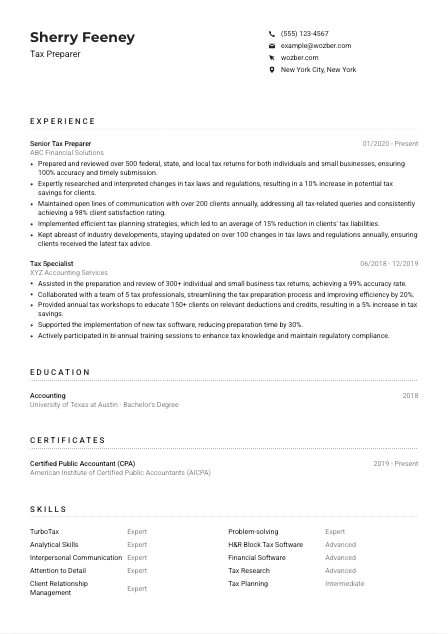
Start by matching your experience bullets to the responsibilities in the job description. For a Tax Preparer, that usually means federal, state, and local return preparation, tax research, client communication, quarterly filings, and tax planning. One strong example from the sample resume is "Prepared and reviewed over 500 federal, state, and local tax returns," which mirrors the role's core responsibility with the right scope and language.
List roles in reverse chronological order with your title, employer, and dates clearly shown. That structure helps hiring managers quickly trace your progression from support-level tax work to higher-volume review, planning, or client advisory responsibilities. If your titles changed over time, let that progression show.
Generic duties are not enough in tax hiring. Show what you improved, protected, or delivered. Useful bullets mention filing accuracy, turnaround time, tax savings, compliance quality, client retention, or process efficiency. In the example, client satisfaction, liability reduction, and software-driven time savings all do real work because they show both technical execution and service value.
Numbers help employers understand your pace and scope. Include return volume, client load, accuracy rate, tax savings, time reduction, or the number of law changes tracked during a filing cycle when those numbers are real. Metrics like 500 returns, 200 clients annually, or a 30% reduction in preparation time tell far more than vague claims about being efficient or detail-oriented.
Prioritize experience that supports this kind of work directly. If you have broader accounting or finance experience, keep the bullets that connect to tax compliance, tax software, documentation review, client advisory work, or regulatory research. Leave out general office or bookkeeping tasks unless they clearly strengthen your case for handling returns accurately and on deadline.
By the end of this section, the reader should know what kinds of returns you handle, how much responsibility you carry, and what results you produce for clients or the firm. That is the clearest proof that you can step into another tax season and contribute quickly.
Education matters in Tax Preparer hiring because it establishes your grounding in accounting, finance, and reporting principles. It will not outweigh weak experience, but it does confirm that you have the technical base for return preparation, tax research, and working through financial records accurately.
If the job asks for a Bachelor's degree in Accounting, Finance, or a related field, make that easy to spot. In this example, a Bachelor's Degree in Accounting aligns directly with the requirement. When your degree is related but not identical, use the exact field name and let your experience do the rest.
List the institution, degree, field of study, and graduation year in a clean order. Tax hiring rarely depends on elaborate education descriptions. Recruiters and hiring managers usually want to confirm qualification quickly and move on to your return preparation history, software use, and client-facing work.
Naming the field matters because "Accounting" or "Finance" connects more directly to the posting than a generic degree label alone. That extra specificity helps with ATS matching and gives context for your knowledge of taxation, financial statements, and compliance basics.
If you are early in your career, coursework in taxation, auditing, business law, or financial accounting can help bridge limited professional experience. Once you have solid tax employment history, those details become optional unless they are unusually relevant to the role or industry served.
Academic awards, high honors, or relevant student projects can add value when they connect to analytical rigor or tax-related study. Keep this brief. For experienced Tax Preparers, a short education entry is usually enough unless an achievement clearly supports your technical credibility.
This section should quickly confirm that you meet the degree requirement and have the academic base for tax work. Then let the rest of the resume show how you have applied that foundation in real filing, research, and client service situations.
Certifications are not mandatory in every Tax Preparer opening, but they can raise your profile when they point to deeper tax knowledge, regulatory discipline, or professional standing. They are especially useful when the role involves review work, planning conversations, or clients who expect a high level of trust.
Start with certifications that support tax preparation, compliance, or accounting authority. This job description does not require a specific credential, but a CPA, as shown in the example, immediately adds weight because it suggests stronger technical grounding and professional commitment. Use that as an illustration, not a rule for every position.
A short, relevant certification section works better than a long list of loosely related courses. Focus on credentials that support return accuracy, tax advisory work, or regulated financial practice. If a certificate does not help explain your value for tax preparation, leave it out.
Add the issue date, active period, or expiration details when that information shows the credential is current. In tax and accounting, current standing matters because laws, filing rules, and continuing education expectations change regularly.
Tax work changes every year, and your certification section should reflect that same professional upkeep. Renewed licenses, active memberships, or newly earned tax credentials show that you stay engaged with the field instead of relying on outdated knowledge.
When relevant, certifications tell employers that your tax knowledge goes beyond day-to-day processing. They can reinforce trust, especially for roles involving review responsibility, planning guidance, or more complex client questions.
The best Tax Preparer skills sections are tightly tied to the work itself. Employers want to see the tools, technical strengths, and client-facing abilities that support accurate filing, tax research, and smooth communication during busy filing periods.
Start with the skills the employer actually named. Here that includes tax software proficiency, numerical and analytical ability, attention to detail, and strong written and verbal communication. When these terms reflect your real background, use them in the same language the posting uses so both ATS screening and human review connect your experience faster.
A Tax Preparer needs more than software familiarity. Include hard skills such as TurboTax, H&R Block Tax Software, tax research, tax planning, quarterly filings, or financial software where appropriate, then balance them with communication, client relationship management, and problem-solving. The sample resume handles this well by pairing software tools with analytical and interpersonal skills.
Do not crowd this section with broad business skills that could belong on any finance resume. Choose the skills that support accurate returns, compliant filings, efficient workflows, and clear client explanations. A shorter list with direct tax relevance is usually stronger than a longer one filled with generic terms.
Your skills section should reinforce what your experience already proves. When the tools and strengths listed here match the filing work, research tasks, and client service described above, the whole resume reads as consistent and credible.
Language ability matters in tax work when it improves client communication, reduces confusion around documentation, and helps you explain deadlines, deductions, or filing requirements clearly. Even when only English is required, how you present language proficiency can still support the client-service side of your profile.
This posting specifically asks for good English communication skills, so English should appear clearly in your language section if you include one. Use an honest proficiency level such as Native or Fluent, especially if your role involves client intake, explaining tax issues, or responding to questions in writing.
If you can work with clients in another language, include it. In tax preparation, that can be useful for community-based practices, small business owners, or family clients who are more comfortable discussing financial documents in a language other than English. Spanish in the example is a practical addition for that reason.
Only claim a level you can use in real tax conversations. If you say you are fluent, you should be able to discuss filing status, deductions, quarterly estimates, or document requests without confusion. Honest labeling protects both your credibility and the client experience.
Not every Tax Preparer role needs multilingual communication, but some client populations make it a real advantage. Include extra languages when they are likely to help with consultations, follow-ups, or explaining tax obligations to a broader range of taxpayers.
This section adds value when it supports how you work with clients. Frame it that way mentally. Languages are useful here because they can make tax meetings smoother, improve trust, and reduce misunderstandings around important filing details.
For a Tax Preparer, language skills matter when they support clear client communication. If they help you explain tax matters more effectively or serve a broader client base, they deserve a place on the page.
The summary is where you frame your background before the reader gets into the details. For Tax Preparers, that means quickly establishing years of experience, types of returns handled, key technical strengths, and any client or tax-planning value that sets your work apart.
Read the posting closely before writing this section. If the role centers on individual and small business returns, tax law research, quarterly filings, and client communication, those themes should shape your summary. This keeps the opening aligned with the job rather than sounding like a generic accounting profile.
Your first line should identify you clearly, such as "Tax Preparer with 4+ years of experience" or another accurate version of your background. The sample summary does this well and immediately positions the candidate within the right part of the finance and tax market.
Use the next lines to highlight what you are known for. Good options include accurate and timely filings, tax research, software proficiency, reducing client liabilities through planning, or managing strong client relationships. Choose the points that best match the target role instead of trying to summarize your entire career.
Aim for three to five lines with dense, relevant detail. This section should feel like a sharp briefing, not a paragraph of general claims. If every sentence points to filing quality, tax knowledge, or client value, the reader will already know what to look for in the rest of your resume.
A focused summary gives hiring teams a quick picture of your return preparation experience, technical strengths, and client-facing value. When this section is tailored well, the rest of the resume lands with much more clarity.
A Tax Preparer resume should leave very little for the reader to guess. It should show the kinds of returns you handle, the software you use, the tax research you perform, and the client results you deliver.
Wozber's free resume builder and ATS resume scanner can help you tighten that alignment, surface missing requirements, and organize your background in an ATS-friendly resume format that reflects the language of the posting.
Once each section points clearly to accurate filings, sound judgment, and reliable client communication, your application is ready for serious review.




