



Use Wozber and land your dream job
Create Resume
No registration required
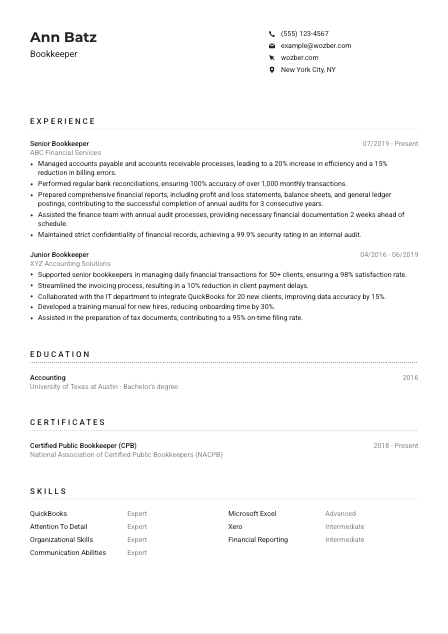
Balancing accounts but your resume just doesn't add up? Check out this Bookkeeper resume example, created with Wozber free resume builder. It shows how to showcase your financial acumen to match the job's ledger of requirements, helping your career equilibrium remain in the black!
Bookkeeping work is trusted with the day-to-day accuracy that keeps a business running. Hiring teams look quickly for signs that you can handle reconciliations, keep accounts payable and receivable moving, catch discrepancies before they grow, and produce clean financial records that support reporting and audits. Your resume needs to make that operational reliability visible from the first section.
A tailored resume also changes how your background is read in an ATS and by finance leaders who need someone productive fast. Wozber's free resume builder helps you align your wording with the posting in an ATS-friendly resume format, so core requirements like bank reconciliations, invoicing, financial reports, and accounting software proficiency surface clearly instead of getting buried under generic accounting experience.
For a Bookkeeper, the header should remove friction immediately. Contact details, title, and location cues help the employer confirm that you are reachable, professionally presented, and available for the role without forcing them to hunt for basics.
Place your full name at the top in a clean, readable format. Bookkeeping is detail-sensitive work, and even your header should reflect order and professionalism rather than decorative styling or crowded formatting.
Add "Bookkeeper" beneath your name when that is the role you are pursuing. Matching the job title helps position you correctly, especially when employers are sorting between bookkeepers, staff accountants, and broader finance support candidates.
List a current phone number and a professional email address. Small errors here create the wrong impression for a role built on precision. If you include a website or LinkedIn profile, make sure the information matches your resume and reflects accounting or finance experience clearly.
If the employer asks for someone based in New York City or open to relocation, note that in your personal details. That is a posting-specific requirement, not a rule for every bookkeeping role, but when it appears, handling it up front prevents unnecessary doubt about availability.
A LinkedIn profile can add credibility if it mirrors your resume with the same dates, titles, software knowledge, and certifications. You do not need a portfolio for most bookkeeping roles, so only include extra links when they support your professional record rather than distract from it.
This section should tell an employer, in seconds, who you are, what role you do, and whether you meet practical requirements such as location and contact readiness. For a Bookkeeper, that kind of clean setup already communicates care with details.




The experience section carries the most weight in bookkeeping hiring. Employers want to see the financial workflows you have handled, the transaction volume or reporting scope you supported, the systems you used, and whether your work improved accuracy, timeliness, or audit readiness.
Before writing bullets, mark the recurring duties in the posting. For this role, that includes accounts payable, accounts receivable, invoicing, collections, bank reconciliations, financial reporting, general ledger work, and audit support. Those responsibilities should shape the wording of your experience bullets so the employer sees direct overlap quickly.
For each position, include your job title, employer, and dates. Reverse-chronological structure works especially well in bookkeeping because it shows the progression of responsibility, from transaction support and data entry to reconciliations, reporting, vendor management, and month-end support.
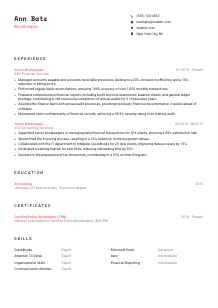
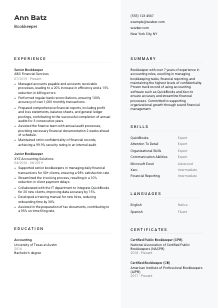
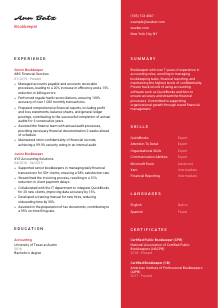
Write bullets around the financial processes you actually owned or supported. Strong examples include managing AP and AR cycles, reconciling bank and credit card accounts, preparing profit and loss statements, posting journal entries, or helping close monthly books. In the sample resume, the strongest bullets mirror the posting closely by highlighting reconciliations, reporting, invoicing, and audit documentation.
Use metrics that fit bookkeeping work naturally. Transaction counts, error reduction, collection improvement, reporting timeliness, audit preparation speed, and efficiency gains all help. "Ensured 100% accuracy across 1,000 monthly transactions" says far more than "responsible for reconciliations" because it shows scale and reliability at the same time.
Keep your strongest space for bookkeeping, accounting operations, reporting, and software-backed process work. If you have unrelated achievements, include them only when they show something useful for finance teams, such as process documentation, internal controls, or cross-functional coordination with auditors, operations, or IT.
Hiring managers should be able to scan this section and understand the books you managed, the reports you produced, the systems you used, and the level of accuracy you maintained. That is the kind of experience story that gets a Bookkeeper shortlisted.
Education matters most when it confirms the accounting foundation behind your work. For bookkeeping roles, that usually means showing formal study in accounting, finance, or a related discipline in a simple format that is easy to review.
Start with the education line the employer actually asks for. Here, the requirement is a Bachelor's degree in Accounting, Finance, or a related field. If you meet that directly, make it clear without forcing extra explanation.
List your degree, field of study, school, and graduation year. That is usually enough for bookkeeping positions. A straightforward layout works best because finance hiring teams often want to confirm qualifications quickly before moving back to your experience section.
If your degree is in Accounting, say so exactly. The example resume does this well with "Bachelor's degree" and "Accounting," which immediately aligns with the posting. When your major is related but not identical, use the formal field name and let your experience provide the rest of the context.
Most experienced Bookkeepers do not need a long list of classes. Include coursework only if you are early in your career or if classes such as financial accounting, managerial accounting, payroll accounting, or auditing strengthen your match for the role.
Honors, accounting society involvement, or a relevant capstone can help if they reinforce your finance background. Once you have several years of bookkeeping experience, these details should stay secondary to the work you have done in the ledger, reporting, and reconciliation side of the role.
Your education section should confirm the accounting base behind your work, not compete with your experience for attention. When the degree requirement is met clearly, the employer can move on to what matters most in bookkeeping hiring: accuracy, systems knowledge, and day-to-day financial ownership.
Certifications can sharpen your profile in bookkeeping because they show specialized training and professional commitment in a field built on accuracy, compliance, and dependable recordkeeping. They matter even more when the employer mentions them directly.
If the job prefers a Certified Public Bookkeeper or Certified Bookkeeper credential, place those certifications prominently. That is one of the easiest ways to show alignment with a stated preference and distinguish yourself from applicants who have only general accounting experience.
List certifications that strengthen your fit for bookkeeping work, such as CPB, CB, payroll credentials, or software-specific certifications when they are relevant. Keep the section focused. Random or outdated certificates dilute the value of the credentials that actually support AP, AR, reconciliations, and reporting work.
For each certification, add the issuing organization and the date earned or active period. That gives hiring teams useful context and shows whether the credential is current. The example resume handles this well by naming both the credential and the certifying body.
Bookkeeping standards, software workflows, and reporting expectations evolve. Continuing education in accounting systems, payroll, tax support, or internal controls can strengthen your resume, especially if you are targeting employers that value audit support or process improvement as part of the role.
Relevant credentials tell the employer that your bookkeeping knowledge has been tested beyond day-to-day experience. For roles that mention CPB or CB as preferred, this section can give your application an immediate lift.
The best skills sections for Bookkeepers are specific and job-linked. Employers want to see the software, financial processes, and work habits that let you maintain accurate records, support reporting cycles, and keep transaction flow organized.
Start with the skills the posting makes visible. In this case, that includes QuickBooks or Xero, attention to detail, organizational ability, and strong English communication. Also look for implied bookkeeping skills such as reconciliations, invoicing, collections, financial reporting, and general ledger support.
List the accounting tools and process skills first, then add a few soft skills that matter in finance operations. Good combinations for a Bookkeeper include QuickBooks, Xero, Excel, bank reconciliation, accounts payable, accounts receivable, financial reporting, attention to detail, and written communication. The sample resume makes the software match especially clear with QuickBooks, Xero, and Excel.
Put the most relevant skills near the top, especially those named in the posting. Avoid long generic lists. A tighter set of bookkeeping-specific skills gives a clearer picture of what systems you can work in and what financial tasks you can handle accurately from day one.
A hiring manager should be able to glance at this section and see the tools and bookkeeping functions you can step into immediately. That matters more than broad claims about being hardworking or dependable.
Bookkeeping is precise work, and communication matters more than many candidates realize. You may need to explain invoice issues, follow up on collections, organize audit documents, or clarify reporting details with vendors, clients, or internal teams, so language ability should be listed clearly.
If the posting asks for strong English communication, list English first and state your level plainly. This directly answers a stated requirement and reassures employers that you can handle written financial communication and day-to-day coordination without friction.
Additional languages can be useful in bookkeeping roles that involve multilingual clients, vendors, or internal teams. For example, Spanish may be helpful in some business environments, but it should remain a secondary advantage unless the employer specifically needs it.
Stick with standard terms so your communication level is easy to understand.
Some Bookkeepers work mostly with internal records, while others communicate with customers, vendors, or international counterparts. If your target role includes collections, billing coordination, or support for diverse client accounts, language range can add useful context to your profile.
Do not pad the section with minimal language exposure unless it is genuinely relevant. A short, accurate list is stronger than an inflated one, particularly in finance roles where precision in every section matters.
This section should confirm that you can communicate clearly where the job requires it. For most Bookkeeper roles, strong English comes first, and any additional language should support a real business need.
Your summary should quickly establish the kind of bookkeeping work you have done, the systems you know, and the financial processes you can be trusted to handle. Keep it compact, but make it specific enough that the employer immediately understands your level and area of strength.
Read the job description before drafting your summary and pull out the themes that define the role. Here, those include bookkeeping experience, accounting software proficiency, reconciliations, financial reporting, confidentiality, and clear communication. Those points should shape the first version of your summary.
Your first sentence should state who you are and how long you have worked in bookkeeping or accounting. "Bookkeeper with 7+ years of experience in AP, AR, reconciliations, and financial reporting" is much stronger than a broad statement about being motivated or detail-oriented.
Use the next sentence to name the systems and capabilities most relevant to the opening, such as QuickBooks, Xero, bank reconciliations, or preparation of profit and loss statements and balance sheets. The sample summary works because it connects years of experience with software knowledge and financial accuracy rather than staying generic.
Aim for a short paragraph, not a mini biography. The summary should give a finance manager enough information to place you quickly, then send them into your experience section for the proof. Cut vague ambition statements and save room for concrete bookkeeping strengths.
A good Bookkeeper summary tells the reader, within a few lines, what books you can manage, what systems you know, and how reliably you handle financial detail. That is all it needs to do, and when it does it well, the rest of your resume lands better.
When each section is tailored well, your resume shows more than accounting familiarity. It shows that you can keep records accurate, manage transaction flow, support reporting, and work confidently inside the software and controls the employer depends on.
Use Wozber to build and refine an ATS-compliant resume with clear bookkeeping language, ATS optimization, and practical structure. The final result should make it easy for employers to see your readiness for reconciliations, AP and AR ownership, reporting support, and the day-to-day precision the role requires.




