



Use Wozber and land your dream job
Create Resume
No registration required
Number-crunching tales, but your resume's ledger seems askew? Turn to this Accounting Assistant resume example, created with Wozber free resume builder. Learn how to match your fiscal flair to job requisites, scribing a career that stacks up profits and praises!
Accounting Assistant hiring moves quickly when a resume makes the day-to-day work easy to see. Employers want someone who can keep ledgers clean, process transactions without errors, support month-end reporting, and stay steady when invoices, reconciliations, and audit requests pile up at once. Your resume should show that kind of reliability through concrete accounting work, not general claims about being organized.
Resume tailoring changes how your background is read, especially when accounting teams are screening for specific tools and transaction work. Using Wozber's free resume builder helps you align your language with the posting, keep an ATS-friendly resume format, and surface details like reconciliations, invoice volume, Excel use, and audit support so a hiring team can quickly recognize that you can handle the books with accuracy.
For an Accounting Assistant, the top of the resume should read like clean administrative control. Hiring teams do not need flair here. They need accurate contact details, a clear role title, and any location detail that removes friction from the application process.
Use your full name in a clear, readable font at the top of the page. Keep it slightly more prominent than the rest of the header so payroll, HR, or finance staff can identify your application quickly when reviewing multiple resumes.
Place "Accounting Assistant" under your name when that is the role you are pursuing. This keeps your positioning consistent from the first line and helps when a recruiter is sorting candidates across adjacent titles such as Bookkeeper, Accounts Payable Clerk, or Junior Accountant.
List a current phone number and a professional email address, then review them carefully. In accounting, small errors matter. A typo in your own contact line sends the wrong message for a role built on accurate entries, reconciliations, and recordkeeping.
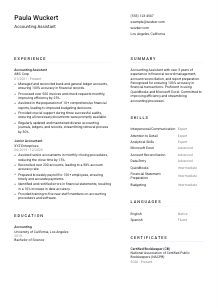
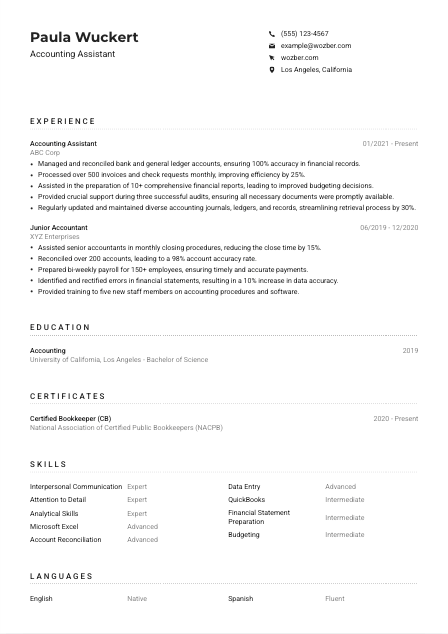
If the employer specifies a location, mirror it in your header. Here, Los Angeles, California is worth stating because it answers a posted requirement immediately. Keep this practical. It is a tailoring move for this opening, not a rule for every Accounting Assistant resume.
A LinkedIn profile or professional website can support your application if it is current and consistent with your resume. For accounting candidates, that usually means matching job titles, dates, and credentials rather than adding extra personal content.
This section should remove questions, not create them. When your title, contact details, and location are accurate and easy to scan, the reader can move straight to your accounting experience.




This is the section that usually carries the most weight for an Accounting Assistant. Hiring managers want to see whether you have handled real transaction volume, kept records accurate, supported reporting cycles, and worked inside accounting processes that depend on consistency.
Start by marking the responsibilities that define the job. For this opening, that includes bank and general ledger reconciliations, invoice processing, financial report support, budget assistance, audit preparation, and maintaining journals and ledgers. Those are the duties your bullets should echo if they match your background.
Show your most recent accounting work first, with job title, employer, and dates clearly stated. That order helps the reader track your progression from earlier finance support work into stronger ownership of reconciliations, reporting, or close support.
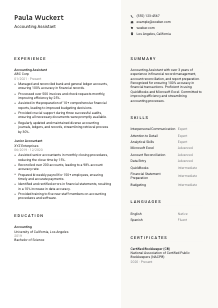
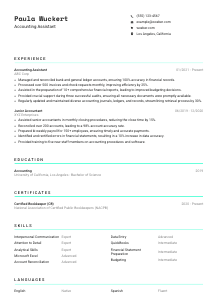
Focus each bullet on work that matters in a finance team. Good examples include reconciling accounts, processing invoices, reducing close time, supporting audits, improving record retrieval, or catching reporting errors before they affect statements. In the sample resume, the strongest bullets tie directly to recurring accounting tasks rather than broad office support.
Metrics make your scope clear. Volume, accuracy, turnaround time, close-cycle improvement, error reduction, and audit support are all useful here. "Processed over 500 invoices monthly" and "reduced close time by 15%" work because they show workload and operational improvement in terms finance teams recognize immediately.
Prioritize roles that strengthen your fit for bookkeeping, ledger maintenance, reconciliation, reporting support, payroll, or transaction processing. If you include unrelated work, keep it brief unless it demonstrates something directly useful, such as handling confidential records or working with high-volume administrative data.
Your experience section should let the reader picture you inside the accounting workflow. If they can see the reconciliations, invoice volume, reporting support, and accuracy you handled, the case for an interview becomes much stronger.
Education matters in accounting because it tells employers whether you have formal grounding in financial reporting, bookkeeping principles, and the structure behind the daily work. Keep this section straightforward and aligned with the level of qualification the job actually requests.
Check the posting for the exact education baseline. Here, a bachelor's degree in Accounting, Finance, or a related field is part of the requirement, so that credential should appear clearly and without extra hunting.
List your degree, field of study, school, and graduation year. Accounting resumes benefit from tidy structure, and this format gives hiring teams the information they need without slowing them down.
If your degree is directly relevant, make that visible. A Bachelor of Science in Accounting, like the example resume shows, instantly supports your candidacy for roles involving reconciliations, reporting support, and ledger maintenance.
Extra detail is most useful for recent graduates or early-career candidates. Courses in financial accounting, managerial accounting, auditing, payroll, or Excel-based financial analysis can strengthen your profile if your work history is still developing.
Accounting practices, software workflows, and reporting requirements change over time. If you have completed recent training in Excel, bookkeeping systems, or accounting software, it can reinforce that your knowledge is current and usable on the job.
For this role, education should quickly confirm that you have the accounting foundation to handle transaction work and reporting support. Clear formatting and a relevant field of study are usually enough.
Certifications are not mandatory for every Accounting Assistant job, but the right one can strengthen your case, especially when it supports bookkeeping accuracy, system knowledge, or day-to-day accounting operations.
Start with the job ad. If no certification is required, treat this section as supporting material rather than the center of your application. For an Accounting Assistant, certificates are most useful when they reinforce hands-on accounting ability.
Choose credentials tied to bookkeeping, accounting operations, payroll, or software used in finance teams. The Certified Bookkeeper credential in the sample resume works because it directly supports the type of recordkeeping and transaction control the role involves.
If a credential is active, recently earned, or time-bound, include the date or date range. That helps the employer understand whether your training is current, especially in areas connected to changing processes, software, or compliance expectations.
Even when certifications are optional, they show that you are building beyond core degree requirements. For accounting support roles, that can matter when employers are choosing between candidates with similar experience in reconciliations or invoice processing.
A focused certification section can add credibility, especially when it supports bookkeeping accuracy or accounting operations. Keep it tight and relevant to the work the employer needs done.
An Accounting Assistant skills section should reflect how the job is actually done. That usually means a mix of accounting software, spreadsheet ability, reconciliation work, data accuracy, and dependable communication with finance teammates, vendors, or internal departments.
Read the posting closely and note both technical and practical requirements. In this case, Microsoft Excel, accounting software, QuickBooks, attention to detail, accuracy, and communication are all worth prioritizing because they connect directly to the listed responsibilities.
Add the skills you can genuinely support through your work history. If you list QuickBooks, Excel, account reconciliation, or financial statement preparation, make sure those tools or tasks also appear in your experience bullets so the resume stays credible and ATS aligned.
Put the most important accounting skills near the top. For many Accounting Assistant roles, that means Excel, reconciliations, invoice processing, ledger maintenance, accounting software, and accuracy-related skills before broader strengths. The sample resume handles this well by pairing software skills with accounting functions such as reconciliation and financial statement preparation.
A well-ordered skills section helps the employer see your operational value fast. Lead with the software, accounting tasks, and accuracy strengths that connect directly to the role's daily workload.
Language ability matters when a posting names it directly or when the work involves regular communication with vendors, clients, or internal teams. For most Accounting Assistant roles, this section should stay brief and factual.
If the posting specifies fluency in English, list English clearly and use an honest proficiency level. That removes doubt on a stated requirement and keeps your resume aligned with the role from the start.
Additional languages can be helpful when the business serves diverse customers or works across regions, but they should remain secondary to the required language. In the example resume, Spanish adds value without distracting from the accounting core of the application.
Use simple terms such as Native, Fluent, Advanced, or Conversational. Avoid vague wording. Clear labels make it easier for the employer to understand whether you can handle written communication, phone calls, or day-to-day coordination in that language.
Do not overstate fluency. Accounting work often involves precise written communication around invoices, payment issues, records, and audit support, so inaccurate language claims can create problems quickly.
Unless the role is heavily client-facing or multilingual by nature, languages should complement your accounting profile rather than lead it. Keep the emphasis on financial accuracy, software use, and transaction support.
This section works best when it confirms required communication ability and adds any extra value without pulling attention away from your accounting qualifications.
The summary sits near the top of the resume, so it should quickly tell the reader what kind of accounting support work you have done and where you can add value. Keep it short, specific, and tied to the responsibilities that appear in the job posting.
Read the posting before drafting this section. For an Accounting Assistant, the summary should reflect the mix of reconciliations, transaction processing, reporting support, audit preparation, and software use that defines the job rather than generic finance language.
Lead with your title and years of relevant experience. A line such as "Accounting Assistant with over 3 years of experience" works because it gives immediate context and positions you for the level of work the employer needs.
Choose strengths that connect directly to the role, such as account reconciliation, invoice processing, financial record accuracy, Excel, or QuickBooks. The sample summary is effective because it combines software proficiency with a clear result, namely accurate financial transaction handling.
Aim for three to five lines. That is enough space to establish your background, name the most relevant accounting capabilities, and hint at outcomes such as accuracy, efficiency, or reporting support without repeating the experience section.
When this section is tailored well, the reader understands your accounting scope before reaching the first bullet point. Make those opening lines specific enough that they already point to reconciliations, transaction work, and dependable financial support.
A polished Accounting Assistant resume should now show the work behind the title: reconciliations completed accurately, invoices processed at volume, records maintained cleanly, and financial reporting or audit support handled with consistency.
Use Wozber's free resume builder to tighten the wording, keep an ATS-compliant resume structure, and check alignment with the posting through the ATS resume scanner. That gives you a resume that is easier to screen, easier to trust, and ready for accounting teams that need dependable support from day one.