



Use Wozber and land your dream job
Create Resume
No registration required
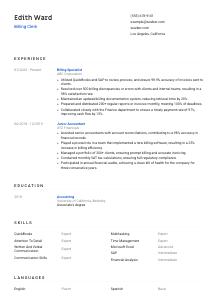
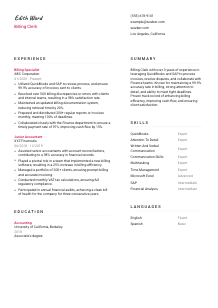
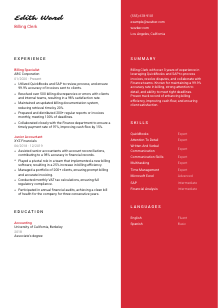
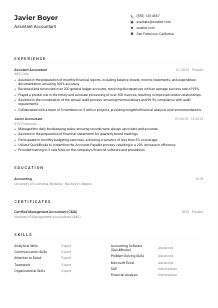
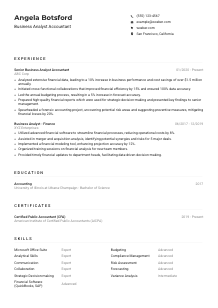
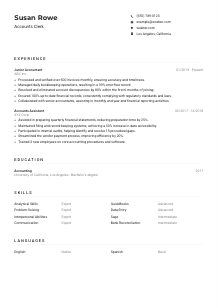
Calculating invoices, but your resume doesn't add up? Scroll through this Billing Clerk resume example, made with Wozber free resume builder. It shows how you can tally your billing skills with job specifics, putting your payment prowess right on the receipt of opportunity!
Billing work gets noticed when something is off. A missed invoice, an unresolved discrepancy, or a late report can affect cash flow and client trust fast. Your resume should make the opposite clear: you handle invoices carefully, keep records current, and stay dependable when deadlines and volume pick up.
For Billing Clerk hiring, the first read often comes down to whether your resume shows the right mix of billing systems, accuracy, and coordination with finance teams. Wozber's free resume builder helps you shape that experience into an ATS-compliant resume, so tools like QuickBooks or SAP, reporting volume, and payment follow-through are easy to spot from the start.
This section should identify you quickly and remove any friction before the hiring team gets to your billing experience. Keep it clean, professional, and aligned with the posting's practical requirements.
Use your full name in a slightly larger font than the rest of the resume. Billing roles depend on organized records and clean documentation, so even this top line should feel orderly and easy to scan.
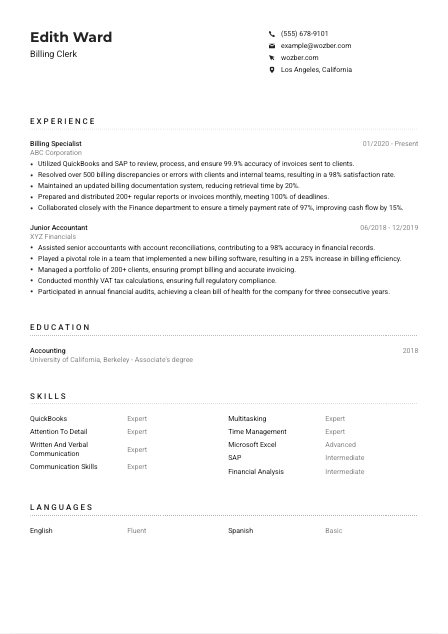
Place "Billing Clerk" directly under your name if that is the role you are pursuing. When your current title is slightly different, such as "Billing Specialist," using the target title here can help connect your background to invoice processing, discrepancy resolution, and billing support work right away.
Include your best phone number and a professional email address. Add LinkedIn or a relevant professional profile if it matches your resume details and supports your finance or accounting background. Make sure every link works and every contact field is current.
If the employer requires local availability, include your city and state in this section. In the example, "Los Angeles, California" directly addresses the stated location requirement and avoids questions about relocation or time zone logistics.
A website is optional for most Billing Clerk candidates. Include one only when it strengthens your application, such as a complete LinkedIn profile or a professional page that supports your accounting or finance background. Skip personal links that do not add value to billing, reporting, or financial operations work.
A tidy contact section tells the employer you handle information carefully. That matters in billing, where accuracy starts long before the first invoice is sent.




This is the section that usually carries the most weight for a Billing Clerk resume. Hiring teams want to see proof that you can process invoices accurately, resolve issues quickly, keep billing records organized, and support timely payment cycles.
Read the posting closely and mark the repeated themes. For this role, the priorities are invoice accuracy, billing record maintenance, discrepancy resolution, reporting, finance collaboration, and comfort with systems like QuickBooks or SAP. Your experience bullets should reflect that exact kind of work if you have done it.
Start with your most recent position and work backward. For each role, include your job title, company name, and dates of employment. If you have held adjacent titles such as Billing Specialist, Accounts Receivable Clerk, or Junior Accountant, keep the focus on the billing tasks that overlap with the target role.
Under each position, show what you handled and what improved because of your work. Billing resumes get stronger when bullets mention invoice volume, error reduction, turnaround time, reporting cadence, dispute resolution, or payment outcomes. The example does this well by showing invoice accuracy, discrepancy resolution, monthly reporting output, and improved cash flow through finance collaboration.
Quantified results help hiring teams judge scope and consistency. Good Billing Clerk metrics include invoice accuracy rates, number of reports or invoices processed each month, discrepancy volume resolved, payment timeliness, retrieval time for documentation, or efficiency gains after a process change. Metrics like "99.9% accuracy" or "200+ reports monthly" sound credible because they match how billing performance is tracked.
Keep the section centered on invoicing, records, reconciliation support, client communication, payment follow-up, and software use. General administrative bullets should stay only if they support billing operations. The goal is to make your experience read like someone who can step into a billing workflow and contribute with minimal ramp-up.
When this section is tailored well, the employer can quickly see your software familiarity, your accuracy under volume, and your role in keeping invoices and payments moving on time.
Education is usually straightforward for Billing Clerk roles, but it still matters because many postings use it as a baseline requirement. Present it clearly and make sure the field of study supports your finance or accounting background.
If the job asks for an Associate's degree in Accounting, Finance, or a related field, list your degree in that exact form when accurate. In the example, "Associate's degree" and "Accounting" directly line up with the posting, which makes the education requirement easy to confirm.
For each education entry, include the school name, degree, field of study, and graduation year or date. Hiring teams do not need extra formatting here. They need to find the credential fast and move on to your billing experience.
If your degree is in a related area such as Finance, Business, or Bookkeeping, list it clearly rather than trying to overstate the match. A related field can still support a Billing Clerk application when your experience shows invoice processing, records management, and financial accuracy.
Most experienced candidates can keep this section brief. If you are earlier in your career, relevant coursework in accounting principles, financial reporting, bookkeeping, Excel, or business systems can help connect your education to billing work.
Include honors, scholarships, or finance-related activities only if they strengthen the picture of you as someone prepared for detail-heavy financial work. Keep them concise so the section stays focused on qualifications that support billing accuracy and administrative discipline.
Once your degree is easy to verify, the reader can spend more attention on the part that usually decides the interview: your billing experience, system knowledge, and accuracy record.
Billing Clerk skills should read like the toolkit you use to keep invoices accurate, records current, and payment activity moving. A good list balances billing software, spreadsheet work, communication, and the detail control needed in financial operations.
Start with the skills named directly in the job ad, then add the operational abilities behind them. Here, that includes QuickBooks or SAP, attention to detail, multitasking, written and verbal communication, and deadline management. These are not random traits. They connect directly to invoice review, error correction, and recurring reporting.
Billing resumes usually need both. Include software and platform knowledge such as QuickBooks, SAP, Microsoft Excel, or billing systems you have actually used, then pair them with skills like discrepancy resolution, record maintenance, communication with clients, and time-sensitive processing. The example's blend of QuickBooks, SAP, Excel, attention to detail, and communication reflects that balance well.
Do not turn this section into a full inventory of everything you can do. Choose the skills most likely to matter in billing operations and mirror the employer's wording where it matches your experience. A compact, focused list is easier for both ATS screening and human review.
The best skills section reinforces your experience instead of repeating generic strengths. When the tools and abilities match your bullets, your billing profile feels much more credible.
Language skills matter in Billing Clerk roles when they support clear client communication, accurate written follow-up, and smooth coordination with internal teams. If the posting names English proficiency, make that easy to find.
When a role specifies strong English communication, list English at the top with an honest proficiency level such as Fluent or Native. That gives the reader a quick answer on a stated requirement and supports the communication side of billing work, including invoice questions, written follow-up, and issue resolution.
If you speak additional languages, include them after English. They can be useful in organizations that work with a broader client base or multilingual internal teams, especially when billing questions need to be resolved clearly and efficiently.
Terms like Native, Fluent, Intermediate, and Basic are enough. Avoid vague labels or inflated descriptions. Billing communication depends on accuracy, and your language section should reflect that same straightforward standard.
Additional languages become more valuable when the role involves customer contact, collections coordination, or communication across departments and regions. They are a plus, but only when presented honestly and in proportion to the role.
If you list languages, make sure they add something practical to your application. English may be the only language that matters for some Billing Clerk openings, while in other settings a second language can help with client responsiveness and smoother issue handling.
For billing roles, that usually means making required English proficiency obvious and treating any additional language skill as a practical asset rather than filler.
Your summary sits at the top of the resume and often decides what the reader notices first. For a Billing Clerk, it should quickly establish your billing experience, software familiarity, accuracy level, and the kind of financial support work you have handled.
Look at the posting and identify the few things that should appear in your opening lines. In this case, those are billing experience, invoice accuracy, discrepancy handling, software proficiency, communication, and coordination with finance. Build the summary around the strongest overlap with your actual background.
Start with a direct line that tells the employer who you are professionally and how long you have worked in billing or related finance roles. The example summary does this effectively by leading with Billing Clerk experience and named systems, which immediately frames the candidate in the right lane.
Use the next lines to mention the tools, billing tasks, and outcomes that best support your application. Strong details include QuickBooks or SAP use, invoice processing, discrepancy resolution, reporting volume, accuracy rate, cash flow support, or client satisfaction improvements. Pick two or three that genuinely define your work.
Aim for a short paragraph that reads clearly in one pass. Three to five lines is usually enough. Skip broad claims and focus on facts that match billing operations, such as "maintained 99.9% invoice accuracy" or "prepared 200+ monthly invoices and reports on deadline."
By the time someone finishes these opening lines, they should already understand your billing scope, your system experience, and your record of accurate, timely financial support.
A well-tailored Billing Clerk resume should make three things easy to see: you know the billing systems the role relies on, you work accurately under deadline, and you can keep invoices, records, and payment follow-up moving with minimal supervision.
Use Wozber's free resume builder to organize that experience into an ATS-friendly resume format, then refine the wording with the ATS resume scanner so the language matches the posting naturally. The finished resume should give hiring teams a clear read on your ability to support accurate billing and timely payment operations.




