



Use Wozber and land your dream job
Create Resume
No registration required
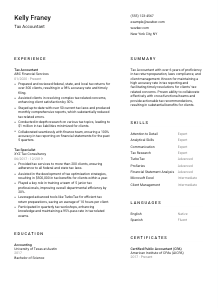
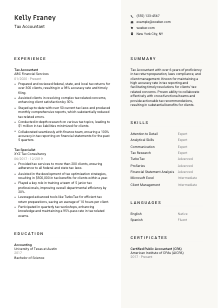
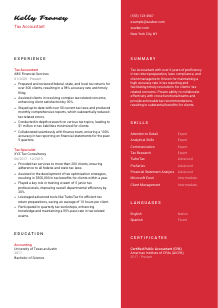
Number-crunching insights, but your resume isn't adding up? Check out this Tax Accountant resume example, created with Wozber free resume builder. Learn how to detail your financial flair to match job requirements, ensuring your career balance always remains in the green!
Tax accounting work leaves little room for vague claims. Hiring teams want to see whether you can prepare accurate returns, interpret changing federal and state rules, research complex issues, and explain the tax impact clearly to clients or internal partners. Your resume should make that operating standard visible from the first section, especially if your background spans individual, business, or organizational filings.
A targeted resume changes how quickly your tax scope becomes clear. When your title, experience bullets, software, and credentials line up with the posting, Wozber's free resume builder helps you shape that experience into an ATS-compliant resume that reads cleanly for both screening systems and accounting leaders. That matters when they need to distinguish general accounting experience from hands-on tax preparation, tax research, and reporting work.
The Personal Details section is simple, but it still sets a tone. For a Tax Accountant, that tone should be organized, accurate, and businesslike, the same qualities clients and finance teams expect when you are handling filings, notices, and reporting deadlines.
Use your full name in a slightly larger font so it is easy to find at a glance. Tax roles involve precision and clear documentation, so even this first line should feel orderly and professional rather than styled for effect.
Place the role title directly under your name using the wording that fits the job you are pursuing. If the opening is for a "Tax Accountant," using that exact title helps frame your background around tax compliance, return review, and research work right away.
List a phone number and email address you monitor consistently, then proofread them carefully. In accounting hiring, small errors can undermine confidence fast, so this section should be as clean as a finished workpaper.
Include your city and state when location is part of the employer's requirements. Here, New York City, NY matters because the posting asks candidates to be local or open to relocating. If a future role does not mention geography, keep the entry simple and avoid giving extra detail that does not support your application.
If you have a LinkedIn profile or professional website, include it only if it reinforces your tax background with consistent titles, dates, and achievements. A profile that shows client-facing tax work, certifications, or software experience can strengthen the first impression. One that is outdated can create questions you do not need.
This section should confirm that you are reachable, professionally presented, and aligned with any practical requirement such as location. For a Tax Accountant, accuracy starts here.




Experience carries the most weight in many tax accounting searches because it shows the kind of returns you have handled, the volume you can manage, the issues you can research, and the business outcomes you have influenced. Generic accounting bullets often miss that distinction.
Start by isolating the real work in the job description. In this case, that includes preparing and reviewing federal, state, and local returns, researching tax issues, resolving client concerns, and collaborating with finance on reporting. Your bullets should mirror those functions using language you can support with real examples.
Lead with your most recent tax-focused position and work backward. That structure helps readers quickly see your current filing scope, client exposure, and progression from supporting tax work into more independent review, research, or advisory responsibility.
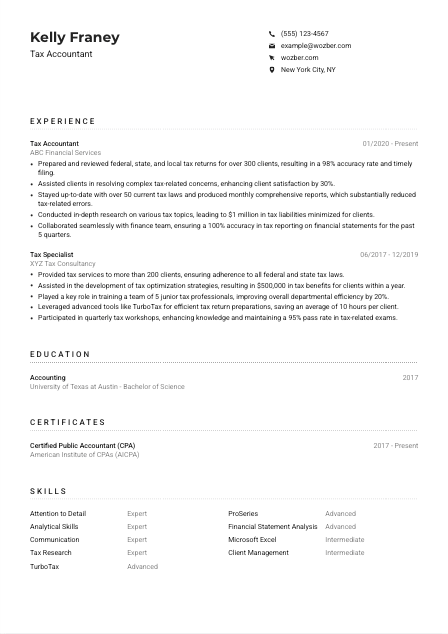
A hiring manager already knows a Tax Accountant prepares returns. What matters is the scale, accuracy, and result. The sample resume does this well with points like preparing and reviewing returns for more than 300 clients at a 98% accuracy rate and helping reduce tax liabilities by $1 million. Those details show judgment and throughput, not just task ownership.
Tax resumes benefit from metrics that feel native to the job: number of clients served, filing volume, accuracy rates, turnaround time, liabilities reduced, tax benefits identified, audit issues resolved, or reporting periods completed without error. Choose measures that reflect your actual contribution, whether you worked on individual returns, entity returns, quarterly reporting, or multi-state matters.
If a past accounting role included payroll, AP, or broad bookkeeping work, keep only the parts that support the target opening. Prioritize return preparation, compliance, tax law research, client advisory work, and coordination with finance or controllers. That kind of editing helps separate tax accountants from general accountants in both ATS screening and human review.
Your experience section should tell a clear story about the returns you handled, the problems you solved, and the level of trust you carried. When those points are specific, your background reads as tax accounting experience rather than general accounting support.
Education matters in tax accounting because employers usually want a formal accounting foundation before they look at software skills or filing volume. Once you have professional experience, the section should stay concise while still covering the degree requirement clearly.
List your bachelor's degree in Accounting or a closely related field exactly and clearly. This posting asks for that credential directly, so make sure it is impossible to miss. If your degree title differs slightly, your field of study should still connect cleanly to accounting or taxation.
Keep the entry easy to scan: degree, field, school, and graduation year. In accounting and tax hiring, simple structure works better than decorative formatting because it keeps attention on qualifications instead of layout.
If your degree is in Accounting, say so plainly. The sample resume does this with a Bachelor of Science in Accounting, which immediately satisfies the education requirement. If your degree is adjacent, such as Finance, support it elsewhere in the resume with tax coursework, certifications, or stronger tax experience.
For early-career candidates, classes in federal taxation, corporate tax, auditing, or financial reporting can help show technical grounding. For someone with several years of tax experience, those details are usually secondary unless they directly support the target role.
Honors, accounting societies, and finance clubs can add context when you are newer to the field. If you already have years of return preparation, client work, and compliance experience, keep the section lean so experience and credentials remain the focus.
Education should confirm that you have the academic base for tax work without taking space away from your filing experience, research ability, and tax credentials.
Certifications carry real weight in tax accounting because they speak to technical depth, professional standards, and commitment to staying current. When a posting mentions a CPA, employers are paying attention to whether it appears clearly on the page.
Start with the certifications that most directly support tax practice. For this opening, the CPA is the obvious example because the employer lists it as preferred. If you hold it, do not bury it below less relevant training or software certificates.
Include only credentials that strengthen your tax profile. CPA, Enrolled Agent, or relevant continuing tax education belong here. Generic certificates that do not connect to compliance, reporting, advisory, or accounting standards can distract from stronger qualifications.
Dates can show that a license is current or that a certification has been maintained over time. In the sample, listing the CPA with an active date range reinforces that the credential is not outdated and remains part of the candidate's professional standing.
Tax law changes constantly, so recent continuing education, annual update programs, or specialized tax training can help, especially if the role involves research-heavy work or frequent client guidance. This is particularly useful when you want to show current knowledge of changing federal and state requirements.
A well-chosen certifications section tells employers that your tax knowledge is formal, current, and backed by recognized standards. For many tax roles, that can materially strengthen the application.
The skills section should reflect the actual mechanics of tax accounting. Employers look for a combination of regulatory knowledge, tax software fluency, spreadsheet ability, research strength, and communication that holds up in client conversations and reporting cycles.
Start with the abilities the posting actually relies on: knowledge of federal and state tax regulations, tax software proficiency, Excel, analytical ability, attention to detail, and client communication. Those are stronger than broad phrases because they map to return prep, review, issue resolution, and reporting support.
Lead with skills that distinguish a tax candidate from a general accountant. Tax research, return preparation, multijurisdiction compliance, tax software, and financial statement tax reporting usually deserve higher placement than broad office or administrative skills. In the sample resume, tools like TurboTax and ProSeries and strengths like tax research make that distinction immediately.
Separate technical and interpersonal strengths if that helps readability. For example, you might cluster tax software, Excel, tax research, and financial statement analysis together, then list communication, client management, and detail orientation nearby. An ATS-friendly resume format also makes these terms easier to parse without turning the section into a keyword dump.
Every skill here should support a real part of the job, whether that is preparing returns, researching regulations, explaining tax positions, or coordinating reporting with finance. If a skill does not help tell that story, cut it.
Language skills are usually secondary in tax accounting, but they can still matter when the role involves direct client communication, multilingual populations, or teams working across different markets. What matters most is representing those abilities accurately.
This posting explicitly requires fluent English, so list it clearly. For a Tax Accountant, that supports client explanations, written tax correspondence, research summaries, and communication with finance or leadership.
Additional languages can help in firms serving diverse individual or business clients. They are especially relevant if you have used them in tax interviews, client onboarding, notice resolution, or document review. The sample's Spanish entry is a good illustration of a language that could expand client coverage, but it is an advantage, not a universal requirement.
Choose realistic labels such as native, fluent, or conversational. If you would not be comfortable discussing filing status, notices, deductions, or tax deadlines in that language, do not overstate it.
Language skills matter more in some tax environments than others. A high-volume consumer tax practice, a multilingual local market, or a firm with cross-border client relationships may value them more than a back-office corporate tax role. Tailor this section to the actual client and communication demands of the job.
Language claims are easy to test in interviews and on the job. Present them with the same care you would use in a return or tax memo so expectations stay aligned with what you can actually deliver.
For tax accounting roles, language skills should support client service or team communication in a concrete way. Keep English clear, add other languages honestly, and let the section stay proportional to the job.
Your summary should quickly establish what kind of tax professional you are. In a few lines, it should cover your level of experience, the core tax work you handle, and one or two outcomes that show how you operate under deadlines and regulatory scrutiny.
Before you write the summary, identify the priorities in the job description. Here, that means tax return preparation and review, regulatory knowledge, tax research, client support, and collaboration on financial reporting. Those themes should shape the wording of the opening lines.
Lead with your title and years of experience so the reader immediately understands your level. The sample uses "Tax Accountant with over 6 years of proficiency," which works because it quickly anchors the candidate in the field and suggests enough experience for independent tax work.
Choose strengths that matter in tax hiring, such as high-volume return preparation, strong accuracy, tax law research, multi-state compliance, client issue resolution, or financial statement reporting support. The sample summary succeeds because it mentions accuracy, client concerns, and cross-functional collaboration instead of relying on vague claims.
Aim for a short paragraph that reads cleanly in one pass. Four lines of specific tax content will do more work than a long introduction full of generic traits. Focus on the kind of returns you manage, the quality of your work, and the business or client results you help produce.
When this section is tailored well, the reader knows within seconds whether you are built for the tax scope of the role. It should frame you as someone who can handle returns, research issues, and communicate tax decisions with confidence.
A Tax Accountant resume works best when every section supports the same conclusion: you understand tax rules, work accurately under filing pressure, and can translate that work into sound advice or reporting. Keep your examples specific, use metrics that belong in tax work, and match the language of the posting where it reflects your real experience.
Wozber's free resume builder can help you organize that experience in an ATS-friendly resume template, refine wording with AI support, and check alignment through an ATS resume scanner so your return preparation, research, software, and credentials are easy to identify. The finished resume should make one thing clear quickly: you are ready to handle the tax workload the role demands.




