



Use Wozber and land your dream job
Create Resume
No registration required
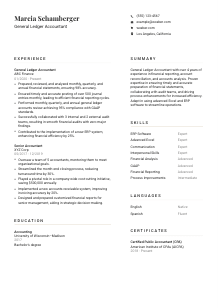
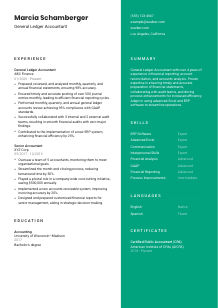
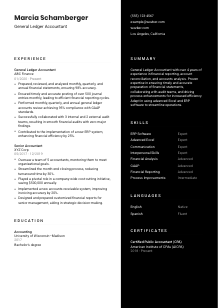
Balancing financial books, but your resume isn't adding up? Browse this General Ledger Accountant resume example, created with Wozber free resume builder. Learn how to clearly present your accounting wins to match the job criteria, so your career graph stays steadily in the black!
General ledger work sits at the center of the close. When a resume for this role stays vague, hiring teams cannot tell whether you have actually owned journal entries, reconciliations, financial statement prep, or audit support at the level the job requires. Your resume should make that operating responsibility visible quickly, with clear scope, accuracy, and reporting cadence.
A tailored resume also helps separate broad accounting experience from true general ledger depth. Using Wozber's free resume builder to align your wording with the posting and keep an ATS-compliant resume structure clean makes it easier for reviewers to spot the experience that matters here, such as month-end ownership, GAAP-based review work, and contribution to cleaner financial reporting.
Accounting resumes are read for precision from the first line. Your personal details should be simple, accurate, and aligned with any practical requirement in the posting so the employer can move straight to your financial reporting experience without friction.
Use your full name as the most visible text on the page. Keep the formatting straightforward and professional. For accounting roles, that clean presentation matters because it sets the tone for the rest of a resume that will be judged on order, accuracy, and control.
If you are applying for a General Ledger Accountant opening, place that title beneath your name when it reflects your background. This immediately frames you around ledger ownership, reconciliations, and reporting work instead of leaving the employer to infer where you fit in the accounting team.
List a reliable phone number and a professional email address, ideally in a simple firstname.lastname format. Small details matter in accounting. If your contact information looks careless, it can cast doubt on how carefully you handle entries, supporting schedules, and month-end documentation.
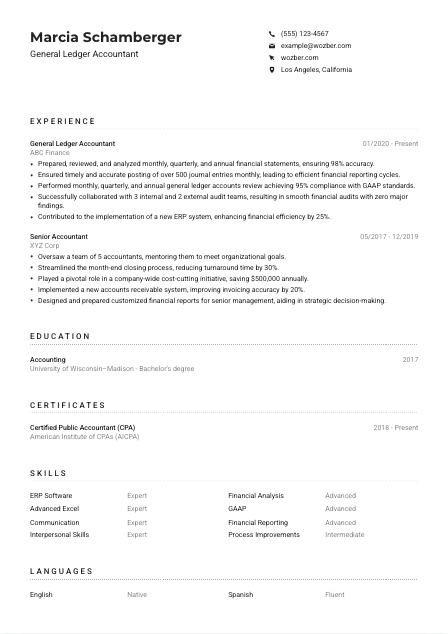
If a role specifies a location requirement, address it directly in this section. In the example, listing Los Angeles, California immediately answers the employer's stated need without wasting space elsewhere on the resume.
A LinkedIn profile can support your application if it matches your resume and reinforces your accounting background with consistent titles, dates, and credentials. A personal website is only worth adding if it contains relevant professional material, such as finance leadership content, publications, or speaking experience.
This section should confirm that you are reachable, professionally presented, and aligned with any practical requirement such as location. Keep it clean so attention stays on your accounting record.




This is the section hiring teams read most closely for general ledger roles. They want to see whether you have handled the monthly close, maintained account accuracy, supported audits, and improved reporting processes, not simply held an accounting title.
Read the posting and underline the work that defines the role. For a General Ledger Accountant, that usually includes financial statement preparation, journal entry posting, balance sheet reconciliations, GAAP compliance, audit support, and process improvement. Those same phrases should appear naturally in your bullets when they reflect your actual work.
List positions in reverse chronological order with job title, employer, and dates clearly shown. That simple structure helps reviewers follow your progression from broader accounting work into stronger ledger ownership, close responsibilities, or senior-level reporting duties.
Focus each bullet on work that matters in general ledger accounting. Good bullets show what you owned, how often you handled it, and what result followed. The example does this well by tying journal entry volume, financial statement preparation, and audit collaboration to concrete outcomes that matter in accounting operations.
Use numbers that are native to accounting work. That can mean volume of journal entries, close-cycle timing, accuracy rates, number of reconciled accounts, audit findings, or efficiency gains from an ERP rollout. In the sample resume, "over 500 journal entries monthly" and "zero major findings" tell a hiring manager far more than general claims about being detail-oriented.
Prioritize experience that shows ledger accuracy, financial analysis, reporting, compliance, and collaboration with auditors or finance leadership. If an older bullet does not help prove those abilities, trim it or rewrite it. Space is better used on work that shows you can keep the books clean and the close on schedule.
Your experience section should show that you can handle the discipline of recurring close work and the judgment behind accurate reporting. When the bullets are specific, measured, and aligned with the posting, your accounting scope becomes much easier to trust.
For general ledger roles, education is usually a baseline screen rather than the main selling point. Still, it needs to confirm quickly that you have the accounting or finance foundation needed for GAAP-based reporting, reconciliations, and financial statement work.
If the posting asks for a Bachelor's degree in Accounting, Finance, or a related field, list that information plainly. Do not bury the field of study. In this case, a Bachelor's degree in Accounting directly supports the employer's stated requirement.
Present your degree, field of study, school, and graduation year in a clean sequence. That makes credential review quick and keeps the section consistent with the orderly presentation expected in accounting resumes.
When you have multiple credentials, lead with the one most tied to the role. For a General Ledger Accountant, an accounting degree should be immediately visible because it connects directly to reporting, account analysis, and compliance work.
Most experienced accountants do not need coursework listed if the degree itself already covers the requirement. Include it only when it adds useful context, such as advanced financial accounting, auditing, or ERP-related systems exposure for an early-career candidate.
Honors, scholarships, or leadership in accounting societies can help if you are early in your career or if the achievement is genuinely notable. For more experienced candidates, those details matter less than professional results in close management, reconciliations, and reporting accuracy.
Your education section should remove any doubt about your academic eligibility for the role. Once that is clear, the rest of the resume can carry the heavier proof around financial reporting and ledger control.
In accounting, certifications can quickly raise the level at which your resume is read. They help show technical commitment, especially for employers who value stronger grounding in accounting standards, audit interaction, and financial reporting discipline.
Prioritize credentials that directly support the role. Here, the clearest example is the CPA, since the posting lists it as preferred. If you hold it, give it prominent placement because it strengthens your credibility for GAAP-focused review and financial statement work.
List the year earned or the active date range when appropriate. That helps employers understand whether the credential is current and maintained, which is especially relevant for licenses and professional accounting designations.
Do not crowd this section with unrelated certificates. Use it for credentials that reinforce your accounting depth, regulatory awareness, reporting knowledge, or systems expertise. Relevance matters more than volume.
Accounting standards, audit expectations, and ERP environments change over time. If you maintain active credentials or complete meaningful continuing education, that can support your case as someone who keeps reporting practices current and reliable.
A well-chosen certification list should raise confidence in your technical grounding. For this role, a CPA or similarly relevant credential can strengthen the impression that you can work accurately within reporting and compliance expectations.
The skills section works best when it reflects the tools and capabilities that actually drive general ledger work. Hiring teams are looking for the software fluency, accounting knowledge, and communication ability needed to keep reporting accurate and month-end processes moving.
Start with the job description. If it calls for ERP software, advanced Excel, analytical ability, communication, and interpersonal skills, those should appear here when they are backed by your experience. This is also where you can reinforce GAAP knowledge, account reconciliation, and financial reporting expertise when relevant.
Lead with the skills that support daily execution in the role. For many general ledger positions, that means ERP platforms, advanced Excel functions, account analysis, reconciliations, financial statement preparation, and audit support. The sample resume handles this well by putting ERP software and advanced Excel near the top.
Avoid filling the section with every general business skill you have used. A shorter list that reflects actual accounting work is stronger. Choose skills that a controller, accounting manager, or recruiter would expect to see in someone responsible for journal entries, close routines, and balance sheet review.
Your skills list should support the story told in your experience section. When the tools, accounting knowledge, and communication strengths line up, your resume reads like someone who can step into the close with less ramp-up time.
Language ability is usually a supporting detail for general ledger roles, but it still matters when the posting names a communication requirement. In accounting, clear written and verbal communication affects audit responses, cross-functional coordination, and how well reporting issues are explained.
If the employer requires strong English communication, make that visible. Listing English with an accurate proficiency level addresses the requirement directly and supports your ability to explain account activity, resolve discrepancies, and work with auditors or business partners.
Place the required or primary business language first, then add any others that could be useful in the workplace. In the example, English appears first, followed by Spanish, which can be a practical asset in some finance teams even when it is not formally required.
Describe language ability with clear labels such as Native, Fluent, Intermediate, or Basic. That helps employers understand your actual communication range, especially if the role includes documentation, meetings, or cross-functional explanation of accounting issues.
Extra languages can strengthen your profile if the company works across regions, supports multilingual teams, or serves diverse internal stakeholders. They are secondary to accounting competence, but they can still be a useful differentiator.
Do not overstate the importance of language skills if the role is primarily focused on close, reconciliations, and reporting. Use this section to support the application, not to compete with the more important proof in your experience and skills sections.
Handle the language section with the same accuracy you would bring to financial reporting. It should confirm that you can communicate clearly in the working language of the role and note any additional language strengths without distracting from your accounting qualifications.
The summary needs to establish your level quickly. For a General Ledger Accountant, that means stating your experience, your core accounting scope, and one or two strengths that match the posting, such as financial reporting, reconciliations, ERP use, GAAP review, or audit support.
Before writing the summary, identify the responsibilities carrying the most weight in the posting. Here, those include financial statement preparation, journal entry accuracy, general ledger review, audit collaboration, and process improvement. Use those priorities to decide what belongs in your opening lines.
Open with your professional identity and years of relevant experience. A line such as "General Ledger Accountant with 4+ years of experience" gives immediate context and helps position you for the level of responsibility tied to recurring close and reporting work.
Mention the capabilities you can support elsewhere in the resume. Good examples for this role include account reconciliation, financial analysis, ERP-driven process improvement, GAAP-based review, or clean audit support. The sample summary works because it stays close to actual responsibilities instead of drifting into generic traits.
Aim for a short paragraph that can be read in seconds. Three to five lines is usually enough. The summary should sharpen your positioning, not repeat your full work history. Give the employer a quick, accurate read on the level of accounting ownership you bring.
A sharp summary tells the reader what kind of accountant you are before they reach the first job entry. For this role, it should make your reporting scope, ledger experience, and technical grounding clear from the start.
A General Ledger Accountant resume should read like someone who can keep financial reporting accurate, support the close reliably, and work comfortably inside audit and GAAP expectations. When each section points back to that standard, the resume feels focused instead of generic.
Use Wozber's free resume builder, ATS-friendly resume templates, and ATS resume scanner to tighten wording, improve ATS optimization, and align your resume with the posting's accounting language. The final result should make it easy to judge your readiness for ledger ownership, reconciliations, and financial statement work.




