



Use Wozber and land your dream job
Create Resume
No registration required
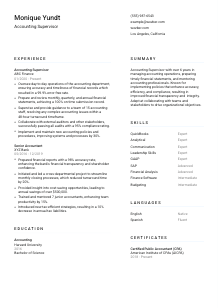
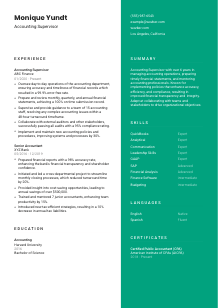
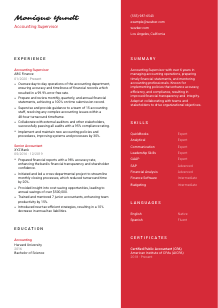
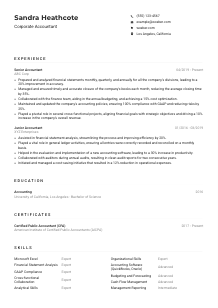
Balancing books, but your resume doesn't add up? Crunch the numbers with this Accounting Supervisor resume example, created with Wozber free resume builder. Learn how to match your financial leadership to the job at hand, adding up to a career equation that stacks up dividends!
Accounting Supervisors are trusted with work that affects close cycles, audit readiness, reporting accuracy, and the daily discipline of the accounting team. A resume for this level needs to show more than solid bookkeeping or staff accounting experience. It should make clear that you can run core accounting operations, review output, resolve exceptions, and keep financial reporting on schedule.
When that detail is missing, hiring teams can struggle to tell whether a candidate has actually supervised month-end work, owned financial statements, or simply supported those processes. Wozber's free resume builder helps you shape that distinction into an ATS-compliant resume by aligning your language with the posting and keeping the structure easy to scan, so your background reads as supervisory accounting experience rather than general finance support.
This section is simple, but it still does real work. For an Accounting Supervisor application, your header should immediately confirm who you are, how to reach you, and whether you meet practical screening requirements before the reader gets into close management, compliance work, or ERP experience.
Use your full name in a clean, readable format that stands out from the rest of the page. In finance hiring, presentation carries weight. A cluttered header can undercut the sense of precision you want attached to work involving reconciliations, reporting, and review responsibilities.
Place "Accounting Supervisor" directly under your name if that is the role you are pursuing. Matching the posted title helps frame your experience correctly from the first line, especially when your background includes titles like Senior Accountant, Accounting Lead, or Finance Manager that could otherwise be read differently.
Include a reliable phone number and a professional email address, ideally based on your name. Check every character. For a role tied to accuracy and control, basic errors in your contact details create the wrong first impression.
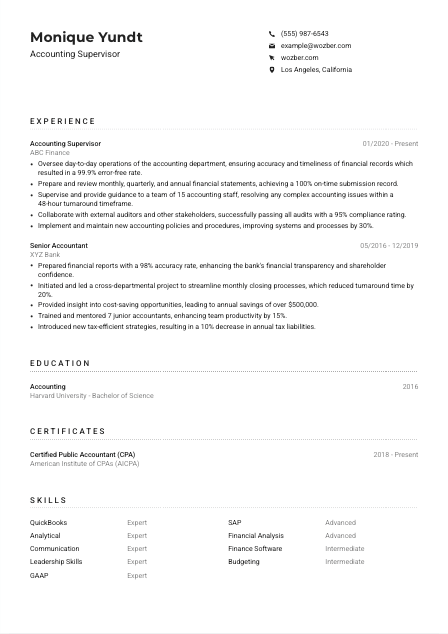
Some openings filter early on location. Here, the employer asks for someone based in Los Angeles, California, so listing Los Angeles, California in the header removes that question immediately. Treat this as targeted tailoring for this opening, not a rule for every Accounting Supervisor resume.
If you include LinkedIn or a personal website, make sure it supports the same story as the resume. Your profile should reflect accounting leadership, systems exposure, certifications, and career progression, not outdated job descriptions or mismatched titles.
A clean header will not win the role on its own, but it clears the first checks quickly and keeps the focus on your accounting leadership, reporting scope, and compliance background.




This is the section most likely to decide whether you are seen as ready for an Accounting Supervisor seat. Hiring teams want to see ownership of accounting operations, review authority, process improvement, and the ability to keep financial reporting accurate and on time across a team environment.
Start by identifying the work that defines the role. In this case, that includes overseeing daily accounting operations, preparing and reviewing monthly, quarterly, and annual financial statements, supporting audits, guiding staff, and improving policies and procedures. Those themes should shape which accomplishments you feature first and how you describe them.
List roles in reverse chronological order and make each entry easy to scan with company, title, and dates. For Accounting Supervisor roles, progression matters. A move from Senior Accountant into direct supervision, review work, or close ownership tells a stronger story than a flat list of accounting tasks with no indication of increasing scope.
Do not stop at statements like "managed accounting operations" or "prepared reports." Show what your work improved. The sample resume does this well by tying day-to-day oversight to a 99.9% error-free rate and financial statement preparation to a 100% on-time submission record. Metrics like close timeliness, audit results, error reduction, savings, or process efficiency are natural proof points in accounting leadership.
Numbers help hiring managers understand scale. If you supervised 15 accountants, reduced monthly close time by 20%, resolved complex issues within 48 hours, or drove $500,000 in annual savings, say so. These details show whether you have handled the volume and accountability that come with supervising an accounting department.
Prioritize bullets that show review authority, compliance support, financial statement ownership, ERP or accounting system use, and staff leadership. If you have older experience with tax strategy, budgeting, or analysis, include it only if it supports the story. For this opening, experience with audit coordination, process controls, and systems improvement deserves more space than general finance support work.
Your experience section should leave little doubt that you can oversee accounting operations, lead staff, and keep reporting accurate under deadline pressure. If the reader can picture you running the department's day-to-day work, this section is doing its job.
Accounting Supervisor roles usually expect a formal grounding in accounting or finance because the work involves judgment, standards, and review responsibility. Your education section should confirm that foundation quickly and without extra clutter.
If the posting asks for a bachelor's degree in Accounting, Finance, or a related field, make that easy to find. A degree such as Bachelor of Science in Accounting directly matches the requirement and supports the technical side of financial reporting, reconciliations, and compliance work.
Include degree, field of study, school, and graduation year or date. That is usually enough. In accounting hiring, this section is mainly a qualification check unless you are early in your career or your academic background strongly supports a specialized area like auditing, taxation, or financial analysis.
Use the formal degree name when it aligns with the job posting. For example, "Bachelor of Science in Accounting" reads more clearly than a shortened label and helps both ATS parsing and human review connect your education to the role requirement.
Honors, finance society leadership, or coursework in auditing, managerial accounting, or financial reporting can be useful if they reinforce your path into accounting leadership. If you already have 5+ years of strong experience, keep these additions brief so the resume stays focused on your professional track record.
Because CPA status is a hard requirement in this posting, make it easy to see in relation to your education. That does not mean combining sections, but it does mean avoiding a layout where the reader has to hunt for a qualification that may determine whether you move forward.
For an experienced Accounting Supervisor, education should quickly establish that you have the expected academic base for financial oversight and then make room for the experience and certification that carry more hiring weight.
In accounting leadership roles, certifications can move from nice-to-have to mandatory. When a posting requires a CPA or equivalent, this section becomes a decisive qualification check rather than a supporting detail.
List your CPA prominently and use the full credential name if needed for clarity. For this opening, CPA is required, so it belongs at the top of the section. If your certification is active, make that visible through the date format or current status.
Only include certifications that support accounting supervision, compliance, reporting, systems, or leadership. One strong credential often carries more weight than a long list of unrelated courses. For most candidates, CPA will be the centerpiece here.
Certification dates help show recency and standing. In a field shaped by evolving standards, systems, and compliance expectations, dates give useful context without taking much space.
If you have recent training in ERP systems, audit support, internal controls, or leadership development, it can reinforce your readiness to supervise a team and improve processes. Keep it selective and role-linked rather than turning the section into a course catalog.
For this kind of role, the certificates section should remove doubt fast. Lead with the CPA, keep supporting credentials relevant, and make your qualification status easy to confirm.
The best skills sections for Accounting Supervisors look like a compact view of how the job is actually done. That means balancing accounting systems, reporting knowledge, analytical strength, and people leadership instead of filling the section with broad business terms.
Use the job description to identify must-have tools and capabilities. Here, QuickBooks and SAP should appear because the employer names them directly. Analytical ability, communication, and leadership also belong because they support review work, staff guidance, and coordination with auditors and stakeholders.
Include both hard skills and leadership-related strengths, but keep them grounded in accounting work. GAAP, financial analysis, budgeting, month-end close, account reconciliation, QuickBooks, SAP, and audit support pair naturally with team supervision, coaching, and cross-functional communication.
A shorter, better-matched list is stronger than a long inventory. Prioritize the skills most relevant to accounting department oversight and financial reporting. The sample resume handles this well by combining system knowledge with GAAP, financial analysis, and leadership rather than listing every finance-related capability.
Your skills section should reinforce what the experience section already proves. If your bullets show team oversight, reporting accuracy, and systems improvement, the skills list should echo that same accounting leadership profile.
Language skills matter in accounting when the role requires clear communication with staff, auditors, executives, or external partners. This section is usually brief, but it still needs to reflect the communication demands of the position accurately.
If the posting asks for English proficiency, include English clearly with an honest proficiency level. In this case, being conversant in English is part of the requirement, so it should be easy to spot.
Terms like Native, Fluent, Professional, or Conversational are usually enough. Avoid vague descriptions. Clear labeling helps the employer judge whether you can handle reporting discussions, audit requests, and day-to-day team communication.
Additional languages can strengthen your profile if they support communication with clients, shared service teams, or multilingual staff. They are a bonus, not a substitute for accounting qualifications.
Do not overstate proficiency. If you may be expected to explain financial results, answer audit questions, or supervise staff in that language, the level you list should match what you can actually do on the job.
For an Accounting Supervisor, communication is often practical and deadline-driven. If another language helps with vendor communication, internal coordination, or a diverse team environment, include it. If not, keep this section concise and let your accounting achievements lead.
List language ability clearly, meet any stated requirement, and keep the emphasis where it belongs on accounting oversight, reporting accuracy, and team communication.
Your summary should read like the top-line case for why you can supervise an accounting function. In a few lines, connect your years of experience to the kind of reporting, compliance, systems, and team leadership the employer needs.
Start with your title or closest equivalent, years of experience, and the kind of accounting scope you handle. For example, mention experience overseeing accounting operations, managing close activities, or supervising staff rather than introducing yourself with generic finance language.
Weave in the qualifications that are central to the posting, such as CPA status, financial statement preparation and review, supervisory experience, and familiarity with tools like QuickBooks or SAP if you genuinely use them. This helps distinguish you from candidates whose background is more purely analytical or transactional.
Aim for 3 to 5 sentences that carry real detail. Strong summaries mention scale, focus, or outcomes. The sample summary works because it points to accounting operations, timely financial statements, mentoring, and policy improvements rather than relying on broad claims alone.
Close with a point that reflects how you work as a supervisor. That might be improving process efficiency, strengthening compliance, reducing errors, or mentoring accounting staff effectively. Choose something that matches the evidence in your experience section so the summary feels grounded.
A focused summary should quickly frame you as someone who can lead accounting operations, produce reliable reporting, and guide a team through deadlines, audits, and process improvements. That is the profile this role needs to see immediately.
An effective Accounting Supervisor resume shows command of the numbers and control of the process behind them. Every section should support that picture, from a location match in the header to experience bullets that show team oversight, reporting accuracy, audit support, and system improvement.
Use Wozber's free resume builder to organize that story in an ATS-friendly resume format, then sharpen the wording with role-specific terms pulled from the posting. When the resume is tailored well, both the ATS and the hiring team can quickly see that you are prepared to supervise accounting operations with accuracy, compliance, and leadership.




