



Use Wozber and land your dream job
Create Resume
No registration required
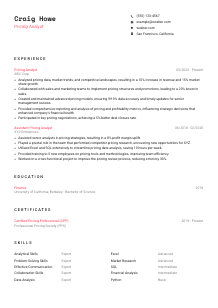
Weighing in on revenue, but your resume feels undervalued? Explore this Pricing Analyst resume example, created with Wozber free resume builder. Learn how to showcase your strategic pricing insights, setting your career trajectory in a profitably progressive direction!
Pricing analysis sits at the point where data meets commercial judgment. Hiring teams want to see whether you can turn transaction data, margin pressure, and market movement into pricing decisions that protect profitability and support growth. Your resume should make that clear through the models you built, the metrics you tracked, and the business decisions your analysis influenced.
A tailored Pricing Analyst resume helps separate broad financial analysis experience from hands-on pricing work. When your resume uses the same language as the posting around pricing models, profitability reporting, competitive analysis, and cross-functional support, Wozber's free resume builder also helps shape that experience into an ATS-compliant resume that surfaces your relevance quickly. The result is a clearer picture of how you contribute to pricing strategy, not just general analytics.
This section is straightforward, but it still carries screening value. For Pricing Analyst roles, hiring teams often check title alignment, location, and professional presentation before they move on to your analytical background.
Use your full name in a slightly larger font than the rest of the header so it is easy to scan. Keep it simple and professional. This role deals with precision, and a clean header immediately supports that impression.
Place "Pricing Analyst" directly under your name if that is the role you are pursuing. Matching the target title helps recruiters and ATS systems connect your profile to the opening quickly, especially when the employer is sorting candidates across finance, strategy, and analytics backgrounds.
List a reliable phone number and a professional email address. Errors here create avoidable friction. In a role where your work may feed into pricing updates, contract reviews, and management reporting, basic accuracy matters more than people think.
If the posting calls for a specific location, include your city and state. Here, San Francisco, California is part of the stated requirement, so showing that location, or making relocation clear, removes a practical question early in the review process.
Include LinkedIn or a professional website if it strengthens your application. For a Pricing Analyst, that profile should reinforce the same story as your resume, such as experience with pricing strategy, financial analysis, reporting, or data tools like Excel, SQL, and Python.
Your contact section should answer the easy screening questions fast: who you are, what role you are targeting, and whether your location and presentation match the opening. Then the reader can move straight to your pricing experience.




This is the section most likely to decide whether you move forward. Pricing Analyst resumes are strongest when they show commercial outcomes, analytical scope, and how the candidate worked with sales, marketing, or leadership to put pricing recommendations into action.
Read the job description closely and identify the work that drives the role. In this case, that includes analyzing pricing data, tracking market and competitor trends, maintaining pricing models, reporting profitability metrics, and supporting negotiations or contract reviews. Those priorities should shape which bullets you keep and which you rewrite.
For each job, include your title, employer, and dates, then use bullet points that start with clear action verbs such as "analyzed," "built," "evaluated," "recommended," or "partnered." Pricing work is easier to trust when the wording shows what you actually owned, whether that was model maintenance, promotional analysis, exception pricing, or weekly margin reporting.
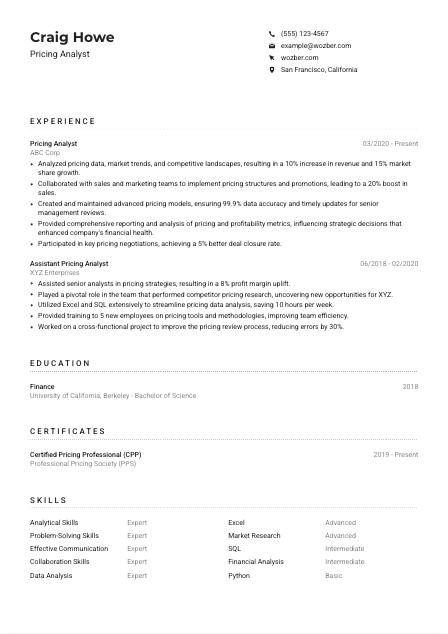
Numbers matter here because pricing decisions are measured in business outcomes. Highlight revenue lift, margin improvement, market share movement, forecast accuracy, deal performance, turnaround time, or error reduction. The sample resume does this well with results like a 10% revenue increase, 15% market share growth, and 99.9% data accuracy, all of which make the pricing work concrete.
Favor accomplishments that show pricing logic over general finance support. A bullet about building pricing models, running competitive pricing analysis, or evaluating promotions is more valuable here than a generic statement about preparing reports. If you have broader analytical experience, frame it through pricing, profitability, discounting, segmentation, or contract terms whenever that reflects your real work.
Employers value analysts who do more than maintain the current pricing process. Include examples where you improved data quality, automated reporting, reduced review-cycle delays, or made pricing analysis easier for commercial teams to use. In the example, streamlining Excel and SQL work to save 10 hours per week and reducing process errors by 30% both strengthen the case.
Your experience section should show how your analysis changed pricing decisions or improved commercial performance. If a reader can quickly see the metrics you moved, the tools you used, and the stakeholders you supported, your resume is doing the right work.
For Pricing Analyst positions, education usually serves as a qualification check first and a specialization clue second. The most relevant degrees show grounding in finance, economics, business, statistics, or another field that supports pricing logic and quantitative analysis.
List the degree that best matches the role requirement. A bachelor's degree in Finance, Business, Economics, or a related field fits naturally here. The example resume uses a Bachelor of Science in Finance, which aligns directly with the posting without needing extra explanation.
Include your degree, field of study, school, and graduation year. That is usually enough for an experienced Pricing Analyst. Recruiters should be able to confirm your academic background in a few seconds and move on to the pricing and analytics evidence in the rest of the resume.
If you are early in your career, relevant coursework or academic projects can help fill out your profile. Prioritize subjects like financial modeling, econometrics, statistics, pricing strategy, market analysis, or data analysis. Use these details only when they add real value, not as filler.
Honors, scholarships, or leadership in finance and analytics organizations can be worth adding if they reinforce your analytical discipline or commercial interest. For candidates with several years of pricing experience, keep these details brief so the section stays proportional.
If you have completed later training in pricing, analytics, or related tools, make sure it appears either here or in certifications. Ongoing learning carries weight in a field where analysts are often expected to work across evolving data tools, pricing methods, and profitability frameworks.
This section does not need to do all the selling. It should quickly confirm that you have the academic grounding for pricing analysis and support the more persuasive story told by your experience, tools, and results.
Certifications are optional in many Pricing Analyst searches, but the right one can sharpen your positioning. They are especially useful when they reinforce pricing methodology, commercial judgment, or technical depth that the rest of the resume already suggests.
List certifications that connect clearly to pricing, finance, analytics, or revenue management. A credential such as Certified Pricing Professional fits well because it points directly to pricing strategy and structured commercial analysis, rather than general professional development.
Order matters. Lead with the certification that most clearly supports the work in the job description. In the example, CPP deserves top placement because it complements responsibilities like pricing strategy development, model maintenance, and pricing recommendations.
Add the name of the issuing organization and the certification date or active period. That helps employers understand both legitimacy and recency, which matters when a credential reflects current methods or continuing professional standing.
Review this section before each application. Expired or less relevant credentials can distract from stronger pricing qualifications, while current certifications in pricing, analytics, or financial tools can reinforce your commitment to the field.
A short, relevant certifications section can strengthen your profile without taking attention away from your experience. The best entries support the same story your resume is already telling about pricing judgment, analytical skill, and commercial credibility.
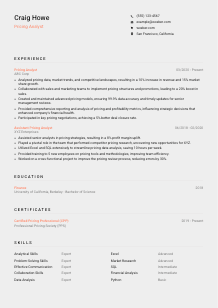
The best Pricing Analyst skills sections balance technical capability with commercial communication. Employers want to see the tools you use to analyze data and the working skills that let you explain pricing recommendations to sales, marketing, and leadership.
Start with the stated requirements. Here, that means data analysis, Excel, SQL, Python, analytical thinking, problem-solving, communication, and collaboration. Then add closely related skills you genuinely use, such as pricing models, profitability analysis, market research, forecasting, or discount analysis.
Build the list around the tools and capabilities most relevant to pricing decisions. Hard skills often carry more weight first, especially when the role involves large data sets and model maintenance. Pair them with business-facing skills that matter in practice, such as presenting recommendations, supporting negotiations, or partnering with sales and marketing.
Place your strongest and most relevant skills near the top. If Excel and analytical skills are central to your day-to-day work, they should appear before less important items. The sample resume handles this well by combining analytical strengths with platform skills and pricing-related capabilities, rather than listing tools in a random order.
A Pricing Analyst skills section should look usable, not decorative. When the list reflects the actual tools, analysis methods, and cross-functional demands of the role, it supports both ATS matching and a more credible read from hiring managers.
Language ability matters when it affects reporting, stakeholder communication, or market coverage. For many Pricing Analyst roles, English proficiency is the main requirement because pricing recommendations, management updates, and contract discussions depend on clear written and spoken communication.
If the posting specifies a language requirement, list it first with an accurate proficiency level. This opening calls for a solid grasp of English, so English should be clearly visible in the section.
Additional languages can be valuable when the business operates across regions, supports multilingual sales teams, or analyzes international markets. In the example, Spanish adds breadth, but it remains secondary to the required English proficiency.
Use realistic labels such as Native, Fluent, Advanced, or Intermediate. Inflating language level can create problems later, especially if the role involves negotiations, executive reporting, or cross-market collaboration where precision matters.
If another language has helped you work with regional teams, interpret market inputs, or support pricing discussions across countries, that context can strengthen your application. Keep it concise and tied to the work.
Only include languages that add real value to your candidacy. For Pricing Analysts, that usually means supporting clearer communication, wider market coverage, or stronger collaboration in cross-border commercial environments.
Your language section should quickly confirm required communication ability and, when relevant, show broader market reach. Keep it accurate, brief, and connected to how pricing work is actually communicated.
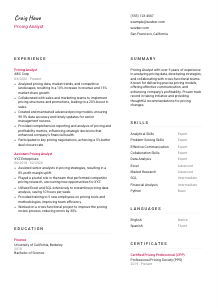
A Pricing Analyst summary should establish your level, your core pricing strengths, and the business outcomes your work supports. In a few lines, it should tell the reader whether you bring pricing strategy experience, analytical depth, and the ability to turn data into recommendations leadership can use.
Start with the main themes in the job description. Here, that includes pricing analysis, market and competitive review, pricing models, profitability reporting, and cross-functional collaboration. Your summary should reflect the parts of that mix you genuinely bring.
A direct first line works best, such as "Pricing Analyst with 5+ years of experience" or a variation that accurately reflects your background. This quickly places you at the right level and helps separate you from broader finance or operations candidates.
Use the middle of the summary to highlight what you are known for. That might be building reliable pricing models, improving margin performance, analyzing competitive trends, or partnering with sales teams on pricing actions. The example summary works because it combines experience, pricing strategy, and profitability impact in a compact way.
Aim for 3 to 5 lines. Avoid vague statements about being motivated or results-driven unless you immediately back them with pricing-related substance. A concise summary with pricing terms, analytical tools, and business outcomes will do more work than a generic paragraph.
When this section is written well, the reader immediately understands your pricing background, your analytical strengths, and the scale of decisions you support. Wozber's AI resume builder can help tighten that language, align it with the posting, and strengthen ATS optimization so your resume surfaces the right pricing signals early.
A strong Pricing Analyst resume shows how you analyze data, shape pricing decisions, and support revenue or margin performance across the business. Each section should reinforce that commercial story with clear titles, relevant tools, and measurable outcomes.
Use Wozber to build an ATS-friendly resume format that reflects the language of the role, surfaces missing requirements, and keeps your content aligned with pricing-specific expectations. When the resume is tailored well, hiring teams can quickly judge your ability to turn analysis into pricing action.




