



Use Wozber and land your dream job
Create Resume
No registration required
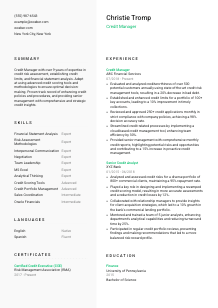
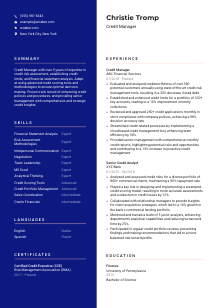
Juggling credit scores, but your resume isn't making the cut? Check out this Credit Manager resume example, created with Wozber free resume builder. Learn how to tailor your fiscal finesse to match job requirements, paving your career path as smooth as a top credit rating!
Credit managers sit where revenue growth meets loss prevention. Hiring teams want to see whether you can evaluate customer risk with discipline, set workable credit terms, and keep collections and exposure under control without slowing down the business. Your resume needs to make those commercial decisions visible through portfolio scope, approval volume, policy judgment, and reporting impact.
In this field, weak resumes often blur the difference between general finance experience and hands-on credit authority. Using Wozber's free resume builder helps you shape an ATS-compliant resume around the terms employers actually use, from credit analysis to risk assessment and reporting cadence, so your background reads clearly as credit leadership rather than broad financial support.
The top of the page should confirm practical fit fast. For a Credit Manager, that means clear identity, direct contact information, and any detail that removes friction early, especially when the employer has named a location requirement.
Lead with your full name in a clean, readable format. Keep it more prominent than the rest of the header so the document feels polished and easy to track, especially when hiring teams review multiple finance and risk resumes in one sitting.
Place "Credit Manager" directly under your name when that is the role you are pursuing. Matching the posted title helps frame your experience around credit authority, policy decisions, collections oversight, and customer risk evaluation from the first glance.
List your phone number and a professional email address, then verify both carefully. Credit roles depend on accuracy and trust, so even small errors in the header can undercut the disciplined impression you want to create.
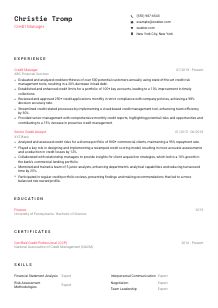
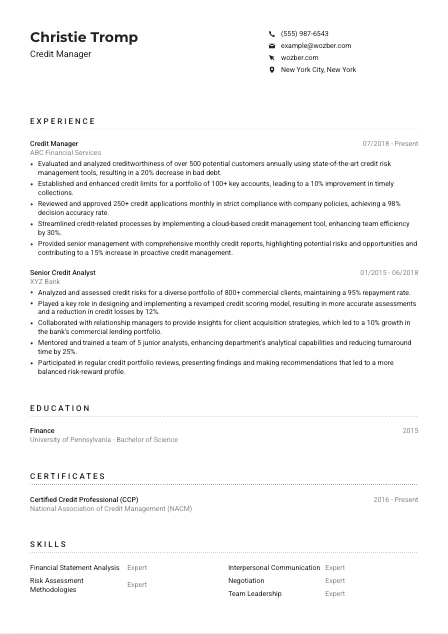
If the employer asks for someone based in a specific city, include that location in your header. In the example, listing New York City, New York immediately answers the posting's location requirement and avoids questions about relocation or availability.
Include LinkedIn or a professional website only if it strengthens your candidacy. For credit professionals, that usually means a profile that supports your resume with consistent titles, certifications, portfolio exposure, or finance-related accomplishments rather than a generic online presence.
This section does not need flair. It needs accuracy, professionalism, and any practical detail that confirms you can move straight into the hiring process for a Credit Manager opening.




This is the section where employers look for actual credit decision-making. They want to see how you assessed risk, set limits, supported collections, worked with sales or lending teams, and reported exposure in ways that protected margin and cash flow.
Read the job description like a checklist of operational expectations. For a Credit Manager, that usually includes creditworthiness analysis, credit limit setting, payment terms, approval authority, collections procedures, and regular reporting to leadership. Those points should guide which achievements you feature and how you phrase them.
List positions in reverse chronological order and make the progression clear. A move from senior credit analysis into credit management tells a useful story when the bullets also show increased authority over approvals, portfolio decisions, policy compliance, and stakeholder coordination.
Focus each bullet on a credit action and its business result. The example does this well with lines such as evaluating more than 500 customers annually, approving 250+ applications monthly, and improving collections performance. That kind of detail shows real operating scope, not just participation in the process.
Use numbers that matter in credit management. Approval volume, account portfolio size, bad debt reduction, repayment rate, turnaround time, collections improvement, and reporting impact all help employers gauge your range and effectiveness. Metrics such as a 20% drop in bad debt or a 98% decision accuracy rate are especially useful because they connect analysis to portfolio outcomes.
Prioritize experience that supports the role's core responsibilities. If a bullet does not show risk assessment, financial statement analysis, credit policy application, negotiations on terms, collections oversight, or collaboration tied to account decisions, it likely belongs elsewhere or can be removed. Every line should reinforce your ability to manage credit exposure with sound judgment.
A Credit Manager resume should show how you handled risk in practical terms. If your experience section makes your approval authority, portfolio scope, and business results clear, hiring teams can quickly see where you would fit in their credit operation.
For credit management roles, education usually serves as a baseline qualification rather than the main selling point. It should confirm your grounding in finance, business, or a related discipline and stay easy to scan alongside your more important experience and certifications.
Start by checking the exact education requirement in the posting. Here, the employer asks for a bachelor's degree in Finance, Business Administration, or a related field, so your degree should be presented in a way that makes that match obvious.
Keep the format simple: degree, field of study, school, and graduation year. In finance and credit hiring, straightforward presentation works better than overexplaining basic academic details unless you are early in your career.
If your degree directly supports the role, say so clearly. "Bachelor of Science in Finance" is stronger than a vague degree label because it ties your education to financial statement interpretation, lending fundamentals, and quantitative analysis.
Relevant coursework can help if you are a recent graduate or your experience is still developing. Subjects such as credit analysis, corporate finance, accounting, risk management, or financial modeling can reinforce your foundation, but seasoned credit professionals usually get more value from giving that space to results in the experience section.
Honors, finance society involvement, or research projects are worth adding when they support your professional direction. Keep them brief and relevant. Once you have years of credit decision-making experience, these details should remain secondary to portfolio work and risk outcomes.
Your education section should quickly confirm that you meet the academic requirement and understand the financial core of the job. Then let your experience and certifications carry the heavier weight.
Professional certifications carry real weight in credit hiring because they show focused expertise beyond a general finance background. They are especially valuable when the employer prefers formal credentials in credit, collections, or risk management.
Look for certifications that are explicitly requested or preferred. In this case, CCP and CCE are called out, which tells you the employer values recognized training in credit policy, risk evaluation, and financial responsibility.
Lead with credentials that directly support the work of approving accounts, managing exposure, and shaping terms. If you hold CCP, CCE, or a similar designation, place it prominently rather than burying it behind unrelated coursework or general training.
Include the year earned and, if relevant, ongoing validity. This gives the employer a quick sense of recency and continuing professional engagement. The example's active CCP and CCE listings work well because they reinforce current standing in the field.
Credit standards, reporting expectations, and risk tools change over time, especially across industries and regulatory environments. Ongoing professional development in areas like commercial credit, collections strategy, financial analysis, or compliance can strengthen your resume and support promotion into broader credit leadership.
When a hiring team is comparing applicants with similar years of experience, credit-specific credentials can sharpen the distinction. List them clearly and let them reinforce your authority in risk and credit management.
A Credit Manager skills section should read like the operating toolkit behind your decisions. Employers expect a mix of analytical capability, policy judgment, negotiation, and communication with sales teams, customers, and senior leadership.
Pull skills straight from the role's real work. In this posting, that includes credit scoring tools, financial statement analysis, risk assessment methodologies, communication, and negotiation. Matching your skills to those functions helps both ATS screening and human review connect you to the role faster.
Lead with the abilities that most directly affect lending or trade credit decisions. Financial statement analysis, credit risk assessment, credit portfolio management, collections strategy, and policy compliance usually deserve priority over broader office or administrative skills.
Do not overload the section with every tool or trait you have ever used. Build a tight list that balances technical strengths and business-facing skills. The example works because it combines core analytical capabilities with negotiation, team leadership, and tools such as Excel and Oracle Financials.
This section should reinforce how you operate, not just what you know. If the list reflects the analysis, decisions, systems, and stakeholder conversations that define credit management, it will do its job well.
Language ability matters in credit work when the role involves customer communication, negotiations on terms, written reporting, or coordination across teams. Present it clearly, especially when the job posting names a required language for business communication.
Check whether the employer specifies a language expectation for reports, correspondence, or verbal communication. Here, strong written and spoken English is required, so English should appear first with an accurate proficiency level.
Order matters. Put the language tied to the job's core communication needs first so the employer can confirm it immediately. That is particularly useful in roles where credit decisions, policy explanations, and collections conversations need precision.
Additional languages can be valuable when you work with diverse customers, regional account portfolios, or cross-border stakeholders. They are not mandatory in every Credit Manager role, but they can strengthen your profile when they expand your communication range.
Use plain labels such as "Native," "Fluent," "Intermediate," or "Basic." Credit discussions often involve sensitive financial information, payment disputes, and approval conditions, so accurate language claims matter more than impressive-sounding ones.
If the company serves multilingual customers or international accounts, language skills can be operationally useful in collections follow-up, account onboarding, and issue resolution. Include them when they add genuine value rather than as filler.
For a Credit Manager, language skills should help explain how you communicate with customers, partners, and leadership. Keep the section accurate and relevant to the scope of the job.
Your summary should quickly tell the reader what level of credit work you handle. In a few lines, it needs to position you around experience, risk judgment, tools, and business outcomes rather than generic finance language.
Read the posting for the few priorities that deserve immediate mention. For this role, those include experience in credit analysis or risk assessment, familiarity with credit tools, and the ability to manage approvals, terms, and reporting. Use those themes to shape the opening lines.
Start with your title and years of relevant experience. A line like "Credit Manager with over 9 years of experience" works because it establishes level quickly and prepares the reader for deeper detail on portfolio management, approvals, and risk decisions.
After the opening, include two or three strengths that matter in credit management, such as financial statement analysis, credit scoring tools, policy development, collections improvement, or reporting to senior leadership. The example summary is effective because it connects technical credit judgment with strategic reporting and process improvement.
Aim for a short paragraph with concrete language. Avoid broad claims about being results-driven or detail-oriented unless you tie them to credit outcomes. The summary should feel like a compressed view of your approval authority, analytical depth, and commercial judgment.
When this section is written well, the employer immediately understands your level of credit responsibility and what kind of portfolio or approval environment you can handle. That sets up the rest of the resume to read with the right context.
A Credit Manager resume works when it shows disciplined risk analysis, sound credit decisions, and the ability to support business growth without losing control of exposure. Keep your examples grounded in approval volume, portfolio responsibility, bad debt performance, collections outcomes, and reporting influence so hiring teams can see the level at which you operate.
Use Wozber's free resume builder and ATS resume scanner to sharpen wording, align your experience with the posting, and present everything in an ATS-friendly resume format. The finished resume should make one thing easy to judge: whether you can manage credit risk with confidence from application review through portfolio reporting.