



Use Wozber and land your dream job
Create Resume
No registration required
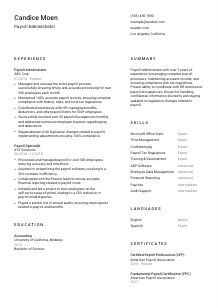
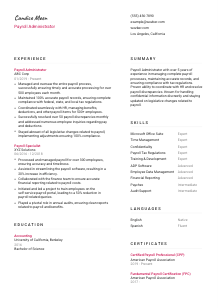
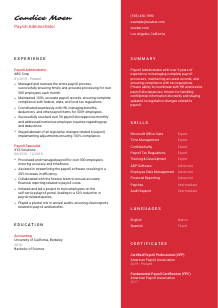
Rolling out paychecks, but feeling taxed by your resume? Check out this Payroll Administrator resume example, created with Wozber free resume builder. It shows how to smoothly itemize your payroll prowess to match job checklists, ensuring your career doesn't get deducted at source!
Payroll work leaves little room for guesswork. A Payroll Administrator is trusted with accurate pay runs, tax withholding, deductions, recordkeeping, and employee questions that often need quick, exact answers. Your resume should make that trust feel earned by showing clean execution, compliance awareness, and the scale of payroll you have handled.
The first screen often separates general administrative experience from hands-on payroll ownership. When your resume mirrors the language of payroll processing, tax compliance, benefits deductions, and employee issue resolution, it becomes easier for both recruiters and an ATS to recognize relevant experience. Wozber's free resume builder helps you shape that language into an ATS-compliant resume that makes your payroll scope and accuracy clear right away.
For payroll roles, the header needs to do one practical job fast. It should confirm who you are, how to reach you, and whether you already meet any location or title expectations that could affect the hiring process.
Use your full name in a larger, clean font so it anchors the page immediately. Payroll hiring is detail-driven, and a cluttered header can create the wrong impression before the reader reaches your experience.
Place "Payroll Administrator" below your name if that is the role you are applying for. This helps frame the rest of your resume around payroll ownership rather than broader office support or HR administration.
Include a current phone number and a professional email address. Check them carefully. Payroll teams deal with precision every day, so even small mistakes in your own contact details can undercut the impression of accuracy.
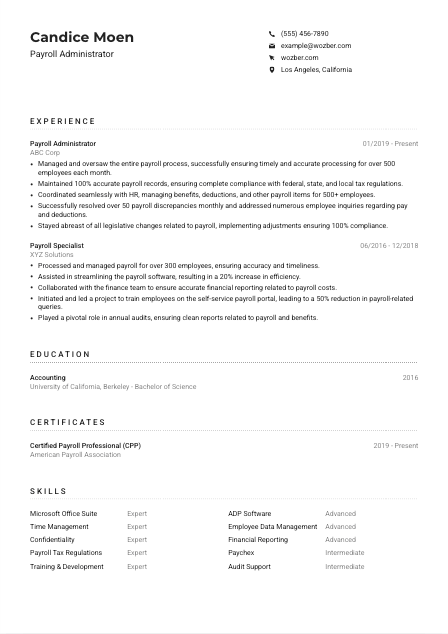
If the employer specifies a city or relocation requirement, include your city and state in this section. In the example, listing "Los Angeles, California" immediately addresses the posting's location filter and removes doubt about availability.
A LinkedIn profile can be useful when it matches your resume and adds payroll-related context such as software exposure, certifications, or promotion history. Skip links that do not support your case for payroll accuracy, compliance work, or system knowledge.
This section is simple, but it still carries hiring value. Clear contact details, the right title, and any stated location requirement help the employer move quickly to the parts that prove your payroll experience.




This is where a Payroll Administrator resume either becomes specific or stays too general. Hiring teams want to see whether you have run payroll, maintained records, handled deductions and taxes, solved pay issues, and worked accurately at a meaningful employee count.
Start by identifying the responsibilities that define the role, such as end-to-end payroll processing, record accuracy, tax compliance, HR coordination, and employee support. Then make sure your bullets reflect those same areas using language that matches your real work history.
List jobs in reverse chronological order and make each entry easy to scan with title, employer, and dates. For payroll positions, a recent role carrying direct processing responsibility usually matters more than older administrative work with only occasional payroll exposure.
Replace generic descriptions with results tied to payroll operations. The example does this well with points like managing payroll for 500+ employees, maintaining 100% accurate records, and resolving more than 50 discrepancies monthly. That kind of wording shows volume, control, and responsiveness.
Quantify employee counts, payroll frequency, discrepancy volume, audit results, processing accuracy, efficiency gains, or reductions in employee queries. Metrics like these are more useful than vague claims because they show the scale and reliability of your work in a payroll environment.
Prioritize experience related to payroll systems, taxes, deductions, benefits administration, reconciliations, audit support, and cross-functional work with HR or finance. If an older role includes unrelated office tasks, keep only the pieces that strengthen your case for handling payroll accurately and confidentially.
After reading this section, the employer should understand how many people you paid, what systems or processes you handled, how accurately you worked, and how you dealt with exceptions. That is the level of detail that separates payroll experience from general administration.
Education is usually not the most heavily weighted section for an experienced Payroll Administrator, but it still matters when the posting asks for a degree in accounting, business, or a related field. Present it clearly so the requirement is easy to confirm.
If the job asks for a bachelor's degree in Accounting, Business Administration, or a related field, list that credential exactly and avoid burying it. In the example, a Bachelor of Science in Accounting directly supports the role's preference for payroll-relevant financial knowledge.
Show degree, field of study, school, and graduation year in a consistent order. Payroll recruiters are usually checking this section quickly, so simple formatting works better than extra design elements.
Accounting, finance, business administration, and related programs carry obvious value because they connect to taxes, reconciliations, record accuracy, and compliance. If your degree is adjacent rather than exact, the field should still be easy to connect to payroll operations.
Early-career candidates can include courses or academic projects tied to payroll accounting, taxation, compensation, HR systems, or business law. Once you have solid payroll experience, that detail becomes optional.
Honors, scholarships, or leadership roles are worth adding only if they support the picture of reliability, analytical ability, or financial discipline. Keep the emphasis on qualifications that make sense for payroll work rather than filling space.
This section should confirm that you meet the stated academic requirement without distracting from your payroll track record. Clear, relevant entries do that job well.
Payroll certifications carry weight because they point to current technical knowledge and commitment to the field. They are especially useful when the employer mentions a preferred credential or when you want to reinforce compliance expertise.
If you hold the Certified Payroll Professional designation, lead with it. The posting here lists CPP as preferred, so placing it prominently helps the employer connect your background to a stated hiring preference within seconds.
Choose certifications that support payroll processing, tax knowledge, compliance, systems, or related finance administration. In the example, CPP and FPC both reinforce a payroll-specific career path better than unrelated general business certificates would.
Add the year earned or active date range if it shows your knowledge is current. That matters in payroll, where tax rules, reporting requirements, and system processes change over time.
If you are pursuing a payroll credential or taking recent coursework in taxation, compliance, or payroll systems, include it when it is credible and relevant. Ongoing learning is particularly useful if you are moving from a payroll support role into broader payroll administration.
Payroll certifications help back up the part of your resume that deals with compliance, accuracy, and changing regulations. When they are relevant and current, they add real weight to your candidacy.
A Payroll Administrator skills section should read like the toolkit behind accurate payroll runs and clean employee records. It needs a practical mix of software, compliance knowledge, and work habits that matter in a payroll cycle.
If the employer asks for ADP, Paychex, or Microsoft Office Suite, include those tools when you have used them in real payroll work. This matters for both recruiter review and ATS matching, especially when payroll software experience is a stated requirement.
List capabilities such as payroll processing, payroll tax regulations, employee data management, benefits and deductions handling, confidentiality, audit support, and time management. The example skills list works because it combines payroll systems with the judgment and control needed to handle sensitive pay data.
Group technical tools, compliance knowledge, and operational strengths in a clean format. A shorter list of highly relevant payroll skills is more convincing than a long mix of broad office terms that do not point clearly to payroll execution.
The employer should be able to connect this section directly to the work in your experience bullets. When the tools, compliance areas, and payroll tasks line up, your resume reads as credible and role-ready.
Language proficiency is usually a supporting section for payroll, not a primary one. Still, it can matter when the posting asks for strong English communication or when employees may come to payroll with questions about deductions, taxes, or pay issues.
If the role asks for strong English communication, list English first and state your level clearly. For payroll positions, this is especially relevant because policy explanations, employee questions, and written follow-up need to be precise.
Additional languages are worth listing when they can improve communication with a broader employee population. In the example, Spanish is a useful supporting skill because payroll often involves direct clarification with employees across departments.
Stick to familiar terms such as "Native," "Fluent," "Intermediate," or "Basic." Avoid vague descriptions. Payroll communication needs accuracy, so your language levels should be just as precise as the rest of the resume.
In some organizations, an extra language helps when explaining pay statements, deductions, or benefits questions to employees who are more comfortable speaking in that language. Mention it as a practical workplace advantage, not as filler.
Languages should support your payroll profile, not distract from it. If multilingual communication is useful in your work environment, include it. If not, keep this section brief and let payroll processing experience stay at the center of the resume.
For payroll roles, communication matters most when it helps you explain pay issues clearly and accurately. List languages in that spirit, with honesty and clear relevance.
Your summary should quickly place you in the payroll function, not in general administration. In a few lines, show your years of experience, the kind of payroll work you own, and the compliance or system strengths that make you dependable.
Start with your title and years of relevant experience, such as payroll administration, payroll specialist work, or end-to-end payroll processing. This immediately tells the reader whether you belong in the payroll lane they are hiring for.
Mention the payroll functions and tools that match the posting, such as full payroll processing, tax compliance, HR coordination, payroll software, and handling confidential employee data. Keep the focus on the areas you have actually done, not a wish list.
A summary becomes stronger when it includes concrete context. The example uses details like 5+ years of experience, accurate record maintenance, discrepancy resolution, and compliance with tax regulations. Those details make the overview feel grounded in real payroll work.
Aim for 3 to 5 lines that read cleanly and stay focused on payroll responsibility. Skip broad personality claims and use the space for process ownership, software familiarity, compliance knowledge, and the kind of employee support you provide.
A useful summary tells the employer, quickly and plainly, that you can run payroll accurately, protect sensitive data, and keep pace with compliance demands. If it does that, the rest of the resume has a strong foundation.
A Payroll Administrator resume should leave very little unanswered. The employer should be able to see your payroll volume, system knowledge, compliance awareness, accuracy, and ability to resolve pay issues without digging for it.
Before submitting, compare your wording to the posting one more time and tighten any section that sounds too generic. Wozber's free resume builder can help you organize that content in an ATS-friendly resume format, and its ATS resume scanner can highlight missing payroll terms or requirements so your experience is easier to match to the role.
When the final version is specific about payroll work, clean in structure, and aligned with the posting, it becomes much easier to judge you as someone who can step in and run payroll with confidence.




