



Use Wozber and land your dream job
Create Resume
No registration required
Crunching payroll numbers, but your resume isn't adding up? Check out this Payroll Analyst resume example, created with Wozber free resume builder. Learn how to seamlessly match your financial flair to job requirements, making sure your career earnings always balance to the right decimal place!
Payroll work gets noticed most when nothing goes wrong. Employees are paid correctly and on time, tax filings stay compliant, reconciliations close cleanly, and exceptions are resolved before they become costly issues. That is why a Payroll Analyst resume needs to show more than general accounting experience. It should make your processing accuracy, audit discipline, reporting insight, and coordination with HR and Finance easy to see from the first screen.
A tailored resume also helps separate payroll specialists from broader accounting candidates whose experience only overlaps on the surface. Using Wozber's free resume builder to align your wording with the posting and produce an ATS-compliant resume makes key payroll terms such as tax compliance, reconciliations, payroll software, and reporting easier to surface, so hiring teams can quickly understand where you've handled payroll volume, discrepancies, and regulatory risk.
Payroll teams work in a high-trust environment, so the top of your resume should feel exact and businesslike. This section is simple, but it still carries useful signals for a Payroll Analyst role, especially when the employer has stated location, communication, or title requirements.
Put your name at the top in a clean, readable format. Payroll hiring often starts with quick screening across several resumes, and a clear header helps recruiters and HR teams identify your application without hunting through the page.
Place "Payroll Analyst" directly under your name when that matches the role you are pursuing. It immediately frames your background around payroll processing, reconciliations, compliance, and reporting rather than leaving the reader to infer whether you come from accounting, HR operations, or finance support.
Include a reliable phone number and a professional email address, then check both carefully. In payroll work, small errors matter. A typo in your own contact details quietly undermines the attention to detail you need for handling employee pay, tax records, and payroll corrections.
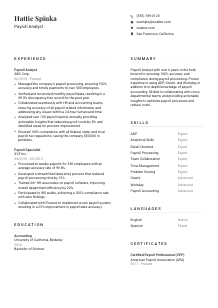
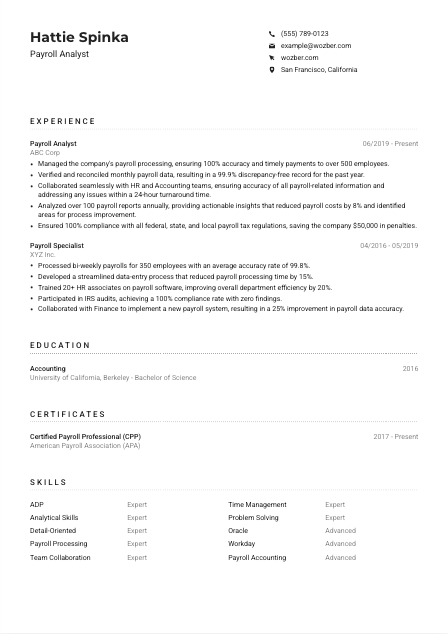
If the employer names a location requirement, include your city and state in this section. Here, listing "San Francisco, California" directly addresses a stated requirement and removes an avoidable question about availability or eligibility for the role's setup.
Add a LinkedIn profile or professional website only if it reinforces your payroll background. For this profession, that might mean showing consistent job titles, payroll systems experience, certifications such as CPP, or progression from payroll specialist work into analyst responsibilities.
Your header should confirm the basics fast: who you are, what role you do, how to reach you, and whether you meet any stated location requirement. Keep it neat, accurate, and aligned with payroll work from the first line.




This section does the heaviest lifting for a Payroll Analyst. Employers want to see whether you have managed real payroll cycles, corrected discrepancies, supported tax compliance, worked across HR and Accounting, and improved payroll operations with measurable results.
Before rewriting your bullets, identify the operational themes in the job ad: payroll processing, data verification, reconciliation, reporting, cross-functional coordination, and tax compliance. Then mirror those priorities in your own language. A bullet such as managing payroll processing with accurate and timely payments speaks directly to the kind of day-to-day ownership employers are trying to fill.
List roles in reverse chronological order with job title, employer, and dates. For payroll hiring, career progression matters. A move from Payroll Specialist to Payroll Analyst, for example, shows growth from transaction execution into analysis, exception handling, reporting, and broader accountability.
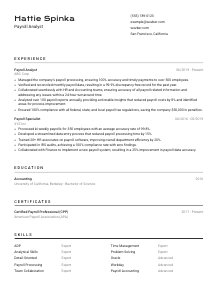
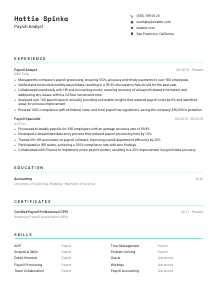
Each role should show what you handled and what changed because of your work. Instead of only saying you processed payroll, show the scope, control, or result. The sample resume does this well with bullets on reconciling monthly payroll data, resolving issues quickly with HR and Accounting, and maintaining compliance across federal, state, and local tax requirements.
Numbers give payroll experience credibility when they reflect real operating scale. Strong examples include employee count, payroll frequency, accuracy rate, discrepancy reduction, turnaround time, report volume, audit outcomes, cost savings, or penalty avoidance. Results like supporting 500 employees, cutting processing time by 15%, or avoiding $50,000 in penalties show impact in terms payroll leaders actually care about.
Prioritize experience tied to payroll operations, payroll accounting, tax filing, systems implementation, audit support, or payroll reporting. If you include broader finance or HR work, connect it clearly to payroll data quality, compliance, or process improvement. The section should leave no doubt that payroll is a core function in your background, not a side task.
Your experience section should show that you can run payroll accurately, resolve exceptions fast, work across systems and departments, and protect the company from compliance risk. When the bullets are specific and quantified, your payroll background becomes much easier to trust.
Education is usually not the deciding factor for an experienced Payroll Analyst, but it still matters because it anchors your accounting, finance, or business foundation. Present it clearly, especially when the posting explicitly asks for a bachelor's degree in a related field.
If you hold a bachelor's degree in Accounting, Finance, or a related discipline, make that easy to spot. For this posting, a Bachelor of Science in Accounting aligns directly with the stated requirement and supports the technical side of payroll accounting, reconciliations, and reporting.
List your degree, field of study, school, and graduation year. That is usually enough. Payroll hiring managers are scanning for relevant education, not academic storytelling, so clarity works better than extra formatting or long descriptions.
Use the formal degree name as it appears on your transcript or diploma. If it closely matches the employer's request, that helps both ATS parsing and human review. "Bachelor of Science in Accounting" reads more strongly than a shortened or vague label when the role calls for accounting or finance education.
Early-career candidates can include coursework or projects tied to payroll, taxation, financial reporting, or accounting systems. If you already have several years of payroll experience, keep this section lean and let your work history carry the detail.
Do not overload the education section with professional credentials, but make sure the overall resume shows both academic preparation and role-specific development. In payroll, that combination works well because the degree supports the accounting base while certifications reinforce compliance and technical specialization.
Your education should confirm that you meet the role's academic requirement without slowing the resume down. Keep it precise and relevant, then let your payroll results do the rest of the persuasion.
Payroll is one of those functions where certifications can carry real weight because they point to current knowledge of regulation, compliance, and professional standards. If you hold a payroll credential, make sure it is presented in a way that supports the role you are targeting.
When a posting mentions CPP or a related certification, place that credential prominently. A Certified Payroll Professional designation speaks directly to payroll processing, tax rules, compliance practice, and the technical knowledge expected in more advanced payroll roles.
List certificates that strengthen your case for payroll work first. One highly relevant payroll certification usually does more for this role than a long list of unrelated training. Keep the section focused on credentials tied to payroll operations, tax regulation, accounting support, or payroll systems.
If the certification is current, renewed, or recently earned, include the date or active period. That helps show your knowledge is up to date, which matters in a field affected by changing federal, state, and local payroll tax rules.
Payroll regulations, reporting expectations, and software workflows change over time. If you are actively maintaining a certification or completing relevant continuing education, that supports your candidacy by showing you stay current with the operational side of payroll, not just the basics you learned years ago.
A well-chosen certification section tells employers that your payroll knowledge is formalized, current, and serious. For roles involving tax compliance, reconciliations, and system accuracy, that extra layer of credibility can matter.
The skills section should read like a payroll toolkit, not a generic list of workplace traits. Employers are looking for a mix of systems knowledge, payroll operations expertise, compliance awareness, and the judgment to catch and fix data issues before payroll is finalized.
Pull the required and preferred skills directly from the posting, then match them only where you genuinely have that experience. Here, that includes payroll processing, tax filing, payroll accounting, analytical ability, detail orientation, and platform knowledge such as ADP, Oracle, or Workday.
For this profession, named systems matter because they affect how quickly someone can step into established workflows. If you have used ADP, Oracle, Workday, or similar payroll tools, list them alongside core functional skills such as reconciliation, payroll reporting, tax compliance, and payroll accounting rather than burying them beneath broad soft skills.
Choose skills that reinforce the kind of payroll work the role actually involves. A concise list of relevant software, analytical strengths, compliance knowledge, and collaboration skills is more convincing than a long inventory of generic abilities. The sample resume strikes that balance by combining system expertise with analytical skills, problem solving, team collaboration, and payroll accounting.
A recruiter should be able to scan this section and see two things quickly: you know the payroll systems and you know the work. Keep the list aligned with real payroll responsibilities so it supports the experience section instead of repeating it vaguely.
Language skills are usually a supporting detail for Payroll Analyst roles, but they can still matter. Payroll involves sensitive employee communication, issue resolution, and coordination with HR, Finance, managers, and sometimes external agencies, so language proficiency should be stated clearly when the posting mentions it.
If the job description calls out a language expectation, include it clearly. In this case, proficient English speaking skills are listed as a requirement, so English should appear in the section and be described at the appropriate level.
Place the required or primary workplace language first. For this role, English belongs at the top because payroll communication depends on precise interpretation of pay details, tax notices, policy updates, and employee questions.
Additional languages can be useful, especially in organizations with diverse employee populations or support functions that handle a wide range of inquiries. Include them if you can actually use them in a professional setting, not just at a basic conversational level.
Choose standard labels such as "Native," "Fluent," "Intermediate," or "Basic." Payroll work leaves little room for ambiguity, and clear proficiency descriptions help employers judge whether you can handle verbal and written communication tied to pay, documentation, and issue resolution.
Even when only English is required, another language may still add value in employee-facing payroll environments. It is not usually a deciding factor for the role, but it can support smoother communication and better service when payroll questions need quick, accurate answers.
List language skills with the same clarity you would use in a payroll report. Cover the required language first, be honest about proficiency, and treat extra languages as added utility rather than filler.
The summary is where you frame your payroll background before the reader reaches the details. For this role, it should quickly establish your years of experience, the payroll environments you have supported, your systems familiarity, and the kind of accuracy or compliance outcomes you consistently deliver.
Start by identifying the few requirements that matter most for the target role. Here, that means payroll processing experience, tax and payroll accounting knowledge, analytical ability, detail orientation, and comfort with platforms such as ADP, Oracle, or Workday. Those points should shape the language of your summary.
Lead with your title and level of experience, such as a Payroll Analyst with 6+ years in payroll operations. That gives immediate context and helps distinguish you from candidates whose background is broader accounting or HR administration with only limited payroll exposure.
Use the next lines to connect your systems knowledge and payroll strengths to business outcomes. The example summary works because it combines software expertise with results such as maintaining accuracy, supporting compliance, and improving payroll processes. That combination reads much stronger than a summary built only on adjectives.
Aim for three to five lines with no wasted space. Every phrase should reinforce payroll capability, whether through scale, compliance, reporting, reconciliation, or software fluency. If a sentence could apply just as easily to a general operations role, rewrite it until it sounds grounded in payroll work.
By the end of the summary, the reader should already understand your payroll depth, systems familiarity, and the level of accuracy and compliance you bring to the function. That gives the rest of the resume a clear frame.
A Payroll Analyst resume works when it makes the operational basics unmistakable: you can process payroll accurately, reconcile data thoroughly, manage compliance risk, and work confidently with payroll systems and reporting. Tailoring each section to those themes creates a much clearer case than relying on generic accounting language.
Use Wozber's free resume builder and ATS resume scanner to align your experience, skills, and summary with the employer's payroll terminology while keeping the document clean in an ATS-friendly resume format. The finished resume should make it easy to judge your readiness to handle payroll volume, discrepancies, tax obligations, and cross-team coordination from day one.




