



Use Wozber and land your dream job
Create Resume
No registration required
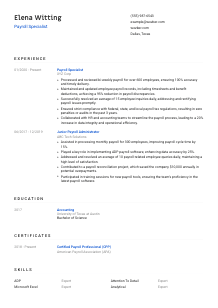
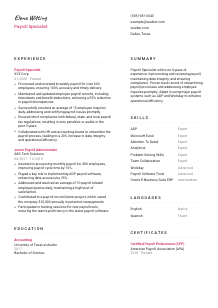
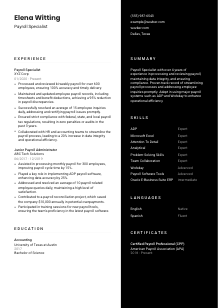
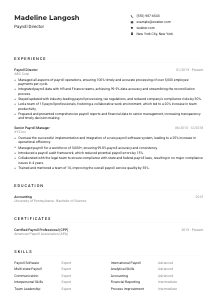
Counting coins but your resume doesn't add up? Check out this Payroll Specialist resume example, created with Wozber free resume builder. It shows how to match your payroll prowess to the job's needs, setting your career up to cash in seamlessly.
Payroll work leaves little room for vague claims. Employers want to see that you can run payroll accurately, manage sensitive employee data, handle tax compliance, and resolve pay issues without creating delays or downstream accounting problems. Your resume should make that operational reliability visible from the first few lines.
A tailored payroll resume changes how quickly a hiring team can connect your background to their payroll cycle, systems, and compliance needs. Using Wozber's free resume builder helps you shape an ATS-compliant resume around the exact language of the job, so tools like ADP, Workday, Excel, payroll audits, and tax reporting are easy to recognize and your day-to-day payroll scope is clear.
Payroll specialists are trusted with confidential records, tax documents, and employee pay data, so even the top of the resume should feel orderly and dependable. Keep this section clean, professional, and aligned with any specific application requirement.
Use your full name as the clearest identifier on the page. Keep it slightly more prominent than the rest of the header so HR or payroll leadership can locate your application quickly when reviewing several candidates.
Use "Payroll Specialist" if that is the role you are pursuing. A matching title helps frame the rest of your experience around payroll processing, record maintenance, reconciliation, and employee support instead of leaving your profile open to broader accounting interpretation.
Include a reliable phone number and a professional email address based on your name. Payroll teams deal in precision, and even small details like outdated contact information or a casual email address can undermine the careful, detail-oriented impression the role requires.
If the employer specifies a location requirement, include your city and state clearly. Here, listing Dallas, Texas directly answers a stated requirement and removes doubt about local availability.
A LinkedIn profile or professional website can support your application if it is current and consistent with your resume. Make sure job titles, dates, payroll systems, and certifications match, especially if you want recruiters to see the same ADP, Workday, or CPP details in both places.
Your header should read like payroll work itself: accurate, current, and free of avoidable errors. Get the basics right so the focus stays on your payroll experience.




For payroll hiring, experience is where employers look for proof that you can handle real payroll volume, protect data integrity, and keep employees paid correctly and on time. Focus less on generic administrative support and more on the payroll cycle, systems used, compliance work, and measurable results.
Start by identifying the work that appears repeatedly in the description. In this case, that includes payroll processing, payroll record maintenance, tax compliance, Excel use, payroll software, and issue resolution. Those priorities should shape which accomplishments you keep, rewrite, or move higher in each role.
Lead with your most recent payroll work so employers see your current systems knowledge and payroll scope first. For payroll positions, recent experience often matters because tax rules, software workflows, and reporting processes change over time.
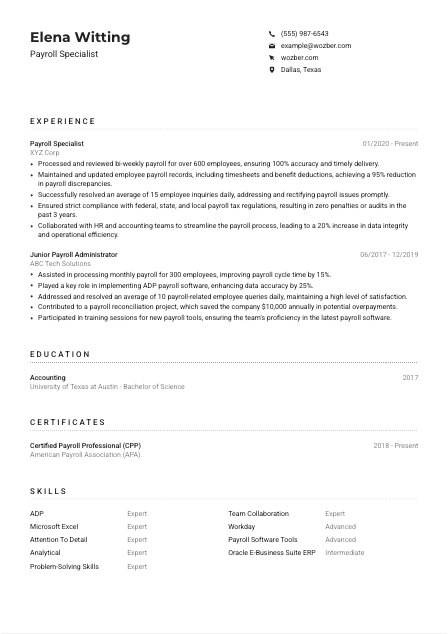
Use accomplishment bullets that naturally echo the work the employer needs done. A line such as "Processed and reviewed bi-weekly payroll for over 600 employees" works well because it directly reflects payroll processing responsibility while also showing scale and accuracy.
Quantify outcomes with measures that matter in payroll: employee headcount, payroll frequency, discrepancy reduction, cycle-time improvement, audit results, overpayment savings, or inquiry volume handled. The sample resume does this effectively with details like 100% accuracy, zero penalties, and a 20% improvement in data integrity.
If you have broader finance or administration experience, keep only the parts that strengthen your case for payroll. Reconciliation work, HR coordination, system implementation, tax documentation, and employee support belong here. Unrelated duties should not crowd out payroll processing, compliance, or systems experience.
Your experience section should show that you can run payroll accurately, work within compliance rules, and solve problems without slowing the pay cycle. When the bullets reflect real payroll scope and outcomes, the match becomes much easier to judge.
Education is usually a straightforward section for payroll roles, but it still matters when the employer asks for a specific academic background. Present it clearly and let it reinforce your grounding in accounting, finance, reporting, and business operations.
If the posting asks for a bachelor's degree in Accounting, Finance, or a related field, state that clearly. A Bachelor of Science in Accounting, like the example, immediately supports work involving payroll calculations, reconciliations, and tax documentation.
List your degree, field of study, school name, and graduation year in a clean order. Recruiters and HR teams often review education quickly, so readability matters more than extra description unless you are early in your career.
When your degree is closely tied to payroll, make that connection visible through the field of study. Accounting, finance, business administration, and similar disciplines signal familiarity with financial controls, reporting structure, and numerical accuracy.
If you are newer to payroll, relevant coursework in accounting, taxation, HR systems, or business analytics can add substance. Academic honors can also help, but only if they support the overall story rather than distracting from hands-on payroll experience.
Training in payroll systems, Excel, compliance updates, or tax reporting can strengthen this part of the resume, especially if it is not formal enough for the certificates section. Use it to show that your knowledge stays current with payroll practice and software changes.
This section does not need much detail, but it should clearly confirm that you meet the degree requirement and have the educational foundation for payroll, reporting, and compliance work.
Certifications matter in payroll because they show technical commitment to wage and tax rules, reporting standards, and current practice. If a posting names a credential, or lists one as preferred, make it easy to find.
When a payroll posting mentions CPP as a plus, list it prominently if you hold it. That immediately tells the employer you have invested in payroll-specific knowledge beyond general accounting experience.
Keep the section focused on certifications that support payroll processing, compliance, systems, or closely related finance work. A shorter, targeted list is usually stronger than a long catalog of unrelated training.
Add the certifying body and the date earned or active period where relevant. For a credential like Certified Payroll Professional, showing the issuing organization and current status gives useful context and signals that the certification is legitimate and maintained.
Payroll regulations, tax rules, and software workflows change, so recent or actively maintained certifications carry weight. Even when a certificate is listed as preferred rather than required, it can help separate you from candidates whose resumes show payroll duties but no formal payroll development.
For payroll roles, certifications are one of the clearest ways to show deeper professional focus. If you have CPP or similar credentials, make them visible and current.
The skills section should read like the toolkit you actually use to process payroll accurately and keep records clean. Lead with systems, technical strengths, and judgment-based skills that connect directly to payroll delivery.
Read the job description for the technical and judgment-heavy skills behind the work. Here that means payroll systems such as ADP or Workday, strong Excel capability, attention to detail, analytical ability, problem-solving, and cross-functional coordination with HR and accounting.
Order matters. Lead with payroll platforms, Excel, and other processing tools, then follow with strengths such as compliance awareness, discrepancy resolution, and collaboration. The sample resume does this well by placing ADP, Microsoft Excel, Workday, and payroll software tools near the top.
Every skill should be something you can back up through experience, results, or daily use. "Payroll tax compliance," "bi-weekly payroll processing," or "Excel reporting" says more than broad filler, and it gives both recruiters and ATS systems clearer payroll-related language to work with.
A payroll skills list should make it easy to see which systems you know, how you support accuracy, and where you add value during the payroll cycle. Relevance matters more than volume.
Payroll is detail-sensitive work, and communication matters whenever employees have questions about deductions, tax forms, corrections, or pay timing. List language ability clearly, especially when the employer states a language requirement.
If the role requires English, list it first with an honest proficiency level such as Native or Fluent. That immediately confirms you can handle payroll correspondence, employee questions, and policy communication in the employer's working language.
Additional languages can be useful in payroll settings with multilingual workforces. If you regularly explain pay statements, withholding changes, or benefits deductions to employees, another language can strengthen your profile even when it is not required.
Choose straightforward labels such as Native, Fluent, Advanced, or Conversational. Payroll communication often involves sensitive or technical topics, so realistic proficiency levels are better than overstated claims.
Not every payroll role needs multiple languages, so do not overemphasize them if your systems knowledge and compliance experience are the bigger selling points. Use this section to support your candidacy, not to distract from core payroll qualifications.
If you are actively improving a language that could help in employee-facing payroll support, you can note it briefly. Just keep the focus on languages you can already use in a workplace setting with confidence.
State them plainly, rate them honestly, and keep them in proportion to the rest of your payroll profile. For most payroll roles, English proficiency should be unmistakable.
Your summary should tell the employer, in a few lines, what level of payroll work you handle and where you bring dependable results. Keep it tight, specific, and closely aligned with the posting you are targeting.
Start with your title and years of relevant experience. For example, "Payroll Specialist with 4+ years of experience" immediately gives the reader role alignment and seniority without wasting space.
Include the payroll platforms, reporting tools, or technical strengths most central to the role. If the employer names ADP, Workday, or Excel, and you genuinely use them, work those into the summary naturally rather than leaving them buried in later sections.
Use a concise achievement or two that reflects payroll priorities, such as improving data integrity, reducing discrepancies, supporting a large employee population, or maintaining compliance with no penalties. The sample summary works because it points to process improvement and prompt issue resolution, both central to payroll work.
Aim for a short paragraph that sounds precise, not inflated. A payroll summary should quickly establish accuracy, systems capability, compliance awareness, and the scale of work you have handled, then move the reader into the experience section for proof.
When written well, your summary tells the employer what kind of payroll professional they are about to read about. Make those first lines specific enough that your experience, systems knowledge, and compliance track record are already in focus.
A payroll resume should make three things easy to confirm: you can process payroll accurately, you understand compliance and records management, and you know the systems the employer uses. If those points are visible across your summary, experience, skills, and certifications, you are presenting the right story for the role.
Use Wozber to turn that story into an ATS-friendly resume format with sharper wording, cleaner structure, and stronger ATS optimization. Wozber's AI resume builder and ATS resume scanner can help you align your resume with payroll-specific requirements, surface missing keywords, and present your experience in a way that makes payroll capability, system knowledge, and compliance discipline easy to recognize.




