



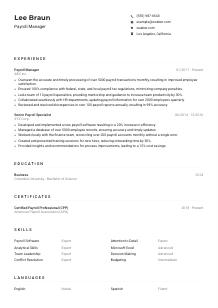
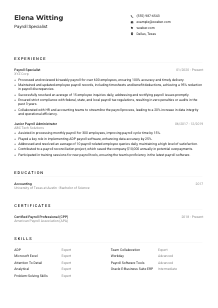
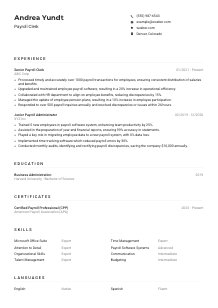
Use Wozber and land your dream job
Create Resume
No registration required
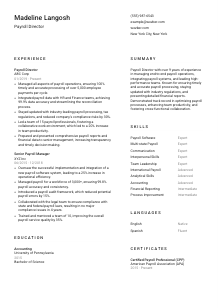
Counting coins, but your resume seems off balance? Check out this Payroll Director resume example, created with Wozber free resume builder. It shows how to match your financial fluency with job requirements, ensuring your career checks all the right boxes!
Payroll leaders are trusted with one of the few processes employees notice immediately when it goes wrong. A Payroll Director resume needs to show control over accuracy, compliance, escalation handling, and team leadership, especially when payroll spans multiple states, complex tax rules, or international populations. Hiring teams want to see that you can keep pay cycles reliable while improving the systems and controls behind them.
A tailored resume changes how quickly that operating scope becomes visible. When your titles, accomplishments, and payroll terminology match the posting, Wozber's free resume builder helps you shape an ATS-compliant resume that surfaces the right keywords, reporting responsibilities, and leadership depth without losing clarity. That makes it much easier for reviewers to see whether you can run payroll cleanly at scale and lead the function with confidence.
Payroll Director hiring starts with practical filters. If your header is missing the target title, accurate contact information, or a required location, your application can lose momentum before anyone reaches your audit controls, reporting experience, or payroll system expertise. Keep this section clean and aligned with the posting.
Place your full name at the top in a clear, professional format. It should be easy to spot, easy to read, and visually stronger than the rest of the contact details. Payroll leadership roles value precision, and even this first line should reflect that standard.
If you are applying for a Payroll Director position, use "Payroll Director" beneath your name when it accurately reflects the role you are targeting. This helps both hiring teams and applicant tracking systems connect your resume to the opening right away, especially when they are screening for leadership-level payroll experience.
List a phone number you answer, an email address that looks business-ready, and check both carefully for errors. Payroll work depends on detail accuracy, so small mistakes here can undermine confidence before your experience section has a chance to prove your command of reconciliations, compliance, or reporting.
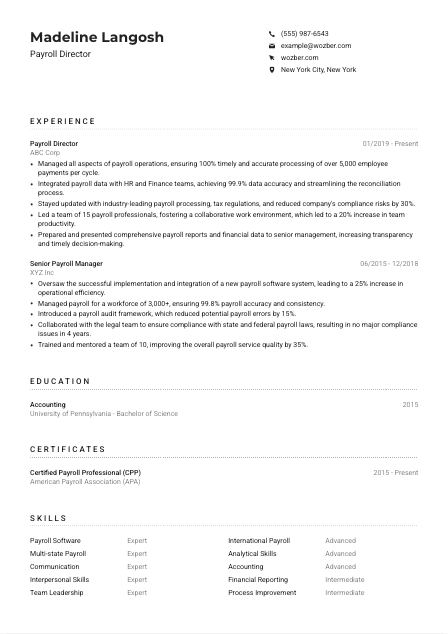
Some Payroll Director openings are tied to a specific office or jurisdiction. In the example here, listing "New York City, New York" immediately addresses the stated location requirement. Use this same approach whenever a posting names a city or region, but do not force location details that are not relevant to the role you want.
A LinkedIn profile or professional website can support your application if it reflects the same career story as your resume. For payroll leadership, that means matching titles, dates, certifications, and scope of responsibility. If the profile is outdated or inconsistent with your resume, leave it off until it is fixed.
Your contact section should confirm that you are reachable, aligned with the target role, and ready for the practical requirements of the job. Clean details set the tone for the more complex payroll story that follows.




This is the section that carries the most weight for a Payroll Director. Employers look for evidence that you have run payroll operations accurately, led teams, worked across HR and Finance, and managed compliance in environments where mistakes affect employees, reporting, and risk exposure. Use your bullets to show scale, control, and leadership judgment.
Before rewriting bullets, pull out the main priorities in the job description. For a Payroll Director, that often includes end-to-end payroll operations, payroll systems expertise, cross-functional coordination, regulatory knowledge, and team leadership. Then make sure your experience section reflects those same themes with concrete examples rather than broad management language.
List your most recent payroll leadership role first and work backward. This format makes it easier to follow your growth from payroll management into director-level ownership of payroll cycles, system implementations, compliance oversight, or larger employee populations.
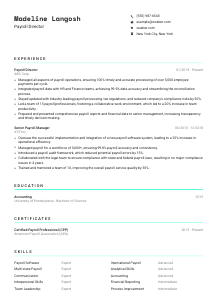
Numbers matter in payroll. Include employee counts, accuracy rates, cycle volume, productivity gains, audit improvements, or compliance outcomes wherever they are real and relevant. The sample resume does this well with results like processing more than 5,000 employee payments per cycle and improving data accuracy to 99.9%, which immediately clarifies operational scale and control.
Choose bullets that reflect the realities of the target role, such as multi-state payroll, international payroll exposure, software implementation, reconciliations, tax compliance, or integration with HRIS and finance workflows. If a posting stresses complex payroll scenarios, make those details visible instead of burying them under generic management statements.
Director-level payroll hiring looks beyond processing accuracy. Include hiring, mentoring, workflow redesign, audit frameworks, service-level improvements, or how you developed a team to handle escalations and reporting deadlines. In the example, leading 15 payroll professionals and improving team productivity by 20% tells a much stronger leadership story than simply saying "managed staff."
A Payroll Director experience section should show what you owned, how large the operation was, what changed under your leadership, and how reliably payroll ran because of your work. Wozber's free resume builder and ATS resume scanner can help you align those points with the language employers use when hiring for payroll leadership.
Education is rarely the deciding factor for a senior payroll hire, but it still matters, especially when a posting names a degree requirement in Accounting, Finance, or a related field. Keep this section straightforward and make it easy for reviewers to confirm that you meet the baseline academic requirement.
If the job asks for a Bachelor's degree in Accounting, Finance, or a related field, place that degree clearly in your education section. A listing such as "Bachelor of Science in Accounting" lines up directly with the requirement and removes ambiguity early in the review.
Include the school name, degree, field of study, and graduation year or date range in a consistent format. Payroll resumes benefit from order and clarity, and your education section should follow that same discipline rather than adding unnecessary detail.
The field matters because it helps explain your foundation in accounting principles, financial controls, reporting, or taxation. For payroll leadership, that context supports the more advanced operational experience you show elsewhere on the resume.
Most experienced Payroll Directors do not need to list coursework, honors, or projects unless those details strengthen a gap in the resume or connect directly to payroll, finance, compliance, or systems work. Use them selectively, especially if you are earlier in your leadership path.
Payroll regulations, tax requirements, and payroll platforms change over time. If you have completed recent training in payroll systems, tax compliance, international payroll, or related finance topics, include it when it strengthens your currency in the field.
Your education section should confirm the required academic background quickly and cleanly. Once that box is checked, your experience and certifications can do the heavier lifting for director-level credibility.
Certifications carry real weight in payroll because they point to specialized knowledge in processing standards, compliance, taxation, and professional discipline. For senior roles, a relevant credential can strengthen your case, especially when the posting explicitly prefers one.
Lead with certifications that are directly tied to payroll leadership, such as the Certified Payroll Professional credential when you have it. In the provided example, the CPP immediately reinforces depth in payroll operations and aligns with the employer's stated preference.
Only include certifications that strengthen your candidacy for payroll oversight, compliance, finance partnership, or leadership responsibility. A short, focused certifications section is more convincing than a long list of loosely related credentials.
Payroll rules change constantly, so dates matter. Listing the year earned or the active certification period shows that your knowledge is current and maintained, which is especially important when the role involves tax regulations, multi-state issues, or international payroll considerations.
If you have pursued additional certification or advanced training over time, include it to reflect ongoing growth in systems, compliance, or leadership. That kind of continued investment is particularly useful for senior payroll roles where process ownership and regulatory judgment are part of the job.
A well-chosen certification section tells employers that your payroll knowledge is formalized, current, and relevant to the demands of the role. That matters when the position carries direct responsibility for accurate pay, compliance, and executive reporting.
A Payroll Director skills section should read like the toolset and judgment areas behind a well-run payroll function. That means combining system knowledge, regulatory depth, analytical ability, and leadership skills in a way that matches the role instead of listing every capability you have picked up across your career.
Start with the posting and identify the actual capabilities the employer names. For this role, that includes payroll systems, payroll software proficiency, analytical strength, communication, interpersonal skills, and experience with multi-state and international payroll. Build your section around those priorities so the match is immediate.
Director-level resumes need both. Include tools and operational areas such as payroll software, multi-state payroll, international payroll, tax compliance, audits, reconciliations, and reporting, alongside people-management strengths like team leadership, stakeholder communication, and cross-functional collaboration with HR and Finance.
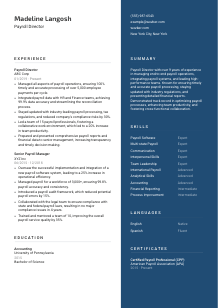
Choose skills that support the work you want to do now. The sample resume is strongest where it stays close to payroll execution and leadership, with entries like Payroll Software, Multi-state Payroll, Team Leadership, and Financial Reporting. A focused list helps the employer picture you running the payroll function, not just collecting keywords.
When this section is tailored well, it reinforces the practical mix of systems expertise, compliance awareness, analytical ability, and people leadership expected from a Payroll Director. Every item should support the story told in your experience section.
Language skills are not always central in payroll hiring, but they can matter when the role requires fluent English for executive reporting, policy interpretation, or employee communication. They become even more relevant when payroll activity crosses regions, countries, or multilingual workforces.
If the job description specifies English proficiency, include it in a simple and direct way. For payroll leadership, strong English supports written policy communication, issue escalation, coordination with HR and Finance, and clear reporting to senior management.
Additional languages can strengthen your resume when the company has international payroll activity or a diverse employee base. A language such as Spanish, as shown in the example resume, can be useful when employee support or payroll coordination extends across broader teams or regions.
Label each language accurately with terms such as Native, Fluent, Intermediate, or Basic. Payroll work often depends on exact interpretation of employee issues and policy details, so overstating language ability can create real problems later.
If another language supports international payroll coordination, regional employee communication, or cross-border administration, that is worth noting. Keep the emphasis practical. The value comes from smoother communication in payroll operations, not from language ability on its own.
Include languages when they add meaningful context to your candidacy. For a domestic payroll leadership role, English may be enough. For broader payroll scope, multilingual ability can help with employee experience, stakeholder communication, and operational coverage across regions.
A language section works best when it supports the actual communication demands of the payroll function. Used well, it adds helpful context without distracting from your core payroll leadership credentials.
Your summary should give a quick, accurate picture of the payroll environment you can lead. For a Payroll Director, that usually means years of experience, scale of payroll ownership, compliance and systems depth, and the kind of team or cross-functional work you have led. Keep it tight, specific, and grounded in your real track record.
Review the posting before writing your summary and identify the few points that matter most, such as years in payroll management, leadership depth, system expertise, complex payroll exposure, and reporting responsibilities. Your summary should echo those priorities in a natural way.
Lead with a direct statement of your payroll leadership background. A phrase such as "Payroll Director with 9+ years of experience" works because it immediately establishes seniority and function without wasting space on generic descriptors.
Use the next sentence to name the areas where you bring the most value, such as end-to-end payroll operations, payroll system integration, multi-state or international payroll, compliance oversight, and executive reporting. The sample summary handles this well by focusing on operational control, team leadership, and process improvement rather than vague ambition.
Aim for a brief summary of two to four sentences. Hiring teams should be able to understand your payroll scope, leadership level, and standout strengths in a few seconds, then move into the experience section expecting to see those claims backed by metrics and examples.
A strong summary tells the reader what kind of payroll leader you are before they reach the details. For this role, it should quickly clarify your operational scope, compliance command, and ability to lead payroll with accuracy and consistency.
A Payroll Director resume should make four things easy to see: the scale of payroll you have owned, the complexity you have handled, the controls you have improved, and the teams you have led. When each section supports those points, the resume reads like a leader who can protect payroll accuracy, compliance, and reporting discipline from day one.
Use Wozber's free resume builder to tighten structure, improve ATS optimization, and align your language with the posting. Then review the final version as a hiring manager would. The resume should leave little doubt that you can run payroll operations reliably and lead the function at a senior level.




