



Use Wozber and land your dream job
Create Resume
No registration required
Navigating investments, but feeling bankrupt on resume ideas? Explore this Financial Management Specialist resume example, created with Wozber free resume builder. Learn how to channel your asset allocation expertise to align smoothly with job requirements, building a career portfolio that always boasts a healthy return!
Financial management work gets reviewed through numbers, controls, and judgment. Hiring teams want to see whether you can build budgets, interpret performance trends, support resource decisions, and keep reporting accurate under deadlines. Your resume should make that operational range visible, not bury it under generic finance language.
A targeted resume changes how quickly your background reads against budgeting, forecasting, compliance, and reporting needs. Wozber's free resume builder helps you shape that experience into an ATS-compliant resume with language that matches the posting naturally, so the hiring team can quickly recognize where you have already handled the same financial processes and business decisions.
Finance professionals are expected to be precise before anyone looks at the first bullet point. Your contact section should reflect the same discipline you bring to reporting, reconciliations, and budget control.
Place your full name at the top in a clean, readable format. Keep it prominent, the way a finance report clearly identifies the owner of the analysis. Avoid nicknames or decorative styling that can distract from a professional presentation.
Add the role title directly under your name when it matches the job you are pursuing. Using "Financial Management Specialist" immediately connects your resume to the opening and helps ATS screening line up your profile with the employer's wording.
List a reliable phone number and a professional email address, then check them carefully. In finance, small errors raise questions fast. If the basics are off, it can undermine confidence before your budgeting, forecasting, or reporting experience even gets reviewed.
Include your city and state when geography matters to the opening. In this example, Chicago, Illinois is part of the stated requirement, so showing that location, or making relocation clear, removes a practical barrier early in the process.
Include LinkedIn or another professional profile if it supports your candidacy. Make sure the titles, dates, and core achievements match your resume, especially around finance systems, reporting scope, and progression into more senior analytical or management work.
This section is brief, but it does real screening work. Clean contact details, an aligned title, and a clear location help the employer move quickly to your financial qualifications without avoidable questions.




This is where hiring teams look for proof that you can manage the mechanics and consequences of financial work. Strong experience bullets show how you planned, analyzed, reported, improved efficiency, and supported decisions that affected cost, profit, compliance, or operational performance.
Start by isolating the employer's main priorities. For this role, that includes financial planning, budgeting, forecasting, analysis, compliance, reporting, tax-related work, and cross-functional support. Use those themes to decide which accomplishments deserve space and which older or less relevant tasks can be cut.
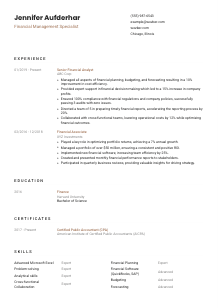
Arrange positions in reverse chronological order and make the most relevant finance roles easiest to scan. Titles such as Senior Financial Analyst or Financial Associate can work well when the bullets clearly show budgeting ownership, reporting cadence, software use, and decision support that overlap with Financial Management Specialist work.
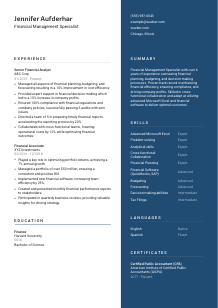
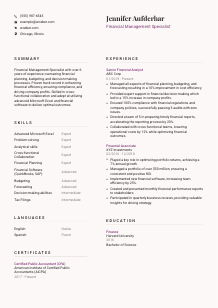
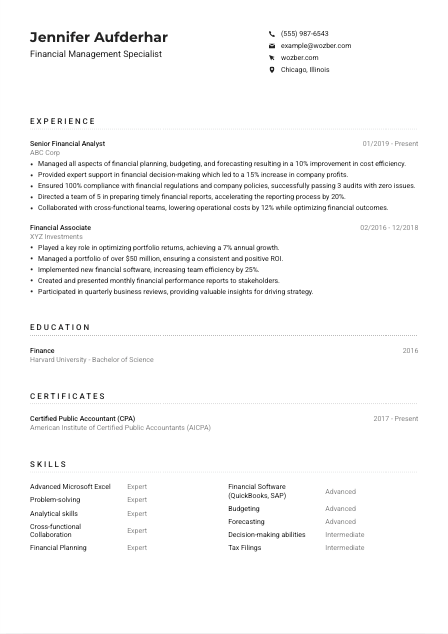
Each bullet should connect a financial activity to a measurable result. Instead of saying you were responsible for planning or reporting, show what changed because of your work. The sample does this well with results such as a 10% improvement in cost efficiency, a 15% increase in profits, and a 20% faster reporting process.
Numbers carry weight in this profession because they show scope and control. Use metrics tied to budgets managed, costs reduced, audit results, reporting turnaround, portfolio size, forecast accuracy, margin improvement, or efficiency gains. A line like "managed a portfolio of over $50 million" gives a hiring manager immediate context for scale.
Prioritize work that speaks to budgeting, analysis, compliance, reporting, tax filings, Excel-heavy modeling, or financial software adoption. If a past role included unrelated duties, trim them back and keep the space for experience that better matches the employer's financial decision-making and operational efficiency needs.
Your experience section should show more than time in finance. It should show control over planning cycles, confidence with reporting, and a track record of improving financial outcomes in ways that are easy to measure.
For financial management roles, education is usually a formal requirement rather than a decorative detail. Present it clearly so the reviewer can confirm that your academic background supports the technical and analytical demands of the position.
List your bachelor's degree exactly and include the field of study. Here, the employer asks for Finance, Accounting, Economics, or a related discipline, so a Bachelor of Science in Finance is a direct match that should be easy to spot.
Keep the entry simple: degree, field, school, and graduation year or date. That structure is easy for both ATS parsing and human review, especially when the employer is checking basic eligibility before spending time on deeper experience review.
If your degree closely supports the role, let that relevance stand on its own. A finance degree already signals grounding in areas such as financial analysis, accounting principles, corporate finance, and performance evaluation, all of which connect naturally to this kind of position.
Relevant coursework, honors, or academic projects can strengthen this section when you are earlier in your career or changing directions within finance. Choose items tied to valuation, managerial accounting, budgeting, tax, financial modeling, or data analysis rather than broad academic filler.
If your development includes formal finance study beyond the degree, such as CPA or CMA preparation, mention it in the appropriate section and keep the education timeline coherent. Continued training matters in finance because regulations, reporting standards, and tools do not stand still.
Education should confirm that you meet the role's baseline qualification quickly and cleanly. Once that box is checked, the rest of the resume can focus on how you apply that training in live financial environments.
Certifications matter most when they reinforce the level of responsibility the role carries. In financial management, designations can signal deeper command of accounting standards, internal controls, reporting discipline, and financial decision support.
When a posting mentions CPA or CMA as preferred, list those designations clearly if you have them. They are strong credibility markers for roles involving compliance, reporting accuracy, tax exposure, and analytical ownership.
Keep this section focused on credentials that support financial planning, management accounting, audit readiness, reporting, taxation, or systems proficiency. A short, relevant list is stronger than a long list of certificates with weak connection to the job.
Show the year earned or active date range when it adds clarity. In regulated and standards-driven work, dates help employers understand whether your credential is current and whether your knowledge has been maintained over time.
If you are actively maintaining or expanding your credentials, make that visible. Finance employers value professionals who stay current with regulatory updates, reporting requirements, and evolving analytical practices, especially when the role supports decision-making across departments.
Well-chosen certifications can strengthen the trust factor in your resume. They help position you as someone who can handle financial responsibility with technical rigor and current professional standards.
A Financial Management Specialist is usually screened for a mix of technical finance capability and practical business judgment. Your skills list should reflect the tools and competencies that actually support planning, analysis, reporting, and compliance work.
Review the posting for both technical and decision-oriented skills. In this case, advanced Microsoft Excel, financial software, analytical ability, problem-solving, and decision-making are all explicit. Mirror that language where it matches your real experience to improve ATS optimization and make the section more relevant.
Lead with the skills most central to the work, such as financial planning, budgeting, forecasting, financial analysis, reporting, compliance awareness, and Excel modeling. Software knowledge like QuickBooks or SAP should support that core picture, not replace it.
Group skills in a way that makes sense to a finance reader. For example, you might separate analytical tools, finance processes, and collaboration skills. The sample resume does this effectively by pairing process skills like budgeting and forecasting with tools like Excel and financial software.
The skills section should make it easy to see that you can work inside the finance cycle, not just talk about it. Prioritize the tools, processes, and judgment calls that the target role depends on every week.
Financial management often requires clear communication with executives, operational teams, auditors, and external stakeholders. Language ability belongs on the resume when it supports that communication or meets an explicit requirement in the posting.
If the employer specifies English, include it with an honest proficiency level. That matters for written reports, budget presentations, policy interpretation, and day-to-day communication around financial decisions.
Additional languages can be useful when the company works across regions, serves multilingual clients, or coordinates with distributed teams. They are especially relevant if your finance work includes stakeholder communication, regional reporting, or support for international operations.
Use clear levels such as Native, Fluent, Advanced, or Conversational. Accuracy matters here too. A finance role often depends on precise written communication, so overclaiming language ability can create problems in interviews or on the job.
Not every Financial Management Specialist role requires multilingual communication, so keep this section in proportion. If additional languages support the employer's market, team structure, or reporting environment, they become a stronger differentiator.
A separate languages section works well when communication requirements are stated or when your additional language skills clearly support business operations. If language is minor in the role, keep the section concise and avoid overstating its importance.
Language skills are secondary to your finance capability, but they can still strengthen your profile when the role involves broader stakeholder communication. Present them clearly and keep the emphasis on practical business use.
Your summary should read like the opening line of a finance briefing: concise, specific, and grounded in results. It needs to establish your level, your core areas of financial ownership, and the type of outcomes you have delivered.
Pull together the recurring themes from the job description before you write. Here, the role centers on planning, budgeting, forecasting, analysis, compliance, reporting, and support for financial decisions. Your summary should reflect that mix rather than giving a broad statement about being a finance professional.
Open with your title or closest equivalent, your years of experience, and your main area of expertise. A line like the sample's "over 6 years of experience overseeing financial planning, budgeting, and decision-making processes" works because it establishes scope immediately.
Choose strengths that connect directly to the employer's needs, such as improving cost efficiency, ensuring compliance, accelerating reporting, or using Excel and finance systems effectively. This is the place to mention the combination of analysis and operational support that financial management roles often require.
Aim for a short paragraph with substance in every line. Three to five lines is usually enough. Avoid generic adjectives and use specifics instead, whether that is years of experience, finance processes managed, software proficiency, or measurable business results.
A well-written summary gives the hiring team a clear read on your financial scope before they reach the first job entry. It should quickly position you as someone who can manage numbers, support decisions, and keep reporting accurate under pressure.
A Financial Management Specialist resume works when it makes your planning, analysis, reporting, compliance, and operational support easy to follow from top to bottom. Every section should reinforce that you can handle financial responsibility with accuracy and business judgment.
Use Wozber's free resume builder to tighten structure, tailor language to the posting, and produce an ATS-friendly resume format that reflects how finance teams actually hire. When the resume is aligned well, the employer can quickly see your readiness to manage budgets, forecasts, reporting cycles, and decision support with confidence.




