



Use Wozber and land your dream job
Create Resume
No registration required
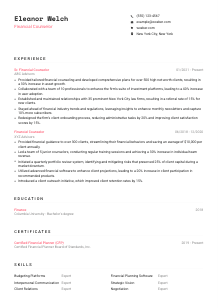
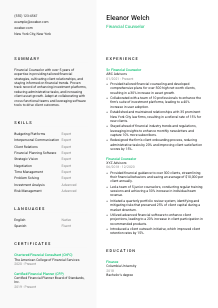
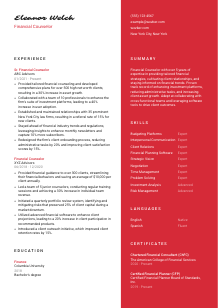
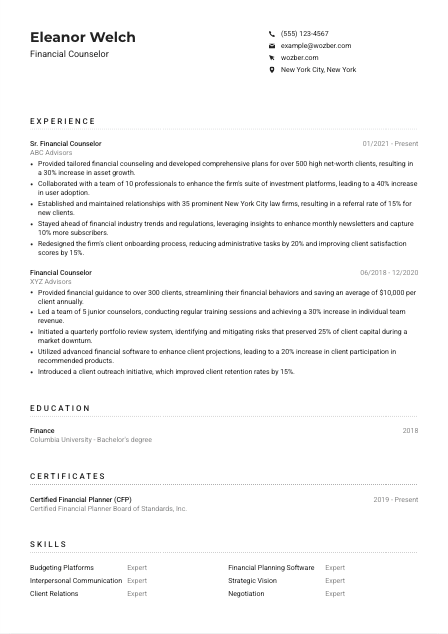
Guiding finances, but your resume feels bankrupt? Check out this Financial Counselor resume example, created with Wozber free resume builder. It shows how to present your fiscal acumen to match job expectations, nudging your career investment steadily towards prosperity!
Financial counseling is built on trust. Employers want to see that you can interpret a client's full financial picture, explain options clearly, and turn goals and risk tolerance into practical plans that people will actually follow. Your resume should make that visible through client outcomes, planning scope, and the kinds of financial decisions you have supported.
A tailored resume also helps hiring teams quickly separate general finance experience from real counseling work. Using Wozber's free resume builder to align your wording with the job description and keep an ATS-friendly resume format can bring forward the details that matter most here, such as client advisory work, planning tools, documentation habits, and collaboration with accountants or attorneys. That makes it easier to see whether you can step into client-facing financial guidance with confidence.
For a Financial Counselor, the contact section should immediately present you as credible, reachable, and professionally aligned with the role. Keep it clean, accurate, and tailored to any practical requirements in the posting.
Place your full name at the top, followed by the title "Financial Counselor" if that matches the role you are applying for. This creates an immediate connection between your background and the opening. If your recent work includes adjacent titles such as Financial Planner or Wealth Advisor, you can still use the target title when your experience clearly supports counseling, planning, and client guidance work.
List a current phone number and a professional email address that uses your name. In a field where clients trust you with sensitive financial decisions, small errors suggest carelessness. Before sending your resume, test every link and double-check every digit. That level of accuracy matters in finance.
Some Financial Counselor jobs have a clear location requirement, especially when client meetings, licensing considerations, or local market knowledge matter. In the example posting, New York City, New York is explicitly required, so that should appear in the contact section. Keep this practical. You are showing that you meet the employer's stated logistics, not turning location into a career headline.
If you have a LinkedIn profile or professional website, include it only when it supports your candidacy. For this role, that might mean a polished LinkedIn presence with certifications, client-service experience, financial planning software exposure, or thought leadership on planning topics. Make sure the content matches your resume dates, titles, and credentials.
Skip age, marital status, photo, and unrelated personal facts. Financial Counselor hiring decisions are better served by information tied to advisory work, client communication, and qualifications. Keep the section focused on professional identity and access.
This section should confirm that you are a professional candidate who is easy to contact and already aligned with the role's practical requirements. Clear contact details and the right title let the rest of your resume do its work.




This is the section hiring teams study most closely. For Financial Counselor roles, they are looking for client advisory scope, the kinds of plans you built, the financial tools you used, and the outcomes your guidance produced.
Read the posting with a highlighter. Mark the work that defines success in the role, such as personalized counseling sessions, presenting financial plans, staying current on regulations and market conditions, and coordinating with other professionals. Then make sure those duties appear in your experience section using language that reflects what you actually did. This keeps your resume aligned with both ATS screening and human review.
List your positions in reverse chronological order and give the most space to work that involved client counseling, financial planning, portfolio guidance, budgeting support, or related advisory services. A title like "Sr. Financial Counselor" should appear prominently because it immediately signals relevant scope. If earlier roles were less directly related, compress them and preserve detail for the work that shows counseling depth.
Each bullet should show what financial issue you addressed, what action you took, and what changed as a result. Good Financial Counselor bullets often include plan development, risk discussions, product recommendations, portfolio reviews, retention improvements, or process changes that improved service quality. The sample resume does this well by pairing activities like comprehensive plan development and onboarding redesign with clear business and client results.
Use numbers that reflect how your work is measured. For this profession, that can include assets grown, clients advised, savings delivered, retention rate, referral growth, adoption of financial platforms, time saved in onboarding, or capital preserved during market volatility. Metrics such as "500 clients served," "30% asset growth," or "15% higher client retention" give hiring managers a much clearer picture of your advisory impact than broad claims about helping clients.
Keep bullets that show financial judgment, client education, planning skill, software use, compliance awareness, or cross-functional coordination. Remove generic duties and unrelated achievements that could belong to almost any business role. A Financial Counselor resume should read like someone who can assess a financial situation, recommend a plan, document follow-up, and build trust over time.
When this section is working, a reader can quickly see the size of your client book, the kind of planning work you handled, and the financial outcomes you influenced. That is the core proof this role needs.
Education matters in financial counseling because it shows your grounding in financial principles, analysis, and business judgment. Present it clearly, with enough detail to confirm that you meet the role's academic requirement without overloading the section.
If the job asks for a bachelor's degree in Finance, Accounting, Business, or a related field, list that qualification in plain terms. In the provided example, a Bachelor's degree in Finance from Columbia University lines up exactly with the employer's requirement. If your degree is in a related discipline, use the official title and let the rest of your resume show the counseling and planning experience that supports it.
Use a straightforward structure: degree, field, school, and graduation year. Hiring teams reviewing Financial Counselor resumes do not need a paragraph here. They need to confirm that you have the expected academic base for planning conversations, product recommendations, and client guidance.
If your education included concentrations or coursework tied to investments, personal finance, risk management, tax, or financial analysis, include that only when it strengthens your relevance, especially earlier in your career. Once you have several years of advisory experience, your client results usually carry more weight than a long course list.
Do not bury major credentials inside the education section. CFP and ChFC belong in certifications, where they can stand out properly. Still, your degree can reinforce the story by showing a formal finance foundation beneath those professional designations.
Honors, scholarships, finance society leadership, or case competition results can help if they point to analytical ability or early commitment to financial planning. Use them sparingly. This section should stay focused on the academic qualifications that support your work with clients and financial plans.
Your education section should confirm that you meet the role's baseline qualification and that your finance knowledge is grounded in formal study. Keep it concise, accurate, and relevant to advisory work.
In financial counseling, certifications often carry real weight because they signal technical knowledge, ethical standards, and commitment to current industry practice. Present them where they can be read quickly and understood immediately.
Lead with certifications tied directly to planning and client advice. If you hold a CFP or ChFC, place them at the top because they are widely recognized in counseling and planning roles. The job description lists these as preferred, so featuring them prominently shows a close match to the employer's expectations.
Choose certifications that reinforce your ability to advise clients on budgeting, investments, financial goals, and long-term planning. Avoid overcrowding the section with unrelated training. For a Financial Counselor, a shorter list of respected finance credentials is usually more persuasive than a long inventory of generic certificates.
Add the year earned and, if relevant, the active period or renewal status. In regulated and advisory environments, current credentials matter. A date range such as "2019 - Present" helps show that the certification is active and maintained, not simply earned once and forgotten.
Financial advice changes with regulation, market conditions, product structures, and planning practices. Your certifications section can signal that you stay current in the field. If you regularly maintain CE requirements or add advanced training tied to planning, retirement, taxation, or risk, that supports your credibility with clients and employers alike.
The right credentials strengthen your profile fast. They show that your client guidance is backed by recognized financial training, not only day-to-day experience.
Financial Counselor skills should show a balance of technical finance capability and client-facing judgment. Employers need to see that you can use planning tools effectively and explain financial choices in a way clients understand.
Review the posting for explicit requirements and the work behind them. Here, that includes financial software, budgeting and investment platforms, interpersonal communication, and client education. Build your skills section from those themes instead of defaulting to a generic finance list.
A useful Financial Counselor skills section combines planning tools and human interaction skills. Budgeting platforms, financial planning software, investment analysis, and risk management belong alongside client relations, communication, and problem solving. The sample resume gets this balance right by pairing software categories with counseling-oriented strengths.
List skills that you can defend in an interview and that connect to the work you describe elsewhere on the resume. Too many broad terms dilute the section. A tighter list built around planning systems, advisory communication, and analysis gives a more accurate picture of how you operate with clients and financial data.
This section should make it easy to see that you can work with financial platforms, interpret data, and communicate recommendations clearly. That combination is central to effective financial counseling.
Language skills can matter in financial counseling because trust, clarity, and nuance are essential in client conversations. If you can serve clients in more than one language, that can broaden the communities and households you are able to support.
Check whether the employer specifies a required language level. In this case, high English proficiency is explicitly requested, so English should appear clearly on the resume. When a posting names a language requirement, do not assume it is obvious from your experience. State it.
If you speak another language well enough to guide clients through financial discussions, add it. In markets with diverse client populations, that can strengthen your value. Spanish, for example, may be relevant when your client base includes bilingual households or community-focused advisory work.
Do not list extra languages just for variety. Include them when they genuinely improve your ability to explain plans, answer questions, or build trust with clients from different backgrounds. For a client-facing finance role, that is where language skill has real resume value.
Label each language accurately with terms such as Native, Fluent, Intermediate, or Basic. Financial conversations involve precision around goals, risk, debt, investments, and legal or tax-adjacent topics. Overstating fluency can quickly create problems in an interview or on the job.
Some Financial Counselor roles are centered on local communities, while others support international clients, expatriates, or multilingual households. Let the language section reflect the service environment you are targeting. Keep it relevant to the kind of counseling work you want to do.
When presented honestly and relevantly, language skills show that you can connect with a wider range of clients and explain financial decisions with clarity. That can be a meaningful advantage in advisory work.
The summary should quickly establish your level, your area of financial counseling expertise, and the outcomes you are known for. In a few lines, it should tell the reader what kind of clients and financial decisions you are equipped to handle.
Start by identifying the core of your background. Are you strongest in personal financial planning, high-net-worth advisory work, budgeting and debt guidance, investment-related counseling, or cross-functional client service? Your summary should reflect the advisory lane you have truly worked in, not a vague finance identity.
Lead with a direct line such as "Financial Counselor with 5+ years of experience" and then add the kind of work you handle. This immediately gives context. The sample summary does this effectively by combining years of experience with tailored financial strategies and client relationship work.
Mention the capabilities that matter most for the target role, such as developing financial plans, improving client outcomes, using planning software, or collaborating across disciplines. Tie them to results where possible. Phrases connected to asset growth, retention improvement, or process efficiency read much stronger than broad claims about being dedicated or detail-oriented.
Aim for a short paragraph that can be scanned in seconds. Avoid repeating every skill or credential from the rest of the resume. Instead, write a summary that makes a hiring manager want to continue because they already understand your advisory focus, your level of experience, and the kind of value you bring to clients.
A well-written summary gives hiring teams an immediate sense of your financial counseling scope and professional level. When it is tailored well, the rest of the resume feels consistent and easier to evaluate.
A Financial Counselor resume should show more than finance knowledge. It should show that you can work directly with clients, translate financial complexity into practical recommendations, and support decisions with sound planning judgment.
Use Wozber's free resume builder and ATS resume scanner to sharpen your wording, match the posting more closely, and build an ATS-compliant resume that highlights the advisory experience, software proficiency, and credentials most relevant to the role.
When each section points to the same story, employers can quickly recognize a candidate who is ready to counsel clients with clarity and trust.




