



Use Wozber and land your dream job
Create Resume
No registration required
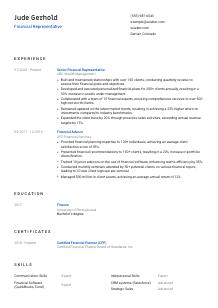
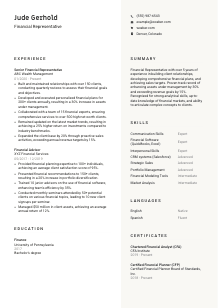
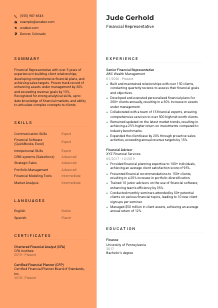
Delivering returns, but your resume is in the red? Compound your credentials with this Financial Representative resume example, built with the Wozber free resume builder. Learn how to highlight your investment insights and financial savvy to match job expectations, putting your career on a lucrative trajectory.
Financial Representative hiring tends to move quickly because the work sits at the intersection of advice, relationship management, and revenue generation. A resume that only says you understand finance is not enough. Hiring teams want to see how you handle client reviews, build tailored financial plans, explain recommendations clearly, and turn trust into long-term account growth.
When that story is tailored well, the first scan becomes much more favorable, especially in an ATS-driven process. Wozber's free resume builder helps you line up your language with the posting, keep an ATS-friendly resume format, and surface the details that matter most for this kind of role, such as planning scope, client portfolio size, and sales performance.
For a Financial Representative, the header should communicate professionalism and remove basic friction right away. This section is simple, but it still affects how smoothly a hiring manager can move from your resume to a first conversation.
Place your name at the top in a clean, readable style. Financial services hiring is formal enough that presentation still matters, and a cluttered header can make the resume feel less polished before anyone reaches your planning or sales results.
List "Financial Representative" under your name when that matches the role you are pursuing. This immediately places your background in the right lane, especially if your recent title was Financial Advisor, Relationship Manager, or another adjacent title with overlapping client and revenue responsibilities.
Add a phone number you actually answer and a professional email address, ideally in a simple format based on your name. In client-facing finance roles, small details carry weight. An outdated number or casual email address can undercut an otherwise credible application.
If the employer asks for local availability or relocation willingness, include that clearly in your contact line. Here, listing Denver, Colorado signals that a practical hiring concern is already covered. If you are relocating, note that rather than leaving the employer to guess.
Include LinkedIn or a personal website only if it strengthens your case. For this profession, that usually means a profile that supports your work history, credentials, licenses, client-facing focus, or thought leadership in planning and market topics. Keep it current before you put it on the page.
Your personal details should confirm that you are reachable, professionally presented, and ready to pursue the role without avoidable questions about title alignment or location.




This section carries the most weight for a Financial Representative because employers want a track record they can picture in practice. Show client relationships managed, plans delivered, assets influenced, revenue produced, and how your advice performed over time.
Start by identifying the recurring demands in the job description. For this role, the main threads are client relationship management, personalized financial planning, collaboration with other advisors, market awareness, and proactive sales. Your bullets should map to those realities instead of describing generic finance duties.
List your most recent position first and include employer name, title, and dates. In financial services, progression matters. A reader should be able to trace how your responsibilities expanded from advisory support, planning, or sales into broader client ownership, larger books of business, or more complex portfolios.
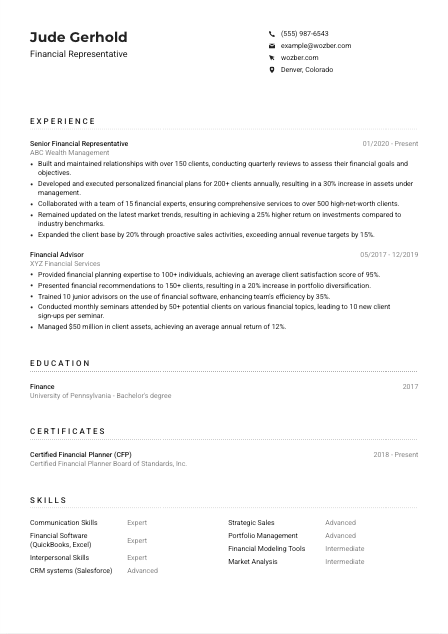
Write bullet points that show what changed because of your work. Strong examples in this field include increasing assets under management, improving portfolio diversification, retaining clients through regular reviews, or surpassing annual revenue goals. The sample resume does this well by tying quarterly reviews, personalized plans, and sales activity to measurable business results.
Numbers matter here because they give context to trust and performance. Include figures such as number of clients served, assets managed, review cadence, revenue growth, conversion rates from seminars or referrals, and returns achieved where appropriate and accurate. Metrics like "150 clients," "$50 million in assets," or "20% client base growth" tell a far clearer story than broad claims about success.
Keep the section focused on experience that speaks to advising clients, presenting financial recommendations, using planning tools, and generating business. If an older role does not connect to client-facing finance, trim it back or remove it. Every bullet should help the reader understand how you would manage relationships, develop plans, and contribute to production targets in the next seat.
By the end of your experience section, a hiring manager should understand the size of your client work, the quality of your planning, and the commercial results you have already delivered.
Education usually plays a supporting role once you have relevant experience, but it still matters in financial hiring because it confirms technical grounding in finance, accounting, analysis, and planning concepts. Keep it easy to review and closely aligned with the role's academic requirement.
Check the posting for the degree level and field before you format anything. Here, the employer asks for a bachelor's degree in Finance, Accounting, or a related area, so that information should be visible at a glance. If your major is adjacent, make the connection clear through the field title rather than assuming it will be obvious.
List degree, field of study, school, and graduation year in a consistent format. Financial employers do not need decoration here. They need a fast read on whether you meet the baseline academic requirement and whether your background supports work in planning, analysis, and client recommendations.
If your credential matches the posting closely, use that wording. For example, "Bachelor's degree in Finance" aligns directly with the requirement and reduces ambiguity in both ATS parsing and human review.
Relevant coursework is most useful for early-career candidates, career changers, or applicants whose degree title does not fully explain their finance training. Choose subjects that connect to the actual work, such as investments, portfolio theory, financial analysis, retirement planning, or risk management.
Honors, finance competitions, investment club leadership, or capstone work can be useful if they reinforce analytical discipline or interest in client advisory work. Once you have several years of experience, keep these details brief so the section stays proportionate.
Your education should quickly establish that you meet the role's academic baseline and have a credible foundation for financial planning conversations and analytical work.
In financial services, certifications often influence how seriously your expertise is taken, especially when the role includes planning advice, investment recommendations, or high-value client relationships. If you hold recognized credentials, make them easy to spot.
Review the posting for named credentials or preferred designations. In this case, CFP and CFA are listed as a plus, so candidates who hold either should feature them prominently. That does not make them mandatory for every Financial Representative role, but it does make them strong tailoring points here.
List licenses and certifications that support financial planning, portfolio guidance, analysis, or regulated client communication. General courses have less value than recognized credentials that hiring managers immediately associate with professional standards and domain knowledge.
Include the issuing body and the active date range when relevant. In a regulated and credential-conscious field, dates help confirm that your certification is current. The example resume handles this well by showing both the credential name and active period.
If you are working toward a designation or regularly complete continuing education in planning, investments, compliance, or tax-aware advising, include that when it adds substance. It shows that your knowledge is current in a market shaped by changing products, rules, and client expectations.
Well-chosen certifications reinforce that your advice is backed by recognized training and that you stay current in a profession where credibility matters from the first client meeting.
A Financial Representative needs a mix of technical finance capability and client-facing judgment. Your skills section should reflect both sides of the job, with emphasis on the tools and abilities that directly support planning, recommendations, relationship management, and growth.
Read the posting closely and extract the capabilities it names. Here, that includes financial software, spreadsheets, financial modeling tools, CRM systems, interpersonal communication, and sales-oriented relationship building. Those are stronger anchors than generic terms like "hardworking" or "team player."
Combine platform knowledge and advisory skills in a way that reflects actual day-to-day work. A useful mix might include Excel, financial modeling, Salesforce or another CRM, portfolio management, market analysis, communication, and consultative sales. The sample resume does this effectively by pairing software and CRM skills with strategic sales and portfolio work.
Prioritize skills that support the target position over broad finance vocabulary. If a skill does not help you build plans, manage clients, present recommendations, track opportunities, or interpret market information, it probably does not need space here. A shorter, role-specific list reads much better than a long inventory of loosely related abilities.
Your skills section should make it obvious that you can handle both the analytical side of the work and the relationship-building that drives client retention and revenue.
Language ability matters in this profession because financial advice depends on clarity, trust, and accurate explanation. If a posting calls out English communication, treat that as an operational requirement, not a minor detail.
When the role specifically requires strong English communication, list English prominently with an honest proficiency level. Financial Representatives regularly explain portfolio strategy, risk, long-term planning, and product recommendations, so language proficiency directly affects client understanding.
If you speak additional languages, include them when they are strong enough to use in professional conversations. In client-facing finance, another language can help with rapport, community outreach, and servicing a broader client base, even when it is not a formal requirement.
Terms such as Native, Fluent, Intermediate, and Basic are usually enough. Keep the labels realistic. Overstating proficiency can become a problem quickly in interviews or client-facing scenarios.
Extra languages are most useful when they support business development or client service. For example, fluency in Spanish may be relevant if you work with bilingual households or conduct community seminars. Keep the point practical rather than treating language skill as a generic bonus.
If you are targeting firms with diverse retail clients, multilingual ability may strengthen your profile more than it would in a narrowly specialized advisory team. Include it where it genuinely supports the kind of relationship-driven work you want to do.
List languages in a way that supports the core requirement of the role: explaining financial concepts clearly and building trust with the clients you serve.
Your summary should give a quick, confident read on the kind of Financial Representative you are. Focus on the blend that matters most in this field: client relationships, financial planning judgment, and measurable growth.
Use the posting to decide what belongs in the first lines. For this position, that means experience in financial planning or related sales, comfort explaining complex concepts, familiarity with financial tools, and the ability to build a book of business. That combination should shape your opening statement.
Start with a direct line that states your profession and tenure, such as being a Financial Representative with 5+ years in client advisory, planning, and revenue-generating relationship management. This helps the reader place your level quickly.
Choose highlights that match how performance is measured in the profession. That might be client portfolio growth, assets under management, revenue target attainment, financial plan volume, or client satisfaction. The example summary works because it combines years of experience with outcomes like a 30% increase in assets under management and revenue performance.
Aim for three to five lines with no filler. Avoid vague traits unless they are tied to real work. "Strong communicator" is more persuasive when paired with evidence that you present recommendations to clients, lead reviews, or translate market conditions into clear planning advice.
A well-written summary should quickly position you as someone who can win client trust, build sound financial plans, and contribute to growth from the start.
A Financial Representative resume works best when it shows two things clearly: you can guide clients with sound financial judgment, and you can grow relationships into measurable business results.
Use Wozber's free resume builder to sharpen that message, keep your resume ATS-compliant, and align your wording with the planning, CRM, sales, and credential requirements in the jobs you target. The finished resume should make your client advisory scope and production record easy to understand.




