



Use Wozber and land your dream job
Create Resume
No registration required
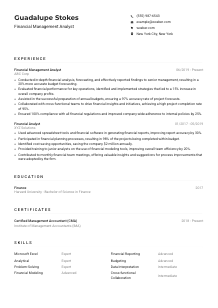
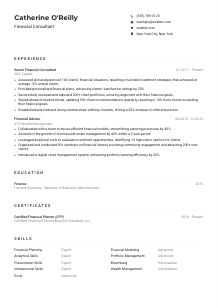
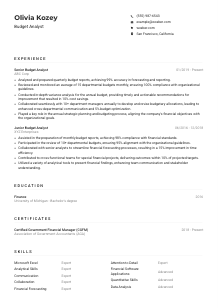
Working through fiscal puzzles, but your resume doesn't add up? Check out this Finance Business Analyst resume example, built with Wozber free resume builder. Learn how to present your analytical acumen to meet job prerequisites, paving a career path that's as robust as your financial models!
Finance Business Analysts sit where reporting, planning, and business decisions meet. Hiring teams want to see more than general finance experience. They look for proof that you can turn raw financial data, budget variance, and operating trends into recommendations leaders can actually use.
A tailored resume changes how quickly that story comes through. When your language reflects the role's mix of financial analysis, forecasting, ROI thinking, and cross-functional work, Wozber's free resume builder helps you shape an ATS-compliant resume that surfaces the right terms and makes your business impact easier to read from the first scan.
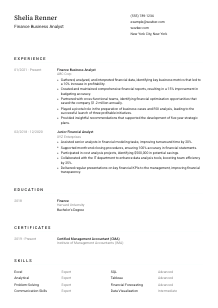
This section is simple, but it still does real work. For a Finance Business Analyst, clean contact details and a precise title reinforce the same qualities the role demands elsewhere: accuracy, clarity, and attention to detail.
Use your full name in a clear, readable style at the top of the page. In finance roles, presentation matters because your resume is often read as a reflection of how you handle reports, models, and executive-facing documents.
Place the job title directly under your name when it matches your background. Using "Finance Business Analyst" immediately aligns your profile with the role and helps separate you from broader analyst candidates whose experience may lean more heavily toward accounting, FP&A, or pure business operations.
Include a reliable phone number and a professional email address, ideally based on your name. Small formatting errors here can undercut the precision expected from someone who works with financial reporting, forecasting, and business case analysis.
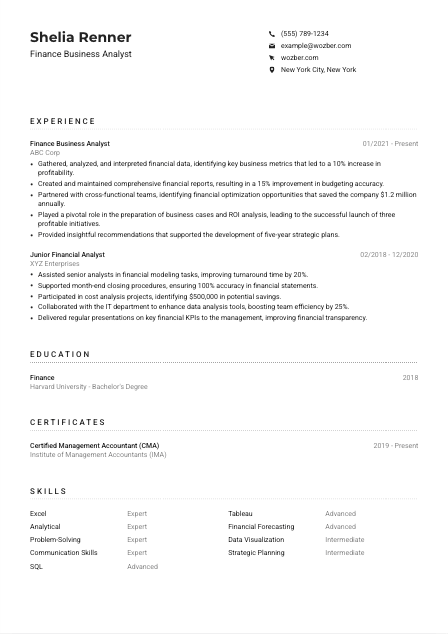
If a posting includes a location requirement, list your city and state clearly. In the example, "New York City, New York" addresses a stated requirement right away and removes unnecessary uncertainty before the employer gets to your experience.
A LinkedIn profile or personal website can strengthen this section if it is current and consistent with your resume. For finance candidates, that usually means matching job titles, dates, certifications, and major achievements rather than treating the link as a placeholder.
Your personal details should make the basics easy to confirm. When the top of the resume is clean, complete, and aligned with the posting, the reader can move straight to your analysis work and business results.




This is where a Finance Business Analyst resume earns attention. Employers want to see how you handled reporting, analysis, forecasting, and decision support in actual business settings, and what changed because of your work.
Read the posting for the actual work behind the title. For this role, that includes analyzing financial data, maintaining budgeting and forecasting reports, partnering across teams, building business cases, and contributing to strategic planning. Those themes should guide which achievements you choose and how you phrase them.
List your most recent role first and include title, employer, and dates for each position. That structure helps recruiters and ATS systems follow your career progression, especially when they are checking whether you already operate at the level of a Finance Business Analyst rather than an earlier-stage financial analyst.
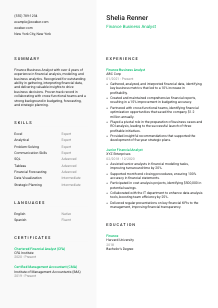
Replace generic task descriptions with business results tied to finance work. The sample does this well with points such as identifying key business metrics that contributed to a 10% increase in profitability and improving budgeting accuracy by 15%. Bullets like these show that your analysis changed decisions, planning quality, or financial performance.
Use numbers that belong naturally in finance work: profitability gains, cost savings, forecast accuracy, time saved, initiative ROI, or reporting improvements. "Saved the company $1.2 million annually" and "supported the launch of three profitable initiatives" are effective because they connect analysis to measurable business outcomes.
Focus on experience that shows financial modeling, KPI analysis, variance reporting, process improvement, and cross-functional partnership. You do not need to include every responsibility from every role. A tighter set of bullets that shows how you supported planning and business decisions will carry more weight than a long list of routine tasks.
Your experience section should show how you think with numbers and how you influence decisions with them. When each bullet ties finance analysis to a result, the hiring team can picture you supporting budget cycles, investment decisions, and long-range planning from day one.
For most Finance Business Analyst positions, education is a baseline qualification, but it still helps frame your technical foundation. Present it clearly so the reader can confirm your background in finance, accounting, or a related discipline without hunting for it.
Start with the degree requirement named in the posting. Here, a bachelor's degree in Finance, Accounting, or a related field is requested, so a finance degree should be shown plainly rather than buried under extra detail.
List degree, field of study, school, and graduation year in a consistent order. That is enough for most mid-level finance resumes and keeps the section easy for both human reviewers and ATS parsing.
If your degree matches the role closely, say so in simple terms. In the example, "Bachelor's Degree, Finance" from Harvard University immediately checks the employer's educational box and supports the candidate's analytical background.
Relevant coursework can help if you are earlier in your career or if your professional experience is still growing. Subjects like financial modeling, managerial accounting, statistics, data analytics, or corporate finance can add context when they reinforce the work shown elsewhere on the resume.
Honors, major projects, case competitions, or finance-related extracurricular work can be useful if they strengthen your profile. For experienced candidates, keep this brief and only include items that connect to analysis, business decision support, or quantitative problem-solving.
Education should confirm that you have the technical grounding for finance analysis work. A clean, relevant entry is usually enough, especially when your experience already shows strong forecasting, reporting, and business partnership skills.
In finance hiring, certifications can add weight when they reflect real analytical depth or professional commitment. They matter most when the employer has called them out directly or when they help distinguish you from candidates with similar experience.
Some finance roles treat certifications as optional, others treat them as a real differentiator. In this case, CMA or CFA is listed as a plus, which means these designations can strengthen your profile even if they are not required.
Prioritize credentials tied to financial analysis, management accounting, valuation, or investment analysis. The example includes both CMA and CFA, which works well because each speaks to rigorous finance knowledge and disciplined professional development.
Show when the certification was earned or the period of active status if that format fits your resume. Dates help employers understand whether the credential is current and how long you have maintained it.
Finance tools, reporting expectations, and analytical methods evolve. If you hold newer credentials or have completed relevant training in areas like data analysis, financial systems, or visualization tools, include them when they support the type of work the job requires.
A well-chosen certification section reinforces that your finance knowledge goes beyond day-to-day reporting. When the credentials match the role, they add another layer of confidence around your analytical range and professional discipline.
A Finance Business Analyst skills section should read like the toolkit behind your reporting, modeling, and recommendation work. The right mix of tools and business-facing strengths helps employers see how you operate before they even reach your bullet points.
Look for named tools and implied working strengths. Here, Excel, SQL, Tableau, financial modeling, data analysis, problem-solving, and communication are all relevant because the role combines hands-on analysis with decision support for senior management.
Lead with the tools and capabilities most central to the job. For this example, Excel, SQL, Tableau, forecasting, and financial analysis deserve priority because they connect directly to budgeting, reporting, trend analysis, and business case work.
Include technical tools, but also show the skills that make the analysis useful inside a business. Items like strategic planning, communication, and cross-functional collaboration belong here when they reflect real experience translating numbers into recommendations, presentations, or process improvements.
Every skill listed should be visible somewhere else in the resume through tools used, analyses completed, or business outcomes achieved. That consistency is what makes the section credible for finance hiring teams.
Language proficiency matters when the role requires clear reporting, presentations, or collaboration across teams. For Finance Business Analysts, communication quality can affect how well insights land with managers, operations partners, and executives.
If the posting specifies language fluency, make that easy to find. This role requires strong English fluency, so listing English prominently with an accurate proficiency level directly answers a stated hiring need.
If you speak more than one language, list them in a practical order. English should come first when it is explicitly required, while another language such as Spanish can still add value if the company works across regions, teams, or customer groups.
Terms like "Native," "Fluent," "Intermediate," and "Basic" are usually enough. They help the reader quickly understand how confidently you can write, present, and collaborate in each language.
Not every finance role needs multiple languages, but some do involve regional reporting, multinational stakeholders, or cross-border business planning. In those cases, multilingual ability can support smoother communication around metrics, presentations, and recommendations.
Only claim a proficiency you can comfortably use in meetings, written communication, or analytical discussions. Overstating language ability can become a problem quickly when the role requires presenting findings or explaining financial results under pressure.
For this kind of role, language skills should support business communication, not fill space. When listed clearly and honestly, they add practical context to how you work with stakeholders and present financial insight.
The summary sets the reading direction for the rest of the resume. For a Finance Business Analyst, it should quickly establish your level, your core finance strengths, and the kind of business impact your analysis supports.
Ground your summary in the work the employer needs done. That means emphasizing financial analysis, modeling, forecasting, reporting, and decision support rather than using a broad analyst statement that could apply to many different functions.
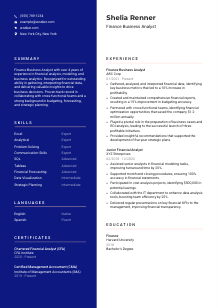
Lead with a direct introduction such as "Finance Business Analyst with over 4 years of experience in financial analysis, modeling, and business analytics." This gives the reader immediate context on your specialization and seniority.
Use the next lines to highlight the capabilities that matter most for the target job. In the example, budgeting, forecasting, strategic planning, and cross-functional collaboration all reinforce the posting, while achievements like improving profitability or launching profitable initiatives add credibility.
Aim for a short paragraph of about 3 to 5 lines. That is enough space to establish your finance focus, analytical toolkit, and business contribution without repeating the details that should appear in your experience section.
A strong summary helps the employer understand your profile before they read a single bullet point. When it clearly connects your experience to reporting, analysis, and business decision support, the rest of the resume lands with much more force.
A Finance Business Analyst resume should make three things easy to see: the quality of your analysis, the business decisions you supported, and the measurable results that followed. When your sections align around those points, the document reads less like a job history and more like a record of financial judgment.
Use Wozber's free resume builder to shape that story into an ATS-friendly resume format, refine role-specific wording with its AI resume builder features, and check alignment with an ATS resume scanner. The final version should make it easy for a hiring team to see you handling forecasts, variance analysis, ROI work, and strategic planning with confidence.




