



Use Wozber and land your dream job
Create Resume
No registration required
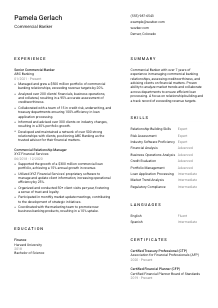
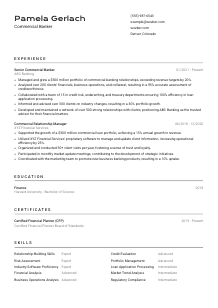
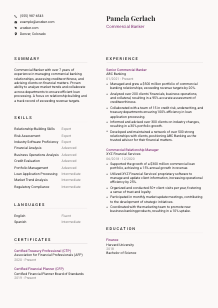
Wealthy portfolios, but your resume feels bankrupt? Check out this Commercial Banker resume example, built with Wozber free resume builder. It shows how to cash in on your finance experience to align with commercial lending requirements, ensuring your career stays robust with monetary milestones!
Commercial banking resumes work best when they show two things early: how you grow revenue-producing client relationships and how you make disciplined lending decisions. Hiring teams want to see commercial judgment in action, whether that comes through portfolio growth, credit analysis, collateral review, loan structuring, or the quality of your client advisory work.
A tailored resume helps separate commercial bankers from broader relationship managers or general finance candidates by making lending scope, portfolio size, and cross-functional work with credit and underwriting easy to trace. Wozber's free resume builder helps you shape that detail into an ATS-compliant resume that uses the right banking language, so the reader can quickly see where you have handled client portfolios, assessed risk, and contributed to loan production.
The top of the resume should confirm the basics without slowing the reader down. In commercial banking, that means clear identity, direct contact details, and any practical requirement that affects eligibility, such as location for a market-based portfolio role.
Place your full name at the top in a clean, readable format. Keep it slightly larger than the rest of the text so it stands out immediately. For a client-facing banking role, the presentation should feel polished and credible, much like the way you would present a lending proposal or client review package.
Add "Commercial Banker" beneath your name if that is the role you are pursuing. Matching the posted title helps position you correctly from the first line, especially when hiring teams are sorting between commercial lenders, relationship managers, and treasury-focused bankers.
Include a phone number you answer reliably and a professional email address. Add LinkedIn or a relevant professional site if it reinforces your banking background with career progression, certifications, or market expertise. Check every detail carefully. A typo in your contact line creates the wrong impression for a role built on accuracy and trust.
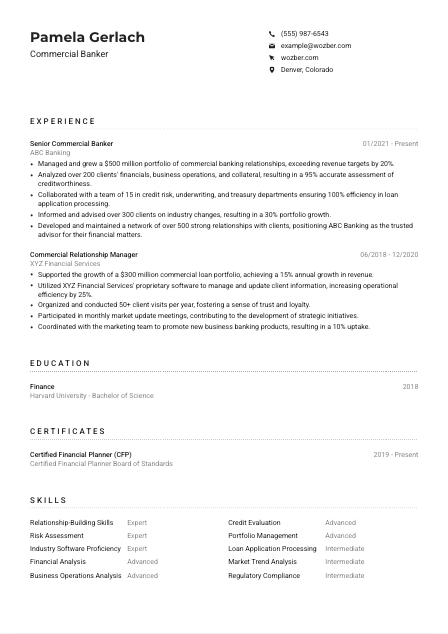
If the employer needs someone already based in a specific market, include your city and state. In the example, listing Denver, Colorado immediately supports the stated location requirement. That kind of detail matters in commercial banking because local market knowledge, in-person client coverage, and territory ownership often shape the portfolio.
If you include a website or profile, make sure it supports your resume rather than distracting from it. A strong LinkedIn page can reinforce your lending background, portfolio exposure, and certifications. Keep the information aligned with your resume so the hiring team sees one consistent commercial banking story.
This section should answer basic eligibility questions fast and cleanly. Once that is in place, the reader can move straight to your lending experience, client book, and revenue contribution.




For commercial bankers, experience carries the most weight because it shows how you handled real portfolios, real clients, and real credit decisions. The strongest entries connect client management with financial analysis, loan execution, and measurable business growth.
Start by marking the responsibilities that define the role. Here, the key themes are portfolio growth, creditworthiness analysis, lending structure, collaboration with credit and treasury teams, and trusted-advisor client relationships. Those themes should guide which achievements you keep and which ones you cut.
List your most recent commercial banking or business banking experience first. Include job title, employer, and dates for each role. This format helps the reader follow your progression from support or relationship roles into larger portfolio ownership, more complex credit work, or broader client responsibility.
Each bullet should show what you managed, analyzed, improved, or closed. Focus on portfolio size, revenue growth, client retention, credit analysis volume, loan processing efficiency, or advisory impact. The sample does this well with details like managing a $500 million portfolio, analyzing more than 200 clients' financials and collateral, and driving portfolio growth through informed client guidance.
Quantify your work with measures that hiring teams recognize: portfolio value, annual growth rate, revenue performance, number of clients covered, loan volume, approval accuracy, turnaround time, or cross-sell results. Commercial banking is a metrics-heavy environment, so numbers help the reader gauge the scale and quality of your book of business.
Prioritize achievements that reflect lending, relationship management, credit judgment, and coordination with underwriting or treasury partners. Leave out points that do not strengthen your case for commercial banking. If you include product promotion or market work, connect it back to portfolio growth, client acquisition, or broader banking revenue.
By the end of this section, the reader should understand the size of business you handled, the financial decisions you supported, and the results you produced. That combination is what turns a banking background into a credible commercial banker profile.
Education is rarely the deciding factor for an experienced commercial banker, but it still needs to line up cleanly with the posting. A finance, business, or related degree confirms the analytical foundation behind your lending work and client advisory responsibilities.
Check the posting for the exact academic expectation before editing this section. In this case, a bachelor's degree in Finance, Business, or a related field is requested. If your degree fits that requirement, make it easy to spot without extra wording.
List your degree, field of study, school, and graduation year. Keep it simple and easy to scan. A line such as "Bachelor of Science, Finance" immediately supports a commercial banking application because it aligns with the analytical and business-focused nature of the role.
If you studied finance, business, accounting, economics, or another closely related field, name it clearly. Specificity matters because commercial bankers are expected to read financial statements, assess operating performance, and understand lending structures, so the field itself carries useful context.
If you are earlier in your career or your experience is lighter, relevant coursework in credit analysis, corporate finance, accounting, treasury, or commercial lending can strengthen this section. Honors can help too, but only if they add meaningful context rather than extra filler.
Student investment groups, finance competitions, or capstone projects can be worth mentioning when they connect to lending, business analysis, or client-facing financial work. For more experienced bankers, these details usually give way to portfolio results and client outcomes.
Your education section should confirm the academic baseline for the role and then get out of the way. In commercial banking, the deeper proof usually comes from how you applied that foundation in lending and relationship management.
Certifications can sharpen your positioning when they reinforce client advisory depth, treasury knowledge, or financial planning expertise. In commercial banking, they are especially useful when the employer lists them as preferred rather than required.
Review the posting for preferred or required certifications before deciding what to feature. Here, CFP and CTP are preferred, which tells you the employer values advisory credibility and treasury-related knowledge alongside lending experience.
Lead with certifications that support commercial banking work directly. CFP can reinforce your advisory and financial planning perspective, while CTP can add weight if the role touches cash management, treasury services, or broader business banking relationships.
Add the year earned or the active date range when it helps the reader understand that the credential is current. In regulated, client-facing financial roles, up-to-date credentials signal ongoing professional discipline and current industry knowledge.
If you are working toward a certification or maintaining one through continuing education, that can be worth noting when relevant. Commercial banking changes with regulation, market conditions, and product complexity, so continued learning carries practical value.
Certifications should add another layer of credibility to your banking profile, especially when they match the employer's preferences. They work best when they support the same story your experience already tells.
A commercial banker skills section should read like the operating toolkit behind your portfolio results. That means pairing financial and credit skills with relationship management, regulatory awareness, and the systems you use to manage client information or lending workflows.
Read beyond the obvious keywords. This posting clearly asks for financial analysis, relationship-building, and industry software proficiency, but it also implies credit evaluation, collateral review, client advisory work, and collaboration with underwriting and treasury teams. Those are the skills worth surfacing if you genuinely use them.
Combine technical banking skills with client-facing strengths. Commercial banking requires more than credit work alone. A useful mix might include financial analysis, portfolio management, risk assessment, loan structuring, regulatory compliance, and relationship management. The example also shows software proficiency and business operations analysis, which help support the broader lending picture.
Do not turn this section into a long inventory of every tool or trait. Prioritize the skills that back up your experience bullets and match the target job. A focused list makes it easier for an ATS resume scanner and for human reviewers to connect your capabilities to portfolio growth, lending judgment, and client management.
This section should echo the work you have already shown elsewhere. When the skills align with your experience and the job description, your resume reads like a banker who can manage relationships and make sound credit calls.
Language ability matters in banking when it affects client trust, reporting clarity, and day-to-day communication across teams. Keep this section straightforward and relevant to the role rather than treating it as a personality add-on.
If the posting names a required language, list it clearly. Here, fluent English is mandatory, so it should appear first and be labeled accurately. That removes doubt about your ability to handle client conversations, internal coordination, and written banking documentation.
Include additional languages if they are relevant to the client base, region, or business mix. For some commercial bankers, another language can help with relationship development, community coverage, or communication with business owners from multilingual markets.
Choose straightforward ratings such as Fluent, Native, Advanced, Intermediate, or Basic. Be accurate. In commercial banking, credibility matters, and language proficiency is easy to test in interviews or client-facing scenarios.
Not every commercial banking job needs multiple languages, but some markets benefit from them. If you serve diverse local businesses or internationally active clients, additional language ability can strengthen your profile. If not, keep the section simple and focused.
Language skills matter when they improve client communication, deepen trust, or help you navigate business conversations more effectively. That is the value to highlight, especially in relationship-driven banking roles.
List the language requirement the employer asked for, then add any additional capability that genuinely supports client coverage. In banking, clarity and credibility matter more than an impressive-looking list.
The summary should tell the reader, in a few lines, what kind of commercial banker you are and what scale of work you have handled. It is most effective when it quickly connects years of experience to portfolio responsibility, credit analysis, and client growth.
Pull together the few themes the employer is likely to care about first: commercial lending experience, relationship management, financial analysis, and revenue or portfolio growth. In the example, the summary works because it highlights 7+ years of experience, creditworthiness assessment, market awareness, and collaboration across teams.
Start with your title and years of relevant experience. That immediately positions you in the right lane. A hiring manager should know within the first sentence whether you are a commercial banker with substantial lending exposure or a broader banking professional transitioning into the field.
Mention strengths that carry real weight in this profession, such as managing commercial relationships, analyzing borrower financials, structuring lending solutions, exceeding revenue goals, or advising business clients. Choose points that are supported by the experience section rather than broad claims.
Aim for three to five lines with real information in each sentence. Skip soft introductions and generic ambition statements. This section should read like a concise banker profile, not a cover letter opening.
When this section is done well, the rest of the resume is easier to read because the reader already knows your level, your lending focus, and the kind of client portfolio you bring. That framing matters.
A commercial banker resume needs to make three things easy to find: the size and quality of the relationships you managed, the financial judgment you applied, and the business results you produced. When those points are clear across your experience, skills, certifications, and summary, the document starts to read like a lender and client advisor rather than a general banking candidate.
Use Wozber's free resume builder to organize that story in an ATS-friendly resume format, then refine the language with its ATS resume scanner and AI tools so your portfolio work, credit analysis, and market-facing experience align closely with the job description. The finished resume should make it easy to judge your readiness to manage commercial clients and grow the book responsibly.




