



Use Wozber and land your dream job
Create Resume
No registration required
Counting bills, but your resume balance is off? Check out this Bank Teller resume example, created with Wozber free resume builder. It shows how to align your customer service and cash-handling skills with job criteria, making your career vault as prosperous as the bank you serve!
Bank tellers work where customer trust and transaction accuracy meet. Hiring teams look quickly for evidence that you can handle cash without errors, follow branch procedures, stay composed at a busy counter, and still deliver courteous service when clients have questions, complaints, or urgent account needs.
On a tailored resume, those strengths show up fast through the right banking language, transaction metrics, and customer-facing results. Wozber's free resume builder helps you shape an ATS-compliant resume around the posting's terminology so a hiring manager can quickly see whether you have the cash handling discipline, service record, and product awareness the branch needs.
For a Bank Teller resume, the personal details section should be clean, professional, and easy to process at a glance. This role deals with precision from the first customer interaction onward, so basic items like job title, email, and location should already reflect care, consistency, and alignment with the opening.
Use your full name as the header and make it the most visible text on the page. A simple, professional presentation fits banking better than decorative styling. This is a customer-facing role built on trust and clarity, so your resume should look steady and organized from the first line.
Place "Bank Teller" directly under your name if that is the role you are pursuing. Matching the posting's title helps both ATS systems and hiring teams sort your resume quickly. It also keeps your positioning clear, especially if your background includes adjacent service roles such as front desk, retail, or cashier work.
List a reliable phone number and a professional email address. Banking employers are careful about detail, and small errors here suggest bigger ones later in transaction work. Use an email format based on your name, and check every character before you send the resume.
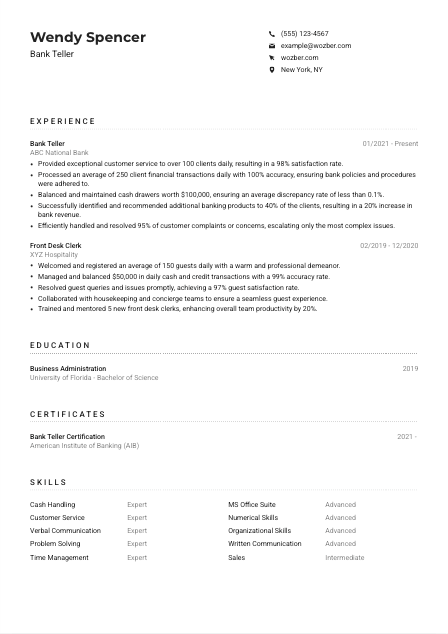
If an employer specifies a location requirement, show your city and state in this section. In the example opening, New York, NY is requested, so including "New York, NY" immediately answers a practical screening question. For branch-based hiring, this can matter early in the review process.
A LinkedIn profile can support your application if it matches your resume and presents your customer service, cash handling, or banking experience clearly. If you include it, make sure job dates, titles, and accomplishments line up exactly. Inconsistent records create avoidable doubts in a role where accuracy is central.
This section should tell the branch that you are reachable, local when needed, and focused on Bank Teller work. Keep it precise and polished. That same attention to detail is part of the job.




The experience section carries the most weight for many Bank Teller applications. Employers want to see more than customer service in general. They want a record of handling money accurately, following procedures, resolving client issues calmly, and supporting branch goals through efficient service and relevant product conversations.
Start with the posting and identify the work that will likely define day-to-day performance. For a Bank Teller, that often includes transaction processing, cash drawer balancing, complaint handling, product referrals, and compliance with bank procedures. Then rewrite your bullet points so those responsibilities appear in your own history with specific proof rather than broad claims.
List your most recent job first, then work backward. Include job title, employer, and dates for each role so the reviewer can follow your progression from customer-facing or cash-handling work into more directly relevant banking responsibilities. If you already have teller experience, that entry should carry the strongest detail.
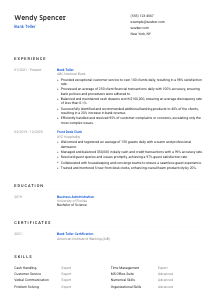
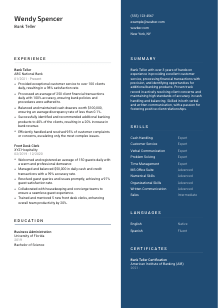
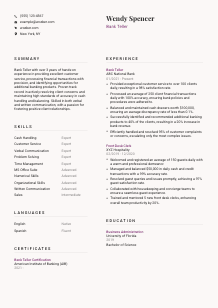
Metrics matter here because teller work is measured through volume, accuracy, service quality, and contribution to branch sales. Strong bullets often mention daily transaction counts, cash totals balanced, customer satisfaction scores, referral rates, or complaint resolution results. The example resume does this well with details like 250 transactions per day at 100% accuracy and a cash drawer of $100,000 kept under a 0.1% discrepancy rate.
If part of your background comes from hospitality, retail, or front-desk work, pull forward the pieces that map directly to teller duties. Cash reconciliation, handling a high volume of customers, resolving issues at the counter, and maintaining accuracy under pressure all translate well. The sample front desk role works because it emphasizes transaction handling, customer volume, and problem resolution rather than unrelated hospitality tasks.
Lead with verbs that show controlled execution in a regulated, customer-facing environment: "processed," "balanced," "resolved," "reconciled," "assisted," "recommended." Then finish each bullet with scope or outcome. "Processed 250 client transactions daily with 100% accuracy" tells a branch manager far more than "responsible for transactions."
Your experience section should make it easy to picture you working the line, balancing a drawer, handling client questions, and supporting branch revenue without sacrificing accuracy. When your bullets show measurable transaction work and customer outcomes, your resume starts reading like a teller resume rather than a general service resume.
Education is straightforward for many Bank Teller openings, but it still matters. Most postings ask for a high school diploma or equivalent, while additional coursework or a college degree can support your candidacy when it connects naturally to finance, business, customer service, or basic operations.
If the posting requires a high school diploma or equivalent, make sure your education section makes that easy to confirm. If you have a college degree, list that instead or in addition, since it already exceeds the minimum requirement. In the example resume, a Bachelor of Science in Business Administration adds useful business context beyond the baseline.
List the school name, degree, field of study, and graduation year or date. Banks and credit institutions tend to prefer resumes that are orderly and easy to verify, and this section should follow that standard. Avoid extra detail unless it strengthens your case directly.
If your education relates to business, accounting, finance, or customer operations, let that relevance come through naturally. A business degree can support your understanding of financial products, administrative discipline, and customer interactions. There is no need to force a connection if your field was unrelated. The value comes from presenting the strongest true link.
Add honors, academic distinctions, or extracurricular activities only if they support the role. Examples might include coursework in accounting, leadership in a business club, or awards tied to reliability and performance. Keep this concise, especially if you already have more than 1 year of relevant work experience.
Short courses in customer service, compliance, financial literacy, or office software can strengthen this section if they reflect current preparation. For entry-level or career-changing applicants, this can be especially useful because it shows initiative and gives hiring teams more context beyond formal schooling alone.
This section does not need to be long. It needs to confirm that you meet the requirement and, where possible, show useful business or financial grounding. Keep it orderly and relevant.
Certifications are not required for every Bank Teller role, but they can help when they reinforce banking knowledge, customer service standards, or operational discipline. Used well, this section shows that your preparation goes beyond basic eligibility and moves toward branch-ready performance.
Prioritize certificates related to banking, financial services, customer service, compliance, or cash handling. A credential such as a Bank Teller Certification can strengthen your profile because it points directly to the work environment, terminology, and service expectations of the role.
Do not crowd this section with unrelated credentials. Hiring managers reviewing teller resumes are looking for items that support branch operations, transaction accuracy, or customer-facing financial work. Two relevant certifications are more persuasive than a long list with little connection to the job.
For each certificate, provide the credential name, the issuing organization, and the date earned or active period. That format helps reviewers quickly place the certification in context. In the example resume, the issuer and date make the Bank Teller Certification more credible and easier to evaluate.
If a certification has lapsed, renew it before highlighting it prominently. Banking employers value current standards, especially in roles tied to procedures, accuracy, and customer trust. Ongoing training also suggests that you take regulated, process-driven work seriously.
A focused certification section can sharpen your resume, especially if you are early in your banking career or moving in from another service role. Keep it relevant, current, and clearly documented.
A Bank Teller skills section should reflect what happens at the counter and behind it. That means balancing technical accuracy with customer-facing judgment. Employers want to see that you can process transactions, manage cash responsibly, communicate clearly, and stay organized during high-volume periods.
Start with the employer's language and pull out the skills that appear in the requirements and responsibilities. For this opening, that includes cash handling, customer service, numerical accuracy, organization, communication, and MS Office proficiency. Adding those exact terms, where they truthfully match your background, supports ATS optimization and keeps your resume aligned with the branch's needs.
Teller work depends on both. Hard skills might include cash balancing, transaction processing, data entry, basic product knowledge, and Word or Excel use. Soft skills should reflect branch-floor realities such as de-escalation, courteous communication, active listening, and problem resolution. The example skills list works because it combines both sides of the job instead of leaning only on personality traits.
Lead with the abilities most central to teller performance, not every skill you have ever used. Cash handling, customer service, numerical skills, organization, and complaint resolution usually deserve more attention than broad entries with little connection to branch work. Keep the section easy to scan so the most relevant qualifications appear first.
This section should read like a practical match for teller operations. When the skills align with transaction accuracy, branch service, and day-to-day tools, the rest of the resume becomes easier to trust.
Language ability can be useful in banking because tellers often serve a broad mix of customers, explain routine transactions, and handle questions that require patience and clarity. English proficiency is often essential, and additional languages can be valuable when they help a branch serve its local community more effectively.
If the posting calls for strong English proficiency, list English clearly and use an honest proficiency level such as "Native" or "Fluent." This should be easy for a reviewer to confirm at a glance because verbal and written communication are part of daily teller work.
If you speak another language confidently, include it. In customer-facing banking, bilingual ability can help with rapport, routine explanations, and smoother service for clients who are more comfortable in another language. The sample resume's Spanish entry is a good example of an additional language that could widen customer support capability.
Be specific about your level. Terms like "Native," "Fluent," "Advanced," or "Conversational" give hiring teams a realistic sense of how you can communicate in a branch setting. Avoid overstating proficiency, especially in a role where customers may rely on your explanations for financial transactions.
Some branches serve multilingual communities, international customers, or neighborhoods where another language is frequently used at the counter. If you know the customer base, language skills can be a relevant advantage. Treat that as a plus, not a universal requirement for every teller opening.
Only list languages you would be comfortable using with customers or colleagues in a professional setting. A short, honest language section is more effective than a long one filled with limited or inactive skills. In teller hiring, clarity and credibility matter more than volume.
Use this section to confirm required English proficiency and highlight any additional language skills that could improve service at the branch. When presented honestly, language ability can strengthen your customer-facing profile.
Your summary should give a branch manager a quick read on your level, your strengths, and the kind of teller work you have handled. In a few lines, it should connect transaction accuracy, customer service, and any sales or referral success without drifting into generic claims.
Before writing the summary, identify the job's central themes. In most teller openings, those are transaction accuracy, customer service, cash balancing, policy adherence, and the ability to recommend relevant products when appropriate. Let those realities shape the language of your summary.
Begin with your professional identity and years of relevant experience. A direct opening such as "Bank Teller with 3+ years of experience" or "Customer service professional with 2 years of high-volume cash handling experience" gives immediate context and helps the reviewer place you quickly.
Choose the qualifications that matter most for the opening. That might include transaction accuracy, customer satisfaction, complaint resolution, drawer balancing, or referral success. The example summary works because it combines precision in financial transactions with customer service and product recommendation ability, all of which map directly to teller work.
Aim for 3 to 5 lines. Skip soft claims like "hardworking team player" unless they are backed by real context. A tighter summary with banking terms, measurable work, and clear service focus will land better than a broad paragraph full of general strengths.
By the time someone finishes this section, they should already understand your teller background, your level of accuracy with money, and how you handle customers at the counter. That is enough to pull them into the rest of the resume.
A Bank Teller resume works best when it shows disciplined cash handling, dependable customer service, and clear alignment with branch procedures. Use the posting's language where it reflects your real background, keep metrics visible, and present your experience in a format that is easy to scan and easy to trust.
Wozber's free resume builder, ATS-friendly resume templates, and ATS resume scanner can help you tighten that alignment, surface missing requirements, and present your qualifications in an ATS-friendly resume format. The finished resume should make one conclusion easy to reach: you can step into the teller line and handle transactions, customers, and branch standards with confidence.




