



Use Wozber and land your dream job
Create Resume
No registration required
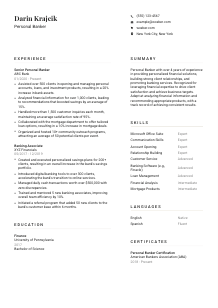
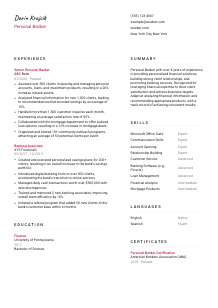
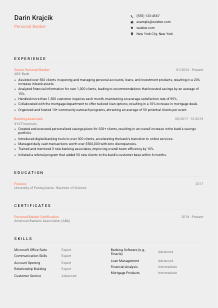
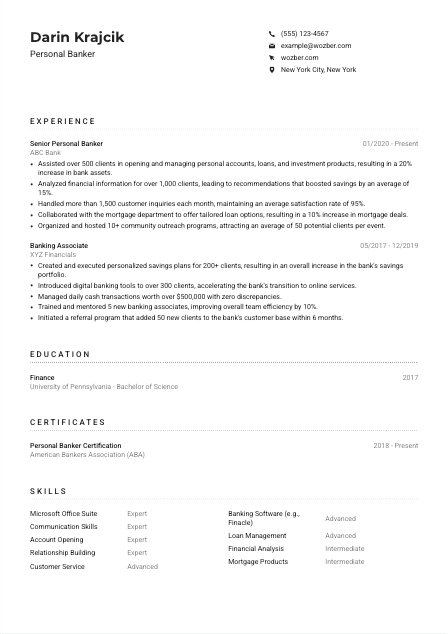
Balancing accounts, but your resume seems overdrawn? Check out this Personal Banker resume example, created with Wozber free resume builder. It shows how to align your financial finesse with the job criteria, ensuring your banking career earns interest at the highest rate!
Personal banking sits at the point where product knowledge, risk awareness, and day-to-day client relationships meet. Hiring teams want to see whether you can move comfortably between account servicing, financial conversations, and cross-department coordination without losing the trust that keeps customers loyal. Your resume should make that blend visible quickly through client volume, product scope, service quality, and measurable contribution to branch goals.
In this field, unclear wording can make solid banking experience look generic, especially when ATS filters are scanning for terms tied to account opening, loan support, financial analysis, and customer service. Wozber's free resume builder helps you shape an ATS-compliant resume around the language employers actually use, so your background reads as personal banking experience rather than broad retail or administrative work. That distinction matters when a bank is deciding who can step into client conversations with confidence from day one.
Personal details carry more weight in banking than they do in many other roles because this is a client-facing position built on credibility, responsiveness, and professionalism. Keep this section clean, accurate, and aligned with any practical requirements stated in the posting.
Use your full name in a clear, readable format that matches the tone of the banking environment. Personal banking is a trust-led role, so visual presentation should feel polished and straightforward rather than creative or overly styled.
Place "Personal Banker" directly under your name if that is the job you are pursuing. This immediately connects your application to branch banking, client accounts, lending conversations, and relationship management, instead of leaving recruiters to guess whether your background is closer to teller work, sales, or general customer support.
List a reliable phone number and a professional email address, then verify both carefully. In banking, attention to detail is part of the job. A typo in contact information sends the wrong message for a role that deals with account accuracy, policy communication, and client follow-up. If your LinkedIn profile is current and reflects banking experience, include it.
If the employer asks for candidates in a specific market, state your city and state clearly. In the example, "New York City, New York" answers that requirement directly and removes uncertainty around local availability. Keep this kind of location tailoring tied to the posting rather than treating it as a universal rule for every personal banker resume.
A website is optional for personal bankers. Include one only when it adds real professional value, such as a polished LinkedIn profile or a finance-focused professional page. This is less about showcasing a portfolio and more about reinforcing your banking background, certifications, and community presence.
This section should answer the basics without friction: who you are, how to reach you, and whether you meet any practical posting requirements. In a client-facing banking role, that kind of accuracy already says something about how you work.




For a personal banker, experience needs to show more than customer contact. It should show the kinds of products you handled, the volume of clients you supported, the quality of service you maintained, and how your work contributed to branch growth, retention, or product adoption.
Read the posting closely, then line up your experience with the actual work involved: opening accounts, discussing loans, reviewing financial information, resolving account questions, and coordinating with partner teams. If you have examples that match those activities, bring them forward. The sample resume does this well by tying prior work directly to personal accounts, loans, investment products, and customer inquiries rather than listing broad front-desk duties.
List your most recent role first and include your job title, employer, and dates for each position. That format helps recruiters trace your growth from general banking support into more advisory or relationship-focused work. It also gives ATS systems a clean structure to parse when identifying banking tenure and progression.
Rewrite each role around outcomes, not task lists. Strong bullets for personal bankers often show client volume, asset growth, satisfaction scores, referral activity, product uptake, or error-free transaction handling. In the example, metrics such as assisting 500+ clients, handling 1,500 inquiries a month, and raising bank assets by 20% make the scope of the work easy to understand.
Prioritize work that proves you can manage client relationships, explain financial products clearly, and handle regulated processes with care. Retail sales, cash handling, service recovery, and financial product support can all be relevant when framed properly. Remove older or unrelated details that do not strengthen your case for account management, loan support, or cross-selling in a banking setting.
Metrics are especially persuasive in personal banking because branch performance is often tracked closely. Use figures tied to clients served, deposits grown, loans supported, digital adoption, referral conversion, satisfaction scores, or transaction accuracy. Even one or two solid numbers per role can show that you did more than maintain service. You helped move business results.
Your experience section should make it easy to picture you working a book of clients, handling daily banking needs, and contributing to branch targets. When the bullets show both service quality and commercial results, your background reads as personal banking experience with real traction.
Education is usually a straightforward section for personal bankers, but it still carries weight because banks often set baseline degree expectations for client-facing finance roles. Present it clearly, and make the connection to banking, finance, or business easy to see.
If the posting asks for a bachelor's degree in Finance, Business, or a related field, make sure that information is easy to find. In the example, a Bachelor of Science in Finance aligns neatly with the requirement. If your degree is in a related field, list it clearly rather than assuming the connection will be obvious.
Include your degree, field of study, school, and graduation year. This is one of the easiest sections for ATS parsing, so keep the structure conventional and readable. Banking resumes benefit from order and consistency, and the education section should reflect that.
If your education directly supports client finance conversations, product knowledge, or business fundamentals, name that clearly. A degree in finance, accounting, economics, or business administration can reinforce your readiness for work involving account recommendations, lending basics, and financial review.
Extra academic detail is most useful early in your career or when it clearly supports the role. Relevant coursework in personal finance, investments, credit analysis, or banking operations can help if your hands-on experience is still developing. If you already have several years in branch banking, keep this section lean unless an achievement is genuinely distinctive.
Banks change quickly around digital channels, compliance expectations, and product mix. If you have recent training in areas such as retail banking, customer relationship management, or financial product knowledge, include it when it adds current relevance. Continuous learning matters most when it supports the way personal banking is actually delivered today.
Education should confirm that you have the academic foundation expected for advising clients on everyday banking products and financial choices. Keep it clean, relevant, and easy to scan.
Certifications can strengthen a personal banker resume by showing formal training, current knowledge, and commitment to professional standards. They are especially useful when a posting names a credential directly or when you want to reinforce product knowledge and client-facing expertise.
If the employer asks for a Personal Banker Certification or similar credential, place it prominently with the issuing body and active dates. The example's ABA-issued Personal Banker Certification does exactly that. Where certification is listed as preferred rather than required, it still adds credibility in a competitive branch hiring process.
Choose certifications that support retail banking, customer advisory work, compliance awareness, or financial product knowledge. A short, relevant list is more effective than a long one filled with credentials that do not help explain your ability to serve personal banking clients.
Many finance credentials matter more when they are active or recently renewed. Include issue dates, renewal periods, or active status when relevant. This helps recruiters understand whether your knowledge is current, especially in areas shaped by regulation, product updates, or customer protection standards.
If you are still growing into the role, targeted certifications can help deepen your profile in lending, deposits, customer relationship management, or compliance. They are not a substitute for client-facing results, but they can strengthen your resume when paired with real branch experience and measurable service outcomes.
This section should show that your banking knowledge is formalized, current, and relevant to the products and client conversations the role involves. For employers that value credentials, that extra layer of professionalism can matter.
The best skills sections for personal bankers feel grounded in branch reality. They combine customer-facing strengths with operational knowledge, product familiarity, and the tools used to manage accounts, transactions, and client interactions.
Start with the language in the posting and match it to skills you genuinely use. For this role, that includes banking software, Microsoft Office Suite, customer communication, financial analysis, and relationship building. The sample resume reflects that approach by combining technical tools with account opening, loan management, and client service capabilities.
Order matters. Lead with the skills most closely tied to performance in the role, such as account management, customer service, banking systems, product knowledge, and communication. This helps both recruiters and ATS tools recognize quickly that your background fits a personal banker opening rather than a broader retail or administrative position.
Avoid padding the list with generic traits. Prioritize skills that support actual branch work, such as deposit products, loan support, account opening, CRM use, cross-selling, cash handling, policy explanation, and resolving customer inquiries. A tighter skills section is more credible and gives a clearer picture of how you operate with clients and internal teams.
Your skills should show that you can handle both sides of the job: the relationship side of personal banking and the operational side that keeps service accurate, compliant, and efficient.
Language proficiency matters in personal banking because much of the work depends on clear explanations, accurate account discussions, and trust during sensitive financial conversations. Present this section honestly and in a way that reflects the client population you can serve.
If the posting requires strong English, list it clearly with an accurate level such as Native or Fluent. Personal bankers regularly explain account options, transaction issues, policies, and product recommendations, so language clarity is central to performance, not a minor detail.
Extra languages can be a real advantage in diverse banking markets because they widen your ability to support walk-in clients and deepen relationships. In the example, Spanish strengthens the candidate's ability to serve a broader client base, but any additional language should be included only when you can use it confidently in a professional setting.
Use honest ratings. If you can greet clients and handle simple questions but not explain lending terms or resolve account issues fluently, do not overstate your ability. In banking, trust starts with accuracy, and that applies to your resume too.
Include languages that genuinely support the kind of branch or community banking work you do. When paired with outreach, relationship building, or day-to-day account support, multilingual ability can strengthen your profile in a practical way rather than reading like a side note.
Some personal banker roles serve highly diverse neighborhoods, while others may not emphasize multilingual support at all. Use this section to reflect the clients you are equipped to serve, not to inflate your resume. When language ability supports stronger client communication, it is worth showing.
This section should help employers understand how effectively you can communicate with their client base. In a relationship-driven banking role, that can influence both service quality and business growth.
Your summary should quickly establish your level, your client-facing banking background, and the business results you tend to produce. Keep it concise, but make sure it reflects the actual mix of service, product knowledge, and financial judgment the role requires.
Start with a direct description of your experience level and specialization. Mention personal banking, retail banking, or client financial services so the reader immediately understands your lane. This helps distinguish you from broader customer service, back-office finance, or teller-only profiles.
Use specific highlights that show what you have delivered, such as client growth, asset increases, satisfaction scores, referral performance, or product adoption. The example summary works because it points to personalized financial solutions and consistent results, then the experience section backs that up with hard numbers.
Briefly mention the strengths that make you effective, such as relationship building, financial analysis, account management, or advising clients on banking products. Keep the language close to the role so the summary supports both recruiter reading and ATS matching.
Aim for 3 to 5 lines that capture your value without repeating your full work history. A personal banker summary should feel focused and commercially aware, with enough detail to suggest branch readiness, client confidence, and product knowledge in a few sentences.
By the end of the summary, the reader should already understand that you can support clients, recommend appropriate banking products, and contribute to branch performance. That is the tone the rest of the resume should continue to prove.
Once each section is tailored to the role, your resume should read like the profile of someone who can step into client conversations, manage everyday banking needs, and contribute to branch growth with confidence. That means clear personal details, banking-focused experience, relevant education, current credentials, and skills that match the work banks actually hire for.
Use Wozber's ATS-friendly resume templates and ATS resume scanner to tighten alignment with the posting, surface missing requirements, and improve ATS optimization without flattening your experience into keyword lists. The finished resume should make one thing easy to judge: whether you can build client trust, handle personal banking products accurately, and perform well in a branch environment from the start.




