



Use Wozber and land your dream job
Create Resume
No registration required
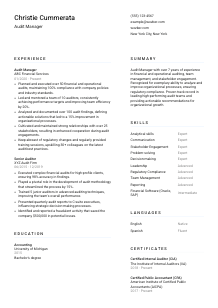
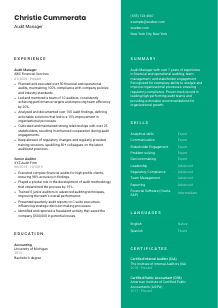
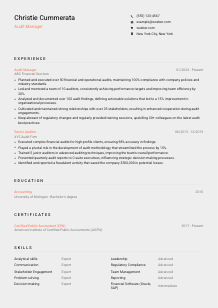
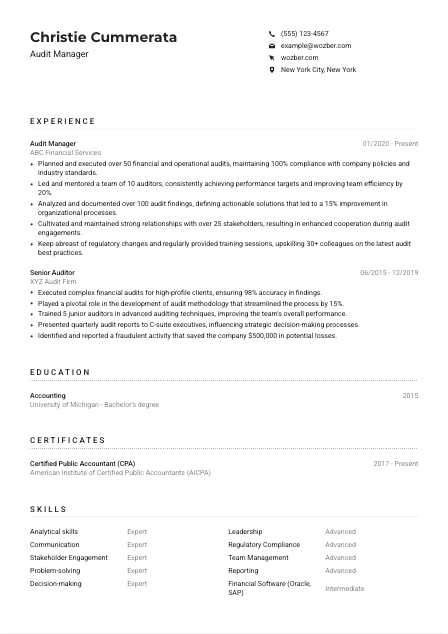
Leading financial inspections, but your resume lacks compliance? Check out this Audit Manager resume example, made with Wozber free resume builder. It shows how to align your regulatory prowess with job specifications, ensuring your career path is always audit without doubts!
Audit managers are trusted with more than testing controls and reviewing numbers. They are expected to run disciplined audits, surface risk early, translate findings into practical recommendations, and lead teams that can stand up to executive scrutiny. Your resume should make that operating standard visible quickly, especially through audit scope, team oversight, and the business results tied to your findings.
Screening usually turns on whether your background reads like true audit leadership rather than strong senior auditor work. Wozber's free resume builder helps you shape an ATS-compliant resume around the language employers use for audit planning, compliance, reporting, and team management, so the hiring team can immediately see your scale, judgment, and leadership range.
In audit hiring, small inconsistencies can undermine confidence fast. The personal details section should look clean, current, and professionally aligned, with no friction around contact information, title, or location requirements when those matter for the role.
Use your full name in the most prominent text on the page so the document feels formal and easy to reference in interview scheduling, internal review, and ATS records. Skip credentials after your name unless they are standard in your market and used consistently elsewhere.
Place "Audit Manager" directly under your name if that is the role you are pursuing and your experience supports it. This helps frame the resume immediately around audit leadership, not general accounting or individual contributor audit work.
List a reliable phone number and a professional email address with no casual handles or outdated providers. For an audit position, this section should reflect the same accuracy you would bring to audit documentation, issue tracking, and report review.
If a job specifies a city or region, include your current location in a simple format. In the example, "New York City, New York" supports a stated requirement, which helps remove an avoidable screening question early in the process.
A LinkedIn profile or professional website can help if it reinforces your audit progression, certifications, leadership scope, or industry exposure. Make sure dates, titles, and employers match the resume exactly so there is no mismatch during background review.
This section should confirm that you are organized, reachable, and aligned with any basic logistics tied to the opening. Clean details help the reader move straight to your audit record without distraction.




For an Audit Manager, experience has to do two jobs at once. It needs to show technical command of financial and operational audits, and it needs to prove that you can lead people, manage findings, and communicate with senior stakeholders in a controlled, credible way.
Start by isolating the work patterns the employer emphasizes, such as planning audits, executing fieldwork, leading auditors, presenting recommendations, and staying current on regulatory change. Then mirror that language where it truthfully matches your background so your experience reads as directly relevant rather than adjacent.
For each position, list your employer, title, and dates, then use accomplishment bullets that show what changed because of your work. Audit leadership resumes land better when they show completed audits, process improvements, issue resolution, stakeholder influence, and team supervision rather than a generic list of responsibilities.
Numbers help employers judge your operating range. Useful metrics for this field include the number of audits completed, size of teams led, improvements in compliance or efficiency, value of losses prevented, or number of stakeholders supported. The sample does this well by citing 50+ audits, a 10-person team, and process improvements tied to documented findings.
As you move into manager-level hiring, earlier audit work matters most when it supports the current story. Keep bullets that show planning, review, coaching, cross-functional coordination, issue escalation, and recommendations to leadership. Trim details that read like routine testing if they do not strengthen your case for audit oversight.
Use verbs that reflect ownership and review authority, such as "planned," "executed," "led," "reviewed," "analyzed," "advised," or "presented." In audit resumes, verb choice helps separate candidates who participated in engagements from candidates who directed them and were accountable for the outcome.
By the end of this section, the reader should understand the size of audits you have handled, the teams you have led, and the quality of judgment you bring when findings need to become action. That is the core of manager-level audit credibility.
Education matters in audit because it establishes the technical base behind your work in controls, financial reporting, risk, and compliance. For experienced candidates, this section should be concise, accurate, and clearly aligned with the degree level and field the employer requests.
If the posting asks for a bachelor's degree in Accounting, Finance, or a related field, make that easy to find. In the example, a bachelor's degree in Accounting aligns directly with the requirement, so the reader can confirm the academic baseline at a glance.
Include your degree, field of study, school, and graduation year or date range in a clean order. Audit employers are not looking for creativity here. They want a clear record that supports your technical background and career progression.
If you are earlier in your career, relevant coursework in auditing, accounting, finance, internal controls, or risk management can help. For more experienced audit managers, those details usually matter less than work history and certifications unless they connect to a specialized industry or audit track.
Specialized seminars, executive education, or formal training in internal audit, fraud examination, SOX, governance, or regulatory updates can be useful if they deepen the story your resume is telling. Keep them relevant to audit leadership and oversight.
A manager with 6+ years of progressive audit experience does not need an expanded education section unless the credential is unusually relevant. Keep the focus on the qualifications that still influence hiring decisions today, and let the rest of the page support your audit results and leadership record.
Education should quickly establish that you meet the role's academic requirements and have the technical grounding expected in audit leadership. Once that is clear, the rest of the resume can carry the heavier proof.
Certifications carry real weight in audit hiring because they signal technical standards, professional discipline, and current standing in the field. When a posting explicitly requires credentials such as CPA or CIA, this section becomes a key qualification check, not a supporting extra.
List certifications like CPA or CIA prominently when they are named in the posting. For this kind of Audit Manager role, those designations are essential and should be visible without making the reader search through the page.
You do not need to crowd this section with every short course or training badge. Prioritize certifications that strengthen your authority in auditing, internal controls, financial reporting, compliance, or risk oversight.
Show the certifying body and the valid date or active range where relevant. The sample uses both issuer and ongoing dates, which helps confirm that the credentials are current and professionally maintained.
Audit standards and regulatory expectations change, so active credentials matter. Make sure renewals are current and that the section reflects any ongoing status accurately, especially for roles that involve training colleagues or interpreting regulatory developments.
Well-presented certifications show that your audit judgment is backed by recognized professional standards. For roles that require CPA or CIA status, this section should remove all doubt immediately.
An Audit Manager skills section should read like the toolkit of someone who can run engagements, lead auditors, and communicate risk clearly. That means balancing technical audit capability with management, reporting, and stakeholder-facing strengths.
Start with the terms the employer chose, especially where they point to how the work is performed. In this posting, analytical ability, communication, leadership, team oversight, and audit execution are all central, and they belong in your skills section if they reflect your real strengths.
Include a mix of audit-specific and manager-level skills, such as financial auditing, operational auditing, internal controls, regulatory compliance, audit reporting, stakeholder management, team leadership, and process improvement. The example also adds tools like Oracle and SAP, which can be useful when systems exposure matters to the employer.
Keep the strongest and most relevant skills near the top rather than treating the section as a full inventory. Manager-level resumes should highlight decision-making, audit planning, review quality, issue analysis, and team leadership before secondary software or general business skills.
Your skills list should support the same story told in your experience section: you can lead audits, guide people, and turn findings into decisions. When the language aligns across both sections, the resume reads as consistent and credible.
Language skills may not drive every audit hire, but they matter when the posting asks for clear communication or when the role works across diverse business units, regions, or executive audiences. Keep this section simple and honest.
Some postings mention language skill as a baseline communication requirement. Here, proficient English is listed directly, so your resume should state your English proficiency clearly rather than assuming it will be inferred.
List English at the top of the section and use a clear proficiency label such as "Native" or "Fluent." That makes it easy for the employer to confirm that you can handle audit interviews, report writing, presentations, and stakeholder discussions in the required language.
Additional languages can be useful if the company operates internationally or if the audit function works across multilingual teams. In the example, Spanish adds range, but it should remain a supporting point unless the employer specifically values it.
Choose labels that accurately reflect your working ability. Audit work depends on precision in interviews, documentation, and reporting, so overstating language fluency can create problems later in panel interviews or on the job.
If the position involves cross-border audits, regional stakeholders, or international reporting lines, multilingual ability may add value. If not, keep the section brief and let it confirm communication capability rather than overstate its importance.
This section should show that you can communicate clearly in the language the role requires and, where relevant, operate comfortably across a broader stakeholder base. For audit leaders, clarity matters as much as fluency.
The summary sets the frame for everything that follows. For an Audit Manager, it should quickly establish years of experience, audit coverage, leadership scope, and the kind of business value you create through findings, compliance work, and recommendations.
Open with your current or target title, years of experience, and core domain. A clear line such as experience in financial and operational auditing immediately tells the reader where you sit within the audit ladder and whether your background matches manager-level work.
Choose strengths that reflect the actual demands of the role, such as leading audit teams, improving processes, presenting findings to senior management, or maintaining regulatory compliance. The sample summary works because it ties audit experience to team management and process improvement rather than using vague leadership language.
Aim for a short paragraph that says something concrete about your record. Avoid generic claims about being results-driven or detail-oriented unless you connect them to audit work, such as stronger compliance, better control environments, or effective audit recommendations.
Your summary should evolve with your career. As you move from execution into broader leadership, reflect that shift through larger audit programs, bigger teams, more senior stakeholders, industry specialization, or credentials that now shape your authority.
A well-written summary tells the reader, in a few lines, why your background belongs in an Audit Manager conversation. It should make the rest of the resume feel consistent, senior, and clearly aligned with the work ahead.
A strong Audit Manager resume shows clear command of audits, credible leadership of people and findings, and current professional standing through the right degree and certifications. Each section should support that same picture, from location and title to quantified audit results and stakeholder-facing communication.
Before you apply, review the wording against the posting and tighten any bullets that sound generic or overly operational. Wozber's AI resume builder, ATS resume scanner, and ATS-friendly resume format can help you align phrasing, surface missing requirements, and present your experience in a structure that makes your audit scope and management readiness easy to judge.




