



Use Wozber and land your dream job
Create Resume
No registration required
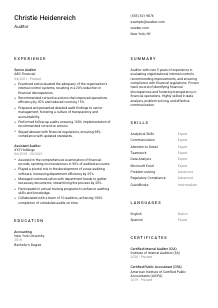
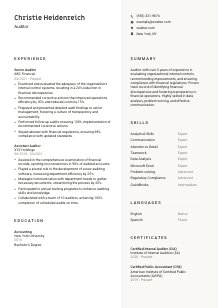
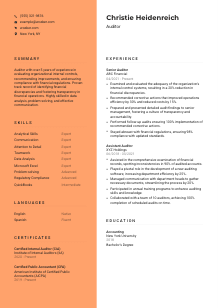
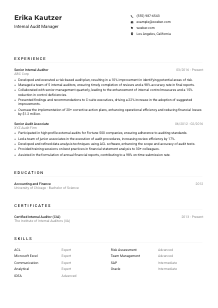
Auditing with precision, but your resume doesn't pass the review? Check out this Auditor resume example, created with Wozber free resume builder. It shows how to clearly reflect your audit expertise to meet job criteria, making sure your career statement is as solid as your reports!
Auditing work is judged by what you can examine, what you can question, and what you can improve once weaknesses appear. A hiring team wants to see how you handled internal controls, audit findings, corrective actions, and compliance pressure, not just that you worked in finance. Your resume should make that audit trail visible in plain business terms.
Screening for auditors gets more precise when the resume uses the same language as the role, especially around internal controls, audit findings, and regulatory standards. Wozber's free resume builder helps shape that content into an ATS-friendly resume format, so both the system and the hiring manager can quickly understand whether your background matches the level of review, reporting, and follow-up the job requires.
This section should read like a clean professional header, not a crowded profile. For an auditor, small details matter. Accuracy in contact information, title, and location already reflects the care expected when reviewing records, documenting findings, and communicating with management.
Use your full name in a prominent, readable format. Keep it simple and professional. Auditing is built on clarity and traceability, and that same standard applies to the top of your resume.
Place the job title directly under your name and align it with the role you want. If you are applying for an Auditor role, say "Auditor." If your background is more senior and the posting supports it, a title like "Senior Auditor" can work. This helps frame your experience before the reviewer reaches your work history.
List a current phone number and a professional email address with no formatting errors. Auditors are expected to document accurately and communicate clearly, so even basic contact details should look dependable and polished.
Some auditor openings include a location requirement because the role involves on-site review, meetings with department leaders, or local compliance needs. Here, New York, NY is stated directly, so showing "New York, NY" in your header removes a logistical question immediately.
If you include LinkedIn or a personal website, make sure it supports your resume with consistent job titles, certifications, and career dates. For auditors, that profile should reinforce credibility, not introduce gaps or mismatched information.
Your personal details should confirm that you are reachable, professionally presented, and aligned with any stated location requirement. Keep the section clean and exact. That is the same discipline the role expects in audit documentation.




This is the section where hiring teams look for audit scope, business impact, and follow-through. They want to know what you reviewed, what you found, what changed because of your recommendations, and whether those changes were actually implemented.
Start by identifying the duties that define the role, then mirror them with your own experience where it is true. For this posting, that means internal control evaluation, corrective action recommendations, audit reporting, follow-up audits, and regulatory awareness. If you have handled those areas, use that wording naturally in your bullets.
List your positions in reverse chronological order with job title, company, and dates that are easy to scan. An ATS-friendly resume format also helps keep employer names, timelines, and accomplishments readable. For audit roles, that clean structure matters because the reviewer is often checking progression from support work into broader ownership.
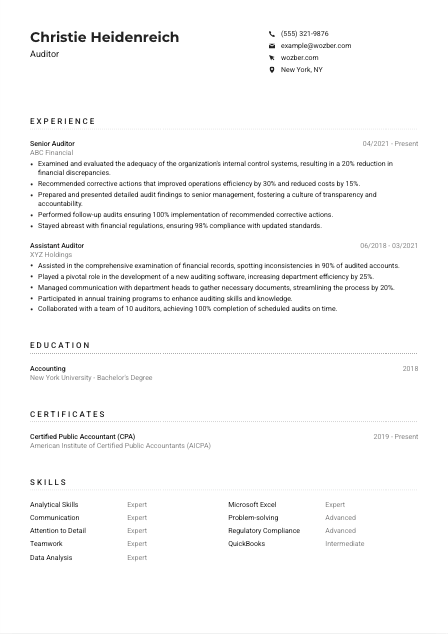
Do not stop at "performed audits" or "reviewed records." Show what your work changed. The sample resume does this well by tying internal control review to a 20% reduction in financial discrepancies and linking recommendations to stronger efficiency and lower costs. Those are the kinds of outcomes that make audit work credible on paper.
Numbers carry weight in auditing because they show scope and material impact. Use metrics tied to discrepancies reduced, compliance rates maintained, corrective actions completed, audits delivered on time, or process efficiency gained. Results like 100% follow-up implementation or 98% compliance with updated standards give hiring teams a clearer sense of execution quality.
Prioritize bullets that show review depth, control testing, reporting, stakeholder communication, and risk or compliance outcomes. If a detail does not help explain your audit judgment or business impact, leave it out. Each bullet should strengthen your case for handling audit cycles, findings, and management follow-up.
Your experience section should show a pattern of disciplined review, clear reporting, and measurable operational improvement. When the bullets are tailored well, a reader can quickly see whether you can evaluate controls, present findings, and drive corrective action in a real audit environment.
Education establishes your technical foundation in accounting, finance, and audit principles. For auditor roles, it usually works as a qualification check first and a depth signal second, especially when the posting names a specific degree area.
When a posting calls for a Bachelor's degree in Accounting, Finance, or a related field, list that qualification clearly and exactly. If your degree matches directly, as the example's Accounting degree does, that alignment should be easy to spot at a glance.
Include degree, field of study, school, and graduation year or date. Avoid overloading this section with extra text if your experience already carries the heavier audit proof. The structure should be clean enough for quick scanning by both ATS software and hiring teams.
If your degree is in Accounting, Finance, or another closely related discipline, let that relevance stand on its own. If the title is broader, you can still support it through coursework or concentration areas tied to financial reporting, assurance, internal controls, or risk.
Early-career candidates can benefit from listing classes, projects, or academic work related to auditing, accounting systems, fraud examination, or financial analysis. This is especially useful if you need to show exposure to audit methodology before your experience section fully does that work.
Honors, scholarships, or notable academic achievements can help if they are recent or relevant. For someone with several years of auditing experience, these details should stay brief. For a newer candidate, they can support credibility and discipline.
Your education section should quickly confirm that your academic background supports audit work. Keep it direct, relevant, and easy to verify so the reader can move on to the practical proof in your experience and certifications.
For auditors, certifications often carry real hiring weight because they point to recognized technical standards and professional discipline. When a job posting asks for CPA or CIA, this section becomes more than supportive. It can be a deciding requirement.
If the role asks for CPA or CIA certification, include it clearly and use the full credential name. In this example, listing both CPA and CIA directly strengthens alignment with the posting and signals broad audit credibility across accounting and internal audit contexts.
Prioritize certifications tied to auditing, accounting, controls, risk, compliance, or financial reporting. A short list of strong, relevant credentials usually works better than a long list of marginal ones that distract from the qualifications the employer actually values.
If the certification is active, in good standing, or recently earned, show that information clearly. Dates help hiring teams understand recency and current relevance, especially in a field shaped by updated standards, regulation changes, and continuing professional education.
Auditors are expected to stay current with standards and regulatory changes. Updated certifications, continuing education, or advanced audit credentials show that your technical knowledge is active rather than static. That matters when the role includes keeping pace with financial regulations.
Relevant certifications show that your audit knowledge meets an external professional standard. If the role names CPA or CIA, make those credentials impossible to miss. They immediately support your authority in controls, compliance, and audit reporting.
The best auditor skills section balances technical judgment with practical execution. Hiring teams are looking for the abilities that support control testing, discrepancy analysis, reporting accuracy, and communication with management, not a generic list of workplace traits.
Read the posting for both stated and implied capabilities. Here, analytical skills, problem-solving, written and verbal communication, and knowledge tied to internal controls and regulations are central. Those should appear if they reflect your real working strengths.
Mirror the wording of the posting when the terms match your background. That helps with ATS optimization and makes your experience easier to connect to the role. For example, skills like "Regulatory Compliance," "Data Analysis," "Communication," and "Analytical Skills" map naturally to this kind of audit opening.
Choose skills that support your experience instead of trying to cover everything. Include a mix of audit-relevant strengths such as internal controls, financial analysis, compliance review, Excel, audit reporting, or audit software where appropriate. A concise, targeted list is more believable and more useful than a long inventory.
Your skills should back up the work shown elsewhere on the resume. When chosen well, they confirm that you can analyze records, communicate findings, and handle the technical demands of audit work without padding the section with generic claims.
Language ability matters in audit work when the role requires clear reporting, cross-functional interviews, or communication across regions. Even when the position is primarily domestic, the language section can still confirm an explicit requirement from the posting.
If the job states that effective communication in English is required, include English and your proficiency level. This is especially important for auditors, since interviews, written findings, management presentations, and follow-up documentation all depend on precise communication.
Additional languages can be valuable if you work with multinational entities, diverse stakeholders, or cross-border compliance environments. They are not mandatory for every auditor role, but they can strengthen your range when the business operates across markets.
Use honest labels such as Native, Fluent, Advanced, or Intermediate. Auditors often need to ask detailed questions, write clear observations, and discuss exceptions with stakeholders, so overstating proficiency can create problems quickly.
If the role involves international subsidiaries, vendor reviews, or broader regulatory coordination, a second language may be a practical advantage. If not, it still belongs on the resume as long as it is truthful and does not crowd out more critical content.
The value of language skills in auditing comes from clearer interviews, cleaner reporting, and smoother collaboration with finance and operations teams. Present them that way, rather than as a generic culture point.
For auditor roles, language ability matters most when it supports accurate reporting and effective communication with stakeholders. Cover the required English proficiency first, then include additional languages that genuinely expand your working range.
An auditor summary should quickly establish your level, your audit focus, and the kind of results you produce. This is where you connect years of experience with the specific audit responsibilities the employer needs covered.
Before writing the summary, note the main themes in the posting. In this case, the emphasis sits on internal controls, corrective actions, audit findings, and regulatory updates. Those points should shape the language of your opening lines.
Open with a direct statement of who you are and how much relevant experience you bring. A line such as "Auditor with 5+ years of experience" works because it immediately places you at the right level for a role asking for at least 3 years of experience.
Follow that opening with two or three concrete strengths or outcomes that reflect the posting. The example summary works because it mentions internal controls, discrepancy detection, regulatory compliance, and operational improvement. That combination speaks directly to how many auditor roles are staffed.
Aim for a short paragraph that includes the most relevant audit terms without sounding stuffed. Wording around internal controls, compliance, findings, corrective actions, and financial regulations helps both ATS systems and human reviewers connect your background to the role quickly.
By the end of the summary, the reader should already understand your audit level, your core strengths, and the kind of findings and improvements you deliver. That clarity sets up the rest of the resume to confirm the same story with stronger detail.
Your auditor resume should show more than familiarity with finance. It should connect your background to internal control reviews, findings that mattered, recommendations that improved operations, and follow-up work that held up after the report was delivered.
Wozber's free resume builder can help you organize that experience into an ATS-compliant resume, strengthen wording with role-aligned terminology, and check alignment with an ATS resume scanner before you apply. When the tailoring is done well, your resume makes it easy to judge whether you can step into the audit cycle and deliver reliable findings from day one.




