



Use Wozber and land your dream job
Create Resume
No registration required
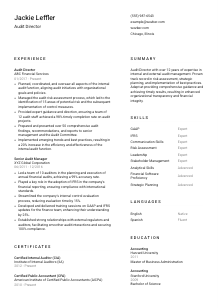
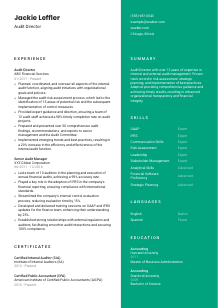
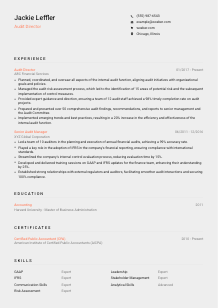
Spotlighting financial clarity, but your resume seems a bit audited-out? Check out this Audit Director resume example, created with Wozber free resume builder. Learn how to present your assurance expertise to match job requirements, harmonizing your career trajectory with discerning precision!
Audit Director hiring turns on judgment, control discipline, and the ability to lead an audit function that management and the Audit Committee can trust. Your resume needs to show more than seniority. It should make clear that you can set audit plans, direct risk assessments, evaluate internal controls, and communicate findings in language that holds up under executive and regulatory scrutiny.
When those capabilities are tailored to the target role, the resume is easier to process both by people and by applicant tracking systems looking for terms like internal audit, risk assessment, GAAP, IFRS, and Audit Committee reporting. Wozber's free resume builder helps shape that content into an ATS-compliant resume, so your background reads clearly as leadership-level audit experience rather than a general accounting profile.
For an Audit Director, the header should establish credibility fast. Hiring teams want clean contact details, a role-aligned title, and any location detail that affects eligibility, without having to search for it.
Use your full name in a slightly larger font than the rest of the resume. At this level, the header should read like executive business correspondence: clear, restrained, and easy to scan.
Place "Audit Director" directly under your name when that is the role you are pursuing. Matching the job title helps position you correctly from the first line and avoids sounding broader or more junior than the opening requires.
Add a reliable phone number and a professional email address, ideally in a simple format such as firstname.lastname@email.com. Since Audit Directors regularly present findings to senior leadership, even small details in presentation should reflect precision and professionalism.
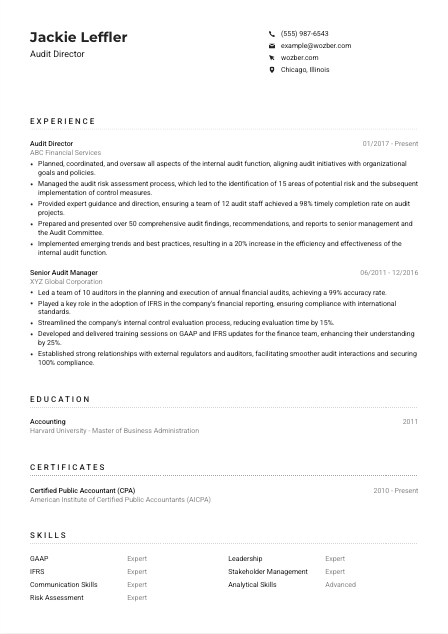
If the posting requires candidates to be based in a specific city or state, show that clearly in the header. Here, listing "Chicago, Illinois" immediately addresses a stated requirement and removes a practical concern before the review gets any further.
Include your LinkedIn profile or professional website if it is current and consistent with the resume. For senior audit candidates, this can reinforce leadership scope, committee-facing work, certifications, and progression across internal or external audit roles.
This section does not need personality or flourish. It needs accuracy, professionalism, and an immediate match on the basics the employer will check first.




The experience section carries the most weight for an Audit Director. It should show how you led audit planning, risk evaluation, control reviews, staff direction, and reporting to senior stakeholders, with outcomes that show operational value.
Start by isolating the responsibilities that define the role. For this opening, those include overseeing the internal audit function, managing the risk assessment process, guiding audit staff, presenting findings to senior management and the Audit Committee, and adapting the function to regulatory and professional changes. Those are the themes your bullets should echo with real examples.
List positions from most recent to oldest, with title, employer, and dates. For audit leadership roles, progression matters. A path from Senior Audit Manager to Audit Director, as shown in the example resume, quickly communicates increasing responsibility for team leadership, audit scope, and enterprise-level oversight.
Focus each accomplishment on what you directed, what changed, and what the business gained. Strong Audit Director bullets often reference audit plans, internal control reviews, risk identification, remediation, policy alignment, or committee reporting. The example does this well by pairing leadership actions with results, such as overseeing the audit function and presenting more than 50 audit reports.
Use numbers that fit how audit work is measured: risk areas identified, audit projects completed on time, team size, reporting volume, process efficiency gains, compliance rates, or control evaluation cycle time. Metrics like a 98% timely completion rate, 15 identified risk areas, or a 20% efficiency improvement make senior audit work far more concrete than broad claims about leadership.
Prioritize achievements that support a Director-level internal audit mandate. Leave out lower-value detail and give more room to experience tied to GAAP or IFRS knowledge, control environments, audit planning, regulatory interaction, and staff management. The reader should come away seeing a leader who can run the function, not simply participate in audits.
By the end of this section, the hiring team should be able to see your audit scope, leadership level, and the business results of your oversight. That is the clearest proof that you can step into a Director seat.
Education matters in audit leadership because it confirms the technical foundation behind your judgment. Keep this section straightforward and aligned with the degree requirements in the posting.
Identify the minimum academic credential in the posting before you format anything else. Here, a bachelor's degree in Accounting, Finance, or a related field is required, with a master's preferred. Make sure that match is easy to spot.
List each degree with school name, degree, field of study, and graduation year. Straightforward formatting helps reviewers confirm qualifications quickly, especially when they are screening multiple senior candidates with similar leadership backgrounds.
If you hold an accounting or finance degree, and especially if you also have an advanced degree, let that support your positioning. In the example, a Bachelor of Science in Accounting meets the baseline and an MBA in Accounting reinforces senior-level business and financial leadership.
Detailed coursework is usually unnecessary at this level. Add it only if it supports a specialized angle in your background, such as technical accounting, forensic audit, or regulatory compliance, and only when that angle matters to the target role.
Honors, projects, or extracurriculars can be left out unless they still carry direct professional weight. For an Audit Director, degrees and certifications usually matter far more than student-era distinctions.
This section should quickly establish that you meet the formal academic bar and, where applicable, that you bring the added depth of a master's-level background.
For Audit Director roles, certifications are often a gatekeeper rather than a bonus. If the posting calls for CPA, CIA, or a similar credential, place that information where it is impossible to miss.
Review the certification language closely and mirror it accurately. In this role, a CPA or CIA designation is required, so those credentials should appear prominently and in their full professional form.
Put the most relevant designations first. CPA and CIA immediately strengthen your standing for roles involving internal controls, audit planning, financial reporting knowledge, and executive-facing recommendations. If you hold both, listing both can reinforce breadth across accounting and internal audit practice.
Show when the certification was earned and, if relevant, that it remains active. Current standing matters in fields shaped by evolving standards, continuing education, and professional accountability.
If you maintain certifications through ongoing learning or hold additional audit-related credentials, include the ones that support the target role. This is especially useful when the job emphasizes staying current with regulation changes and emerging audit practices.
These credentials should leave no doubt that you meet the profession's formal standards and stay engaged with current audit practice.
An Audit Director skills section should read like the toolkit of someone who leads audits, evaluates risk, and communicates with senior stakeholders. Keep it specific to the work, not padded with broad business language.
Read for both explicit and implied skills. This job clearly points to GAAP, IFRS, analytical ability, communication, leadership, and risk assessment, while also implying capability in internal controls, audit planning, staff oversight, and executive reporting.
Your mix should reflect how the role actually operates. Technical skills might include GAAP, IFRS, internal controls, audit risk assessment, and financial reporting. Leadership skills should cover team direction, stakeholder management, and presenting recommendations to senior management or the Audit Committee. The example resume strikes that balance well.
Do not turn this into a master inventory. Choose the capabilities that support the target role most directly and name them in language the employer uses. For senior audit positions, a shorter, sharper list usually works better than a long list of generic strengths.
This section should support the rest of the resume by confirming that your technical command and leadership range match the demands of an enterprise audit function.
Language skills are usually a supporting detail for Audit Directors, but they still matter when the posting names a communication requirement or the organization operates across regions.
If the employer explicitly requires proficiency in a language, include it and label your level clearly. Here, the ability to communicate clearly in English is required, so English should appear in this section if you include languages at all.
Place English at the top and indicate the proficiency level honestly, such as Native or Fluent. For a role that involves presenting findings and recommendations to senior management and the Audit Committee, clarity in written and verbal English is directly job-relevant.
Additional languages can be valuable when audits involve international entities, cross-border reporting, or multilingual stakeholders. They are supportive credentials, not a substitute for core audit leadership experience.
Use realistic levels such as Native, Fluent, Intermediate, or Basic. Overstating language ability can become a problem quickly in roles that require clear reporting, interviews, or stakeholder communication.
If the company has global operations or international reporting obligations, another language may strengthen your profile. In the example, Spanish adds breadth, but it supports the application rather than defining it.
Keep this section brief and accurate. Its job is to confirm communication capability where required and, when relevant, add range for global or cross-functional audit work.
The summary should establish your level quickly. In a few lines, show your years of experience, audit leadership scope, technical grounding, and the kind of outcomes you drive.
Use the job description to decide what belongs in the opening lines. For an Audit Director, that usually means years in internal or external audit, leadership responsibility, risk assessment expertise, knowledge of accounting standards, and experience reporting to senior stakeholders.
Lead with a direct statement of who you are and how long you have worked in the field. A line such as "Audit Director with 12+ years in internal and external audit" immediately sets the level and is stronger than a vague opening about being results-driven or strategic.
Choose strengths that match the posting and your record, such as audit planning, internal control evaluation, GAAP or IFRS knowledge, team leadership, or Audit Committee reporting. The example summary works because it names risk assessment, strategic planning, and best-practice implementation instead of relying on generic executive language.
Aim for a short paragraph that can be read in seconds. Every phrase should earn its place by clarifying scope, expertise, or outcome. Leave detailed metrics for the experience section, but make sure the summary already sounds like someone trusted to lead the audit function.
A well-shaped summary helps the reader place you at the right level from the start. For an Audit Director, that means clear audit authority, credible technical depth, and leadership that extends beyond the department into business decision-making.
A polished Audit Director resume should show exactly what senior leadership needs to know: the size of the audit scope you have led, the control and risk work you have owned, the standards you work under, and the quality of reporting you bring to management and the Audit Committee.
Use Wozber's free resume builder to organize that experience in an ATS-friendly resume format and sharpen the language around the requirements that matter most. When the resume is tailored well, it becomes much easier to judge your readiness to lead the internal audit function from day one.




