



Use Wozber and land your dream job
Create Resume
No registration required
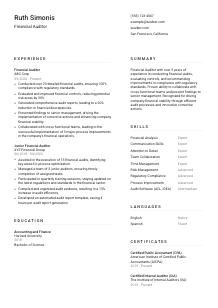
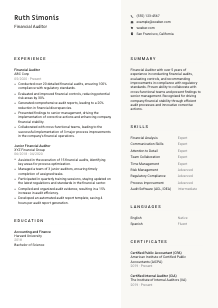
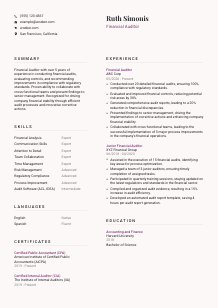
Working through ledgers, but your resume doesn't balance? Check out this Financial Auditor resume example, created with Wozber free resume builder. Learn how to showcase your scrutinizing skills to meet job requirements, ensuring your career trajectory stays in the green!
Financial auditors are trusted with work that affects compliance, financial integrity, and management decisions. A resume for this field needs to show more than familiarity with audits. It should make your testing work, control evaluation, reporting judgment, and follow-through on risk findings easy to understand from the first read.
The first screen often comes down to whether your background clearly matches the audit environment the employer needs, including years of experience, regulatory exposure, reporting responsibility, and credentials such as CPA or CIA. Wozber's free resume builder helps shape that information into an ATS-friendly resume format, so hiring teams can quickly see whether you have handled the kind of audit work, stakeholder communication, and corrective-action support the role requires.
This section is simple, but it still does hiring work. For a Financial Auditor, clean contact details and a clearly stated title support a professional first impression and remove avoidable friction before anyone reviews your audit experience.
Place your name at the top in a readable format that stands apart from the rest of the page. Audit roles value clarity and order, and even this small formatting choice should reflect that same discipline.
Add "Financial Auditor" under your name when that matches the role you are pursuing. It immediately frames your background in the right lane, especially when employers are sorting candidates across internal audit, external audit, accounting, and broader finance profiles.
Include a reliable phone number and a professional email address. Use the version you actually monitor, and check that voicemail, inbox name, and email format all support a professional impression. In audit hiring, small errors can raise unnecessary questions about attention to detail.
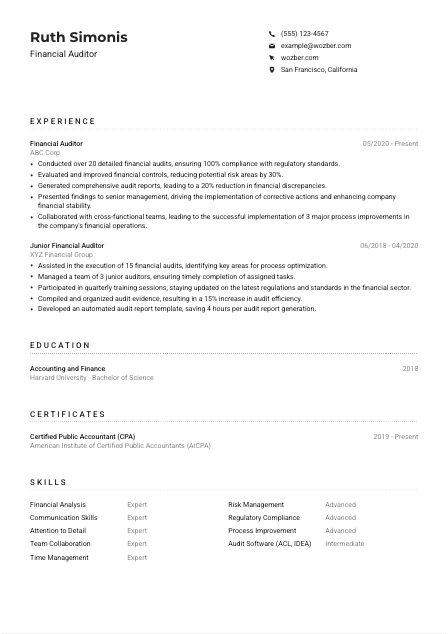
If the job asks for a specific location, show your city and state when you already meet that requirement. In the example, listing San Francisco, California immediately answers a stated hiring condition. If relocation is needed, address that directly rather than leaving the employer to guess.
A LinkedIn profile or professional website can help when it reinforces your resume with consistent titles, certifications, and career dates. Keep it current, especially if it includes audit, compliance, SOX, internal control, or financial reporting work that supports your application.
Your personal details should confirm that you are easy to contact, correctly positioned for the role, and already aligned with any stated logistics. Keep this section accurate and uncluttered so the focus stays on your audit record.




Hiring teams spend the most time here because this is where audit capability becomes concrete. They want to see the kind of audits you handled, the controls or risk areas you reviewed, the quality of your reporting, and whether your work led to corrective action or process improvement.
Read the job description closely and mark the verbs and responsibilities that define the work. For a Financial Auditor, that often includes conducting financial audits, reviewing compliance, evaluating controls, identifying risk areas, preparing audit reports, and presenting findings to management. Use that language where it truthfully matches your background so your experience reads as directly relevant.
List positions in reverse chronological order and include your title, employer, and dates for each one. That structure helps hiring teams quickly track your progression from junior audit work into broader responsibility, such as moving from testing support and audit evidence preparation into leading reviews and presenting findings.
Most audit resumes mention routine responsibilities. Stronger bullets show what your work changed. Instead of only stating that you evaluated controls, show what improved because of that work. The example does this well with points such as reducing risk exposure by 30% and cutting financial discrepancies by 20%, which makes the audit impact measurable.
Quantify scope and outcomes with numbers that make sense for the profession. Useful measures include number of audits completed, compliance rate, control gaps identified, hours saved through process changes, time to issue reports, or reduction in recurring findings. A bullet such as "conducted over 20 financial audits with 100% compliance" tells far more than a generic statement about being responsible for audits.
Keep the emphasis on financial audit work, control testing, reporting, regulatory knowledge, and cross-functional follow-up. If you have accounting or finance tasks that are less relevant, trim them back unless they strengthen the story. Every bullet should help the reader understand your audit scope, judgment, and business impact.
Your experience section should show how you review financial activity, surface control issues, and help move findings into action. When those points are backed by outcomes, the employer can picture you doing the work with much less guesswork.
Audit hiring usually starts with a baseline academic requirement, especially in accounting, finance, or a related field. Your education section should make that qualification easy to confirm without pushing the reader to search for it.
If the posting asks for a bachelor's degree in Accounting, Finance, or a related field, present that information directly. A degree such as "Bachelor of Science in Accounting and Finance" aligns cleanly and should be written in full so the match is obvious.
List degree, field of study, school, and graduation year in a consistent order. This section does not need extra wording. In a profession built on clean documentation, concise structure works in your favor.
For Financial Auditor roles, the field matters almost as much as the degree level. Make sure Accounting, Finance, or a closely related discipline is easy to see. In the example, the combination of accounting and finance directly supports the audit focus of the role.
If you are early in your career, relevant coursework can help bridge limited experience. Include classes that support audit work, such as auditing, financial reporting, taxation, internal controls, or corporate finance. Once you have several years of audit experience, this usually becomes optional.
Honors, scholarships, or relevant projects can be useful when they connect to analytical work, financial statement review, or compliance-related studies. Keep them only if they add something your experience section does not already cover.
This section should quickly establish that you meet the educational baseline for audit work. Present it clearly, and let it support the stronger story told by your experience and certifications.
Certifications carry real weight in financial auditing because they point to technical depth, professional standards, and ongoing learning. When a posting mentions CPA or CIA, that preference should be visible on your resume without delay.
If the job specifically prefers CPA or CIA, include those credentials prominently in this section. These designations are widely recognized in audit hiring and can influence how your technical background is ranked against other applicants.
Show certifications that strengthen your case for financial audit, internal control review, compliance, or financial reporting oversight. A shorter, role-specific list is stronger than a broad collection of less relevant credentials.
Add the year earned or the active date range where appropriate. This helps employers understand whether the credential is current. In the example, showing CPA and CIA with active dates reinforces both qualification and ongoing professional standing.
Auditing standards, regulatory expectations, and reporting requirements change over time. If you maintain credentials through continuing education or have completed recent audit-related training, that supports your ability to work with current standards and expectations.
Relevant credentials tell employers that your audit knowledge has been tested beyond day-to-day experience. Make them easy to find and directly tied to the work the role requires.
A Financial Auditor skills section should read like an operating toolkit, not a generic list of strengths. Choose skills that support testing, analysis, reporting, compliance review, and collaboration around corrective actions.
Pull skill requirements from the posting and group them into the kinds of work the role involves. In this case, analytical skills, attention to detail, communication, control evaluation, compliance awareness, and risk identification all belong because they connect directly to audit execution and reporting.
Use the employer's wording when it accurately describes your abilities. If your background includes financial analysis, regulatory compliance, risk management, or process improvement, name those skills clearly. The sample resume also adds audit software such as ACL and IDEA, which is useful when those tools reflect your actual working environment.
Prioritize the skills that hiring teams expect to see in an auditor before listing broader workplace traits. A compact section built around technical and audit-relevant strengths is easier to scan and supports stronger ATS optimization than a long, mixed list of loosely related abilities.
Your skills section should reinforce the same picture as your experience section: a professional who can examine financial records, evaluate controls, communicate findings, and help strengthen compliance.
Language skills matter in audit work when they affect documentation, interviews, report writing, or communication with management and stakeholders. Present them clearly, especially when the job calls out a required language.
If the employer specifies English, list it first and state your level clearly. For this role, the ability to speak and write in English is essential, so that requirement should be easy to confirm at a glance.
Lead with the language needed for audit documentation and stakeholder communication, then add others that may support the role. Additional languages can be valuable in firms with international operations, multilingual clients, or diverse internal teams.
Terms such as "Native," "Fluent," or "Professional Working Proficiency" are easier to interpret than vague descriptions. In audit roles, where written accuracy matters, precision in how you describe language ability is important.
Do not overstate fluency. Audit work can involve detailed discussions of exceptions, controls, and regulatory issues, and weak language ability becomes visible quickly in interviews or on the job.
A second language is worth including when it can help with cross-border audits, multilingual reporting environments, or communication with varied stakeholders. In the example, Spanish adds breadth, but English remains the key hiring requirement.
This section should quickly confirm that you can handle the communication demands of the role, especially written English for reports, findings, and management updates.
Your summary should capture your audit profile in a few lines: years of experience, type of audit work, core strengths, and the business results your reviews have influenced. It should feel grounded in financial auditing, not interchangeable with general finance or accounting roles.
Start by stating that you are a Financial Auditor and give your experience level in natural terms, such as 3+ years or 5+ years. This quickly places you in the right hiring bracket and helps distinguish you from candidates whose background leans more toward accounting operations than audit.
Follow with two or three strengths that match the posting, such as conducting financial audits, evaluating internal controls, identifying risk areas, preparing audit reports, or presenting findings to senior management. Keep the wording close to the work you have actually done.
A summary gains credibility when it includes concrete impact. The example points to improved audit efficiency, corrective action support, and stronger financial stability. You do not need several metrics here, but one grounded result can sharpen the whole section.
Aim for a short paragraph that gives a clear audit profile without repeating your full experience section. Skip generic claims and focus on the work that defines you as an auditor. When done well, the summary prepares the reader to expect the same level of substance in the bullets that follow.
A focused summary should make your experience level, audit scope, and reporting value clear within seconds. Once that is in place, the rest of the resume has a much easier job proving you can step into the role.
A Financial Auditor resume should show clean qualification matching, credible audit scope, and measurable outcomes in controls, compliance, and reporting. When each section supports that picture, hiring teams can quickly see whether you have the background to review financial processes, surface risk, and communicate findings with confidence.
Use Wozber to build an ATS-compliant resume with job-aligned wording, audit-focused structure, and practical ATS optimization. With Wozber's ATS resume scanner and ATS-friendly resume templates, you can tighten the match between your experience and the posting, then present it in a format that makes your audit readiness easy to judge.




