



Use Wozber and land your dream job
Create Resume
No registration required
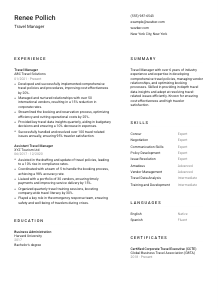
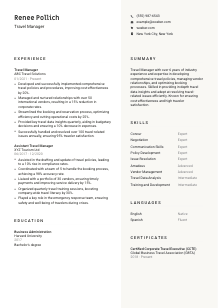
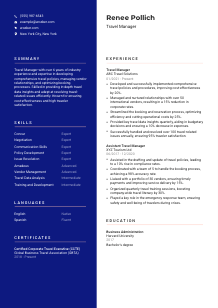
Navigating journeys, but your resume feels stranded? Take a look at this Travel Manager resume example, created with Wozber free resume builder. It shows how to map your travel expertise to match job coordinates, ensuring your career takes off and never lets turbulence get in its way!
Travel management sits at the intersection of policy, vendor performance, and traveler experience. Hiring teams want to see that you can keep bookings running smoothly, contain spend, and step in when disruptions hit, whether that means renegotiating hotel rates, tightening policy compliance, or resolving urgent itinerary issues before they escalate.
A tailored resume helps your background read as corporate travel leadership rather than general operations or hospitality support. Using Wozber's free resume builder to align your wording with the job description and create an ATS-compliant resume makes it easier to surface the details that matter first, such as policy ownership, booking platform experience, reporting discipline, and vendor negotiation results.
For a Travel Manager, the top of the resume should establish professional relevance quickly. This section is simple, but it still does real work by confirming title alignment, contact accuracy, and any location requirement that affects eligibility.
Use your full name as the most visible text on the page. Keep it easy to read and professional, since this heading anchors the rest of a resume that may include vendor negotiations, travel systems, and policy leadership.
Place the exact job title you are pursuing under your name when it reflects your background. Using "Travel Manager" immediately frames your experience around travel policy, booking operations, supplier management, and traveler support instead of broader administrative work.
Your contact information should be complete and error-free so recruiters can move quickly when they want to discuss your travel operations background or system experience.
If the employer asks for candidates in a specific market, include your city and state. Here, listing "New York City, New York" directly answers a stated requirement and removes a common screening question before it comes up.
A LinkedIn profile can reinforce your resume when it reflects the same titles, dates, and travel-management scope. If you include it, make sure it supports the story you are telling about policy development, supplier relationships, and travel program oversight.
This section should confirm that you are reachable, aligned with the role, and eligible on the basics. For a Travel Manager application, that means no gaps between your headline identity and the operational role you want to hold.




This is the section where Travel Manager candidates separate themselves. Hiring teams look for practical ownership: policy rollout, corporate rate negotiations, booking process oversight, reporting, traveler issue resolution, and the ability to improve both cost control and service quality.
Read the job description closely and mark the responsibilities that define the role. For Travel Manager positions, that usually includes policy development, vendor management, booking oversight, travel reporting, and emergency support. Those themes should shape which achievements you keep and how you phrase them.
List roles in reverse chronological order with job title, employer, and dates. A clean sequence helps hiring teams track your move from coordination or assistant-level work into broader ownership of travel programs, supplier relationships, and cost management.
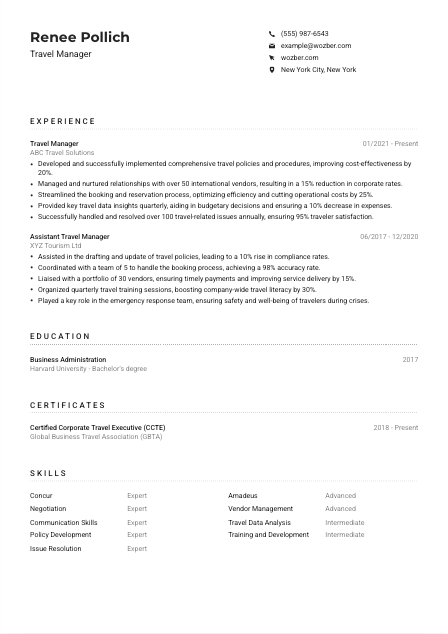
Each role should show what changed because of your work. The sample resume does this well by tying core Travel Manager responsibilities to outcomes such as improving cost-effectiveness by 20 percent, reducing corporate rates by 15 percent, and cutting operational costs by 25 percent. That kind of phrasing tells a hiring manager you did more than process bookings.
Numbers carry weight here because travel programs are measured through spend, compliance, service levels, booking accuracy, traveler satisfaction, and response time during disruptions. If you provide quarterly cost reporting, reduced rate leakage, improved SLA performance, or resolved a high volume of traveler issues, say so clearly.
Keep the section focused on work that supports corporate travel operations. Achievements tied to vendor negotiation, reservation systems, traveler communications, incident handling, training, or travel analytics deserve space. Unrelated wins should only stay if they show transferable operational control or stakeholder management.
Your experience section should show that you can manage a travel program, not simply participate in one. When your bullets connect process control with savings, service quality, and traveler support, your value is much easier to judge.
Education is usually a qualification check for Travel Manager roles, especially when the employer asks for a bachelor's degree in business, hospitality, or a related field. Present it clearly, then let your experience carry the heavier proof of travel program leadership.
If the posting asks for a bachelor's degree, list that information in a way that is easy to confirm. Degrees in Business, Hospitality, or related areas are common fits because they support budgeting, service operations, and organizational planning.
Include your degree, field of study, school, and graduation year or date. Keep the layout simple so the reader can verify qualifications quickly without losing focus on the more decision-making parts of your resume, like vendor performance and cost reporting.
When your degree maps closely to the requirement, let that connection be visible. In the example, a Bachelor's degree in Business Administration aligns naturally with a posting that asks for business or hospitality education.
Most mid-career Travel Managers do not need to list coursework. Include honors, projects, or specialized study only if they relate to travel operations, hospitality management, business analysis, or another area that strengthens your case for this specific role.
Formal education does not have to carry the whole story. If you have industry training or credentials that deepen your knowledge of travel policy, supplier management, or corporate travel operations, those can reinforce your professional development alongside your degree.
This section should confirm that you meet the academic requirement without taking attention away from your travel-management results. A concise, relevant entry is usually enough.
Certifications are especially useful in travel management because they show current engagement with industry standards, policy knowledge, supplier practices, and corporate travel operations. They matter most when they connect directly to the work named in the posting.
Start with certifications that strengthen your authority in corporate travel. A credential like CCTE fits naturally when the employer mentions travel certification as a plus, because it supports your credibility in program management and industry practice.
List the certifications that support the role first. A short section with highly relevant credentials is more useful than a long list of loosely connected courses, especially for a position centered on travel policy, booking systems, and vendor relationships.
If the certification is active, renewable, or recent enough to show current knowledge, include the date range or year. That helps the reader understand whether your training reflects today's travel environment, tools, and service expectations.
Travel management changes with supplier models, booking tools, compliance expectations, and traveler support standards. Keeping certifications current signals that you stay engaged with the field rather than relying only on older experience.
A relevant certification will not replace experience, but it can strengthen how your resume reads, especially when the role involves corporate travel policy, vendor oversight, and program accountability.
The skills section should mirror how Travel Managers actually work. That means a mix of booking platforms, negotiation, policy oversight, reporting, and communication skills that support both the traveler experience and the financial side of the program.
Start with the capabilities the employer names directly, then add closely related ones you genuinely use. For this role, that includes booking software proficiency, negotiation, communication, vendor management, issue resolution, and travel data analysis.
Lead with the skills that would matter on day one. For many Travel Manager roles, that means systems such as Concur or Amadeus, followed by policy development, supplier negotiations, traveler support, and reporting. The example resume handles this well by giving booking software and negotiation prominent placement.
Choose skills that reinforce your experience bullets rather than trying to cover everything. A concise list that combines technical tools with operational strengths is more convincing than a long inventory. If you claim expertise in vendor management or travel analytics, your experience section should show rate reductions, SLA oversight, reporting cadence, or similar outcomes.
Your skills section should make it obvious that you can run the systems, manage suppliers, and support travelers without losing control of cost or compliance. Relevance matters more than volume here.
Language ability can matter in travel management because the work often involves traveler support, supplier coordination, and communication across regions. Even when the role is primarily domestic, the resume should still answer any stated language requirement clearly.
If the posting specifies an English-speaking environment, make sure your English proficiency is listed clearly. That removes uncertainty for a role that depends on fast communication with travelers, vendors, and internal stakeholders.
Additional languages can strengthen your profile when you work with international travelers, global hotel partners, or cross-border itineraries. In the example, Spanish adds useful range without distracting from the required English proficiency.
Terms such as Native, Fluent, Intermediate, and Basic are usually enough. Clear labels are more useful than vague descriptions when employers are trying to understand whether you can handle supplier calls, traveler questions, or regional coordination.
Not every Travel Manager job needs multiple languages, so do not force this section. Include extra languages when they genuinely support the travel program's geography, vendor base, or traveler population.
Only list languages you can use in real work situations. If you mention fluency, be prepared to handle practical communication, whether that means itinerary changes, service escalations, or coordination during disruptions.
For Travel Managers, language skills matter when they help you support travelers and coordinate with suppliers more effectively. Keep the section accurate and tied to actual working use.
Your summary should quickly frame the scale and focus of your travel-management experience. In a few lines, it needs to show whether you understand the commercial, operational, and service side of the role.
Build the opening around the areas that matter most in travel management: policy development, booking operations, vendor negotiations, cost control, reporting, and traveler issue resolution. This gives the reader a clear picture before they get into the detail of your experience.
State your professional identity and experience level early. A line such as "Travel Manager with 6+ years of experience" works because it immediately places you within the expected seniority range for roles asking for several years in travel management or related work.
Use the summary to mention two or three high-value capabilities backed by your background. The example does this by highlighting policy development, vendor relationships, booking optimization, travel data insights, and issue resolution, which closely match the posting's priorities.
Aim for a short paragraph that reads cleanly in seconds. Avoid vague traits and focus on what you manage, improve, or deliver, whether that is lower travel spend, smoother reservations, stronger compliance, or higher traveler satisfaction.
A well-written summary gives context to every section that follows. For a Travel Manager, it should quickly establish that you can oversee the program, control travel spend, and support travelers when plans change.
Once your resume clearly shows policy ownership, booking platform proficiency, vendor negotiation results, reporting habits, and traveler support, it becomes much easier for employers to picture you running their travel program. That is the standard your application should meet.
Wozber can help you get there faster with its ATS-friendly resume format, resume tailoring tools, and ATS resume scanner, which help align your wording with the posting while keeping the final document structured and readable. The finished resume should make one thing clear right away: you can manage travel operations with control, cost discipline, and dependable service.




