



Use Wozber and land your dream job
Create Resume
No registration required
Steering fast-paced routes, but your resume is stuck at a red light? Check out this Transportation Operations Manager resume example, created with Wozber free resume builder. Learn how to effortlessly match your logistics leadership with job coordinates, keeping your career on the expressway to success!
Transportation operations managers are hired to keep freight moving without losing control of cost, carrier performance, or service reliability. That means your resume needs to show more than general logistics experience. It should make your operating range visible: routing decisions, on-time delivery performance, vendor management, team leadership, and the way you improve daily transportation flow when conditions change.
A tailored resume changes how quickly that operating range comes through, especially when employers screen for transportation-specific terms like TMS, route efficiency, carrier relationships, and KPI reporting. Wozber's free resume builder helps organize that language into an ATS-compliant resume that reads clearly to both systems and hiring teams, so your background is understood in the context that matters for transportation operations.
The top of the resume should identify you as someone who can run transportation operations, communicate with carriers and internal teams, and step into the employer's network with minimal friction. Keep this section clean, accurate, and tailored to the role's practical requirements.
Use your full name in a slightly larger font than the rest of the header so it anchors the page immediately. For management roles in logistics, a straightforward presentation works best. The emphasis belongs on your operating experience and results, not on styling.
Place "Transportation Operations Manager" under your name when that is the role you are pursuing. This helps frame the rest of the resume around transportation planning, carrier oversight, route optimization, and cross-functional coordination rather than broader supply chain work.
List a reliable phone number and a professional email address. Transportation leadership often involves fast-moving communication around service issues, provider coordination, and operational follow-up, so accuracy here matters. Double-check every character before sending.
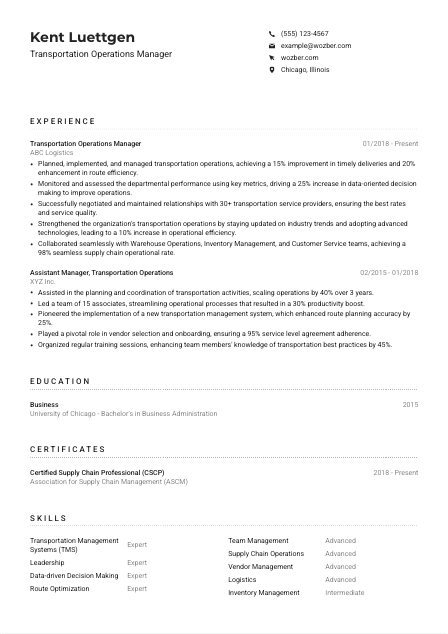
If the employer specifies a city or relocation expectation, address it directly in your header. In this case, listing Chicago, Illinois signals that geography will not slow down the hiring decision. If you are relocating, make that clear rather than leaving the employer to guess.
Include LinkedIn or a professional website only if it reinforces your resume with transportation-specific value, such as leadership progression, logistics project scope, or supply chain credentials. Make sure dates, titles, and achievements match your resume exactly.
Your header should answer the practical basics fast: who you are, what role you do, how to reach you, and whether location is already aligned. That keeps attention on your transportation results instead of avoidable questions.




For this role, the Experience section carries most of the hiring weight. Employers want to see how you managed transportation activity, improved service levels, controlled cost drivers, worked with carriers, and led teams through measurable operational change. Build each role around those points.
Start by identifying the operating themes in the posting: timely deliveries, route efficiency, TMS knowledge, KPI tracking, vendor negotiation, regulatory awareness, and collaboration with warehouse or customer service teams. Then choose examples from your own work history that match those responsibilities directly. This keeps your experience aligned with what transportation leaders are actually expected to run.
For every position, include job title, company name, and employment dates in a consistent format, starting with the most recent. Clear chronology helps employers read your progression from coordination or assistant management work into broader transportation leadership, fleet oversight, or multi-carrier responsibility.
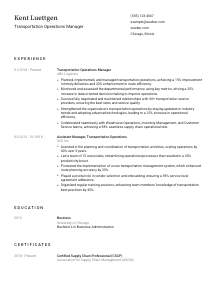
Your bullets should show what changed because you managed the operation. Strong transportation examples include improving on-time delivery, reducing route inefficiency, raising SLA performance, expanding capacity, or improving carrier service quality. The sample resume handles this well with lines like a 15% improvement in timely deliveries and a 20% gain in route efficiency.
Numbers matter here because transportation work is measured constantly. Include metrics tied to delivery performance, route utilization, cost control, productivity, provider count, service adherence, or efficiency gains. A bullet about managing 30+ transportation service providers or lifting productivity by 30% gives a hiring manager a much clearer sense of scale than a general statement about vendor management.
Choose accomplishments that reflect transportation planning, execution, and improvement. Strategic planning, TMS rollout, route planning accuracy, team supervision, and cross-functional supply chain coordination all belong here. Leave out achievements that do not support the case that you can lead transportation operations with data, discipline, and service accountability.
By the end of the Experience section, the reader should understand the size of the operation you handled, the levers you improved, and the results you delivered across carriers, teams, and service performance.
Education matters most here as confirmation that you have the academic grounding for operational planning, business analysis, and supply chain decision-making. Keep it direct, and emphasize alignment when the role asks for a degree in business, logistics, supply chain, or a related discipline.
If the posting asks for a bachelor's degree, make sure that information is easy to find. Degrees in Business, Logistics, Supply Chain Management, Operations, or related fields are especially relevant because they support the budgeting, planning, and analytical side of transportation leadership.
List degree, field of study, school, and graduation year in a consistent order. Hiring teams often scan this section quickly, so clarity matters more than extra detail. A line such as "Bachelor's in Business Administration, Business" works because it is easy to read and easy to match to the requirement.
When your degree lines up with the posting, use the formal title rather than an abbreviated or casual version. That helps connect your academic background to the employer's requirements, especially when the role is looking for business, logistics, or supply chain training.
If you are early in your career or your studies included transportation, logistics analytics, operations management, or supply chain modeling, a short mention can help. For more experienced candidates, your operating results usually matter more than classroom detail, so keep this selective.
Honors, leadership roles, or student projects are worth listing when they point to analytical discipline, leadership, or supply chain interest. If they do not support the transportation operations story, leave them out and keep the section lean.
Education should quickly confirm that you meet the role's degree requirement and bring the business or supply chain foundation expected for transportation planning and operational management.
Certifications are especially useful in transportation and supply chain roles because they show continued investment in industry standards, operating knowledge, and professional credibility. When the posting mentions credentials like CSCP or CTL as a plus, make those stand out.
Prioritize certifications tied to logistics, transportation, supply chain operations, or regulatory knowledge. CSCP and CTL are strong examples because they support the kind of planning, vendor coordination, and network understanding expected from a transportation operations manager.
A short list of relevant certifications is stronger than a long list of loosely connected training. Choose credentials that support the role's actual demands, such as transportation strategy, logistics execution, carrier management, or supply chain improvement.
Add the issuing organization and the active or completion date so the employer can place the certification in context. In a field shaped by changing technology, compliance standards, and operating models, current credentials carry more weight than vague mentions.
Transportation operations changes with new TMS capabilities, reporting practices, service expectations, and regulatory updates. An up-to-date certification section helps show that your knowledge is developing alongside the work, not frozen at an earlier stage of your career.
Handled well, certifications strengthen the picture of a manager who understands transportation operations in practice and keeps pace with how the field is changing.
This section should reflect the tools and management capabilities that drive transportation performance day to day. Employers are looking for a mix of systems knowledge, analytical judgment, and leadership skills that connect directly to service, cost, and coordination across the supply chain.
Review the posting for the capabilities that shape the job in practice. For this kind of role, that usually includes Transportation Management Systems, route optimization, KPI analysis, team leadership, vendor management, and cross-functional coordination with warehouse or inventory teams.
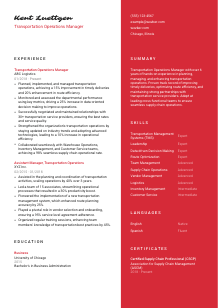
Put the most job-relevant skills first, especially ones named in the posting or central to transportation operations. If TMS knowledge is required, it should appear prominently. The sample resume also gets this right by leading with Transportation Management Systems, leadership, data-driven decision making, and route optimization.
Do not turn this section into a long inventory of every tool or soft skill you have ever used. Focus on capabilities that support carrier oversight, delivery performance, routing, operational reporting, provider negotiations, and team execution. A shorter, sharper list is easier for both recruiters and ATS screening to interpret.
Your skills list should quickly show that you can run transportation operations with the right systems, the right judgment, and the right management range.
Language ability is not the centerpiece of most transportation operations manager resumes, but it can still matter when the role requires clear communication across carriers, customers, warehouse teams, or multi-regional operations. Present it simply and tie it to actual usefulness.
If the posting says English proficiency is essential, list English first and state your level clearly. For a management role that involves reporting, vendor communication, and cross-functional coordination, this requirement should never be left implied.
After the required language, add others that may help in day-to-day operations or broader logistics environments. Spanish, for example, can be useful in many transportation settings where warehouse, carrier, and service communication spans diverse teams.
Choose clear levels such as Native, Fluent, Advanced, or Conversational. Avoid overstating ability. In operations management, language skill is quickly tested in meetings, issue resolution, and provider communication.
Even when not required, another language can strengthen your profile if it helps with team communication, customer interactions, or regional coordination. Keep the emphasis practical rather than decorative.
If your transportation background includes multi-site networks, international logistics, or culturally mixed teams, language capability can reinforce your ability to manage those environments. If not, keep this section brief and factual.
Language details should add useful context, especially around communication range, without distracting from your operational leadership and transportation results.
The summary is where you frame your value in a few lines before the reader reaches the deeper detail. For a transportation operations manager, that means quickly establishing management experience, transportation scope, and the kinds of results you are known for delivering.
Read the posting closely and pull out the themes that define success in the job: transportation planning, timely deliveries, route efficiency, KPI-driven improvement, provider management, and cross-functional supply chain support. Those themes should shape the summary language.
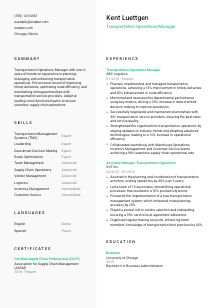
Lead with a direct statement of who you are professionally and how long you have worked in transportation or logistics management. A line like "Transportation Operations Manager with 6+ years of experience" works because it gives immediate context without wasting space.
Follow with the areas where you create value, such as improving on-time performance, optimizing routes, strengthening carrier relationships, implementing TMS improvements, or leading teams across transportation and warehouse operations. The sample summary uses this approach well by combining operating experience with delivery, efficiency, and partnership results.
Aim for a compact paragraph, usually three to five lines. Skip vague claims about being driven or results-oriented unless you attach them to transportation outcomes. The summary should read like a concise operating profile, not a generic introduction.
A good summary tells the employer, in a few seconds, what level of transportation operation you can run and what kind of performance improvement they can expect from you.
Once each section is tailored, your resume should present a clear picture of how you manage transportation flow, improve delivery performance, work with carriers, and lead cross-functional logistics execution. That is what employers are trying to understand when they review this role.
Wozber's free resume builder can help you shape that content into an ATS-friendly resume format, and its ATS resume scanner can surface missing terms from the job description so your experience is easier to match to the role. The finished resume should make one thing easy to judge: you can run transportation operations with control, efficiency, and measurable results.




