



Use Wozber and land your dream job
Create Resume
No registration required
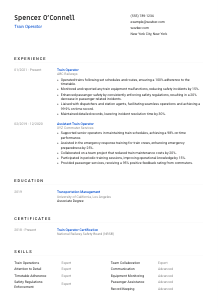
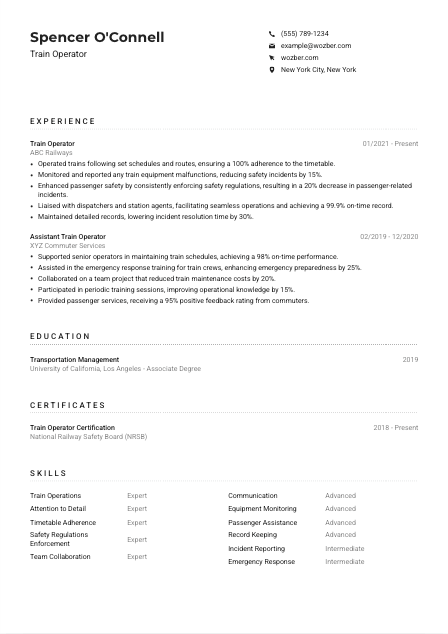
Navigating tracks, but your resume seems off-rail? Jump aboard this Train Operator resume example, created with Wozber free resume builder. Learn how to seamlessly merge your locomotive prowess with job route specifics, leading your career down a track of success!
Train operators work in a role where small lapses carry real consequences. Hiring teams look for candidates who can keep service moving on schedule, follow operating procedures under pressure, monitor onboard systems, and communicate clearly with dispatchers, station staff, and passengers when conditions change. Your resume needs to make that operating discipline visible from the first section.
Screening for this kind of position often starts with one practical question: can this person be trusted to run service safely and keep accurate records in a live transit environment? A tailored resume, built with Wozber's free resume builder and shaped for ATS optimization, brings those details forward fast by matching your experience, certification, and rail operations language to the posting. That gives a hiring team a clearer read on your readiness for scheduled service, safety compliance, and incident reporting.
Transit employers usually make early decisions from basic facts before they even reach your experience. For a Train Operator, that means your contact details should immediately confirm who you are, what role you do, and whether you meet practical requirements such as location and professional presentation.
Use your full name in the largest text on the page so it is easy to identify in both human review and ATS parsing. Skip nicknames unless they are the name you use professionally across licenses, payroll records, and certifications.
Place "Train Operator" directly under your name when that is the job you are pursuing. Matching the posting's title helps connect your resume to the role quickly, especially when employers are sorting applicants across related positions such as conductor, assistant operator, or rail crew roles.
Your phone number and email should be easy to scan and ready for scheduling interviews, reference checks, or follow-up on shift availability.
If the employer requires local availability, say so clearly. In the example posting, New York City, New York is stated outright, so listing that location helps remove a common screening question early. For other applications, include city and state whenever proximity matters for route assignments, reporting times, or local licensing.
A LinkedIn profile can support your application when it reflects the same rail, transit, or transportation background shown on your resume. Make sure job titles, dates, certifications, and major achievements such as timetable adherence or safety improvements match exactly.
This section should answer the basics without slowing the reader down. When your title, contact details, and location line up with the posting, the hiring team can move straight to your operating background.




For Train Operator hiring, experience carries the most weight when it shows safe operation, schedule control, communication under live conditions, and disciplined reporting. Generic duty lists fall flat here. Employers want to see what kind of service you handled, how you performed against timetable expectations, and how you responded to equipment or passenger issues.
Read the job description line by line and mirror the work that matters most. For this role, that includes safe and timely train operation, system monitoring, communication with dispatch and station staff, passenger assistance, and recordkeeping. When those duties appear naturally in your bullets, your background reads as directly relevant rather than adjacent.
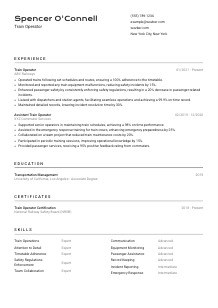
Put rail or transportation positions first and give the strongest detail to jobs where you were directly involved in train movement, schedule adherence, onboard checks, or crew coordination. The sample resume does this well by leading with a Train Operator role and following with Assistant Train Operator experience, which shows progression inside the same operating environment.
Do not stop at "operated trains" or "communicated with dispatch." Show what happened because of your work. Strong bullets mention outcomes such as consistent on-time performance, fewer safety incidents, faster incident resolution, or improved passenger feedback. The example bullet about achieving 100% timetable adherence is effective because it connects a core duty to a measurable standard that matters in rail operations.
Quantify results with metrics that hiring teams recognize: on-time record, incident reduction, response time, compliance rates, passenger satisfaction, or equipment issue reporting. The sample resume uses figures like a 15% reduction in safety incidents and a 99.9% on-time record, which immediately tells the reader how the candidate performed in live service conditions.
Every bullet should strengthen your case for running trains safely and efficiently. Prioritize achievements tied to timetable discipline, safety enforcement, equipment monitoring, emergency response, and coordination with dispatchers or station agents. Less relevant work can stay brief unless it adds something useful about transportation operations or passenger-facing service.
Your experience section should read like a record of safe, dependable service. If the bullets show route discipline, operational communication, and measurable performance, you are giving the employer real reason to trust you in the cab.
Education matters here as baseline qualification and supporting context. It usually will not outweigh direct operating experience, but it can reinforce that you meet minimum requirements and have formal exposure to transportation systems, safety practices, or operations management.
If the posting asks for a high school diploma or GED equivalent, make sure that requirement is easy to confirm. When you hold a higher credential, list it cleanly so the employer can still infer that you meet the baseline. Do not leave this section vague in a regulated or safety-sensitive field.
Use a simple structure: school name, degree, field of study, and graduation year. That is enough for most Train Operator roles and keeps the section easy to read in an ATS-friendly resume format.
Specialized education can strengthen your profile even when it is not required. An associate degree in Transportation Management, as shown in the example, supports the candidate's rail background because it aligns with operations, transit systems, and service coordination. Treat that as an advantage, not as a universal expectation for every Train Operator job.
Coursework is most useful when you are early in your career or when the classes directly support the job, such as rail safety, transportation logistics, mechanical systems, or emergency procedures. If you already have several years of train operations experience, keep this brief or skip it.
Honors, technical programs, or extracurricular involvement tied to transportation, mechanics, or safety can add context if they support your operating profile. Include them only when they strengthen the case that you understand structured, process-driven work.
This section should quickly confirm that you meet the stated requirement and, where applicable, show a stronger foundation in transportation operations. Keep it factual, easy to scan, and relevant to regulated service work.
For train operations, certifications often carry more practical weight than broad professional development courses. They show current qualification, compliance with operating standards, and readiness for safety-sensitive work. If a posting names a required license or certification, that item needs immediate visibility.
Put any Train Operator certification or regional operating license at the top of this section. The job description here specifically asks for valid certification or licensing where required, so that credential should never be buried below unrelated training.
Choose certifications that support train movement, passenger safety, emergency response, or regulatory compliance. A short, focused list is stronger than padding this section with generic courses that do not affect operating authority or service performance.
Include issue dates and, when relevant, renewal or active status. In a field where certifications can expire, current dates help the hiring team understand whether you are ready to work without extra clarification. The example resume handles this well by showing ongoing certification status.
Transit systems value operators who stay current on emergency procedures, incident response, and operational updates. If you have training similar to Emergency Response Training in the example, include it because it supports the reality of handling disruptions, passenger incidents, and service irregularities.
Your certifications should show that you are qualified to operate, prepared for safety responsibilities, and current with required standards. That is a direct hiring advantage in rail and transit roles.
A Train Operator skills section works best when it reflects real operating work, not broad personality claims. Focus on the abilities that keep service safe, on time, and well coordinated across the cab, platform, and dispatch chain.
Use the posting to identify the exact terms the employer values. Here, that includes train operations, attention to detail, communication, equipment monitoring, passenger assistance, and record keeping. Matching that language improves ATS alignment and makes your profile easier to connect to the role.
Lead with hard and role-specific skills such as timetable adherence, safety regulations enforcement, incident reporting, emergency response, and equipment monitoring. The sample resume does this effectively by centering operational and safety skills instead of filling the section with generic workplace traits.
Group or order skills by relevance so the most important ones appear first. If you use proficiency labels, make sure they match the depth shown in your experience. For example, claiming expert-level timetable adherence or train operations should be supported by bullets showing on-time performance, route execution, or operating responsibility.
This section should back up the experience section with the language of real train operations. When the skills match the work, the resume feels consistent and credible.
Language ability matters in train operations because instructions, incident reports, announcements, and safety communication all depend on clarity. For many employers, English proficiency is a practical requirement tied to operations and passenger service, not just a box to tick.
If the posting requires fluency in English, list English at the top with your true proficiency level. That gives the employer immediate confirmation that you can handle radio communication, written reports, and passenger-facing instructions.
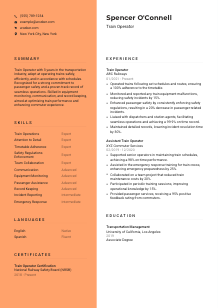
Additional languages can strengthen your profile, especially in commuter systems or urban transit environments where operators and crew interact with diverse passengers. Spanish in the sample resume is a useful example of an added communication asset, but the value depends on the routes, riders, and service context of the job you are targeting.
Terms such as Native, Fluent, Conversational, or Basic are easier to interpret than vague descriptions. Choose the level you can support in real work situations, especially if the role involves passenger assistance during delays, incidents, or emergency announcements.
Some Train Operator roles are almost entirely local and procedure-driven, while others involve more frequent passenger interaction. Adjust emphasis accordingly. For a busy commuter network, extra language ability can support customer service and de-escalation even when English remains the core requirement.
Only include languages you can actually use. In this profession, language skill matters when it improves crew communication, rider support, or incident handling. That practical value is what makes the section worth keeping.
For a Train Operator, language skills should show that you can communicate clearly where it counts: with crew, with control, and with passengers. Lead with required fluency and keep the rest grounded in real use.
Your summary should sound like someone trusted with a safety-sensitive route, not like a generic transportation profile. In a few lines, show your level of experience, the operating strengths you bring, and the kind of service results you have produced.
Focus on the themes that define Train Operator work: safe operation, schedule adherence, communication, equipment awareness, and passenger safety. Those are the points that deserve space in the opening paragraph of your resume because they frame how the rest of your experience will be read.
Start directly with who you are and how long you have worked in rail or transportation. A line such as "Train Operator with 3 years in the transportation industry" works because it immediately places you in the right professional category.
Choose details that hiring teams care about, such as strong timetable performance, a record of reducing safety incidents, experience coordinating with dispatch, or disciplined incident reporting. The sample summary works because it combines safety, efficiency, and communication without drifting into vague claims.
Aim for 3 to 5 lines. That is enough room to establish operating credibility without repeating the experience section. Every phrase should tie back to transit service, rail safety, or reliability under schedule pressure.
Your summary should quickly tell the reader that you can operate safely, stay on time, and handle the communication and reporting that keep rail service running. If that is clear in the first few lines, the rest of the resume has a strong foundation.
A Train Operator resume should leave little doubt about four things: you can run service safely, follow schedules, communicate clearly, and document issues accurately. Review every section with those standards in mind, then cut anything that does not support them.
Use Wozber's free resume builder to organize the resume in an ATS-friendly resume template, and use the ATS resume scanner to compare your wording against the posting's operating, safety, and reporting requirements. That helps surface missing details before you apply.
When the resume is tailored well, a hiring team can quickly see that you are ready for the responsibility of live rail service. That is the standard to aim for.




