



Use Wozber and land your dream job
Create Resume
No registration required
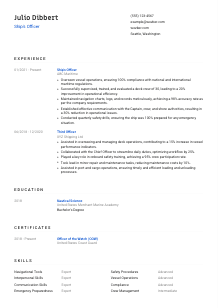
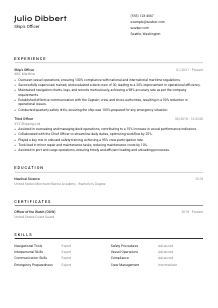
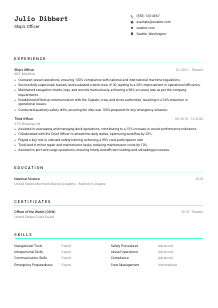
Navigating the high seas, but your resume seems adrift? Check out this Ship's Officer resume example, created with Wozber free resume builder. Learn how to align your maritime mastery with job requirements, ensuring your career sails as smoothly as the waters you command!
Ship's Officers are trusted with far more than watchkeeping. The role sits where navigation, crew supervision, recordkeeping, and safety discipline meet, and hiring teams read resumes with that operational responsibility in mind. Your resume needs to show that you can keep a vessel compliant, keep a bridge team coordinated, and respond calmly when procedures matter most.
A tailored resume changes how quickly that capability comes through, especially when maritime employers screen for required credentials, sea-going experience, and regulation-heavy responsibilities in an ATS-compliant resume. Wozber's free resume builder helps you line up your wording with the posting, organize sections clearly, and present the kind of bridge, safety, and crew-management experience that makes you easier to place in a working shipboard environment.
Maritime employers do not need a long introduction here. They need clean contact information, the target title, and any location detail that affects deployment or relocation decisions. Keep this section straightforward so the rest of the resume can focus on vessel operations and command support.
Use your full name exactly as you use it on licenses, certificates, and employment records. A clean, prominent heading helps employers connect your resume to training documents, sea service records, and application paperwork without confusion.
Place "Ship's Officer" under your name if that is the position you are pursuing. This immediately aligns your resume with the vacancy and helps distinguish you from candidates applying more broadly as deck officers, third officers, or marine operations personnel.
List a reliable phone number and a professional email address you check regularly. If a hiring manager or crewing coordinator is trying to confirm availability, interview timing, or certificate status, they should not hit a dead end because of outdated contact information.
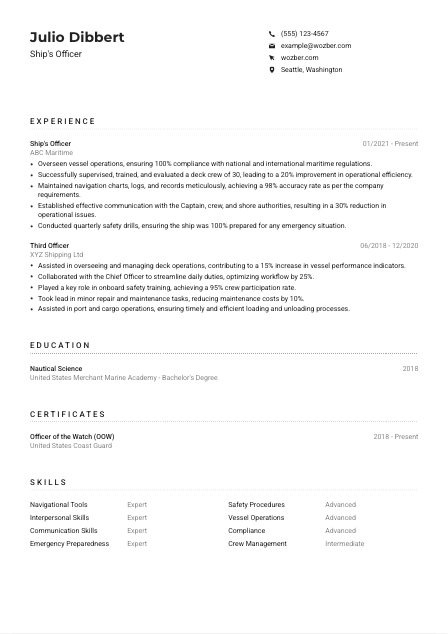
If the job requires you to be based in a specific port city or willing to relocate, state that clearly. In this example, Seattle, Washington matters because it removes doubt about deployment readiness and local availability.
Include a LinkedIn profile or professional website only if it supports your candidacy with maritime credentials, vessel history, training, or industry experience. Make sure it matches the dates, titles, and qualifications shown on your resume.
This section should answer practical questions fast: who you are, what role you want, how to reach you, and whether location is a hurdle. Once that is clear, the hiring team can move straight to your watchstanding, compliance, and crew leadership background.




For a Ship's Officer, experience is where employers look for proof of safe operations under real conditions. They want to see time at sea, scope of responsibility, familiarity with regulations, and examples of how you handled crew oversight, documentation, and emergency readiness. Write this section like an operational record, not a generic job history.
Read the job description closely and mark the responsibilities that define the role. Here, that includes regulatory compliance, supervision of deck crew, maintenance of navigation charts and logs, communication with shore authorities, and regular safety drills. Your bullets should reflect those same work areas when they match your actual experience.
Start with your most recent sea-going role and include job title, employer or vessel operator, and dates. This makes your progression easy to follow, whether you moved from Third Officer to Ship's Officer or built experience across cargo and passenger operations.
Each position should show what you were trusted to run, maintain, or improve. Good Ship's Officer bullets mention crew supervision, navigational record accuracy, drill execution, port communication, watchkeeping support, or vessel performance. The sample resume does this well by tying deck crew supervision to a 20% improvement in operational efficiency.
Quantify the parts of your work that are naturally measured. Crew size, compliance rates, log accuracy, drill frequency, reduction in operational issues, turnaround support, or maintenance savings all help hiring teams understand your scale and consistency. Metrics such as "100% compliance" or "30% reduction in operational issues" feel credible here because they connect to regulated shipboard work.
Keep the section focused on sea service, deck operations, safety execution, navigation support, reporting, and leadership. Extra achievements are only useful if they strengthen your case for standing watch, coordinating crew activity, or maintaining legal and operational standards on board.
A hiring manager should be able to read this section and picture you on the bridge, on deck, and in communication with the Captain and shore side contacts. When your bullets show scope, discipline, and measurable outcomes, your experience reads like proven shipboard responsibility.
Education matters here because it anchors your technical training in navigation, seamanship, maritime law, and vessel operations. For Ship's Officer roles, this section usually supports required qualifications rather than carrying the application on its own, so clarity matters more than detail overload.
Start by checking the education requirement in the posting. In this case, a Bachelor's degree in Nautical Science or a related field is part of the baseline, so your degree and field should appear exactly and clearly in the section.
List degree, field of study, institution, and graduation year in a clean order. Maritime employers reviewing multiple candidates do not need extra wording here. They need to confirm that your academic background supports bridge duties and officer-level training.
If your degree is directly aligned, say so plainly. "Bachelor's Degree in Nautical Science" immediately reinforces that your education matches the technical and regulatory demands of the role, just as the sample resume does.
You do not need to turn this into a transcript. Include relevant coursework, honors, or maritime projects only if they sharpen your profile, especially if you are earlier in your career or the role places weight on a specific operational area.
Cadet leadership, academy command roles, simulator work, or maritime society involvement can help if they connect directly to bridge teamwork, vessel safety, or officer development. Keep it brief and relevant to professional practice at sea.
This section should quickly reassure the employer that your academic preparation aligns with officer-level vessel operations. Clear formatting and a directly relevant degree keep the focus where it belongs.
In maritime hiring, certificates are not a decorative extra. They can decide whether you are legally and operationally eligible for the role. Present them clearly so employers can confirm that you meet the required standard before they invest time in the rest of the application.
Check the vacancy for required credentials and place those first. Here, the Officer of the Watch, or OOW, certificate is essential, so it should be easy to find and impossible to miss.
List credentials that directly support your ability to serve in the role, especially watchkeeping, safety, and regulatory qualifications. For this type of position, a valid OOW certificate carries much more weight than unrelated training because it speaks directly to bridge responsibility and legal compliance.
Include the issuer and the date range so employers can quickly assess whether the credential is current. The sample resume handles this well by showing the United States Coast Guard as issuer and making the certificate's active status visible.
Maritime compliance moves with renewals, endorsements, and recurring training. Review this section before every application so expired or missing information does not raise concerns about readiness for assignment or regulatory coverage.
When certificates are listed clearly and kept current, employers can move forward without wondering whether you meet officer-level requirements. That matters in a field where legal eligibility and operational trust go together.
The best skills section for a Ship's Officer does not read like a generic leadership list. It should capture the operational mix the job requires: navigation, safety, compliance, communication, and crew oversight. Keep it focused on abilities you can support elsewhere in the resume.
Use the posting to identify the specific capabilities the employer wants to see. Here, navigational and piloting skill, proficiency with electronic and traditional navigational tools, interpersonal strength, communication, and crew management all belong in the shortlist.
Ship's Officers need both. Include hard skills such as chart work, navigational systems, vessel operations, and safety procedures alongside crew supervision, communication with port authorities, and emergency preparedness. That balance reflects how the job is actually performed on board.
Avoid padding this section with broad traits that could belong on any resume. A shorter list built around navigation tools, compliance, bridge communication, crew management, and safety execution gives a more credible picture of officer-level capability. The sample skill list works because it stays close to the day-to-day realities of the role.
This section should reinforce the operational profile already shown in your experience. When the skills are specific to bridge work, safety systems, and crew coordination, they support a faster and more confident read of your candidacy.
Language ability matters in maritime work because instructions, safety communication, and shore-side coordination leave little room for ambiguity. Even when only one language is required, how you present it can affect how employers judge your ability to work with multinational crews and external authorities.
If the posting names a language requirement, place it first. For this role, English proficiency is mandatory, so it should appear clearly in your languages section and align with your ability to handle logs, commands, reporting, and port communication.
List your strongest and most relevant languages first. If English is native or fluent, make that visible. Additional languages, such as Spanish in the sample resume, can add value in diverse crew settings or international port operations.
Even when not required, extra languages can strengthen your profile if they improve communication with crew members, terminal staff, inspectors, or local authorities. Keep them if they serve real operational contexts rather than filling space.
Choose clear levels such as Native, Fluent, Intermediate, or Basic. Inflated language claims become obvious quickly in interviews and can create risk in a role where accurate communication affects safety and compliance.
If your target employers work international routes, mixed-nationality crews, or frequent port calls in multilingual regions, language skills become more than a bonus. They support clearer coordination, fewer misunderstandings, and smoother daily operations.
For Ship's Officer roles, language skills matter when they improve command clarity, safety communication, and contact with shore authorities. Present them in that practical light, and the section adds real value.
Your summary should quickly establish what kind of Ship's Officer you are, how much sea-going experience you bring, and which responsibilities you handle with confidence. This is one of the first places an employer looks for command level, operational scope, and fit with the vessel environment.
Before writing, identify the few requirements that carry the most weight. In this case, years of officer experience, vessel operations, navigation, compliance, crew supervision, and emergency readiness are better summary material than broad personality claims.
Start with a direct statement of your title and years of experience, such as more than 5 years as an officer on cargo or passenger vessels if that matches your background. This gives immediate context for the level at which you have operated.
Use the next sentence to name the work you are trusted with, such as overseeing vessel operations, maintaining navigational records, managing deck crews, or supporting safe and compliant passage. The sample summary is effective because it ties experience directly to compliance, communication, and safety drills.
Aim for 3 to 5 lines with concrete maritime language. A compact summary with terms like maritime regulations, navigation charts, emergency preparedness, and crew leadership gives hiring teams a sharper first read than generic statements about being dedicated or hardworking.
A well-built summary frames the rest of the resume around shipboard responsibility, not vague ambition. By the time a recruiter reaches your experience section, they should already know your operating level, your maritime strengths, and the kind of vessel environment you can support.
A Ship's Officer resume should read like a record of safe operations, disciplined documentation, and dependable crew leadership. When each section supports that picture, your application becomes much easier to trust.
Use Wozber to tighten the wording, check ATS optimization, and build an ATS-friendly resume template that keeps your credentials, sea-going experience, and operational scope easy to read. The final result should make one thing clear fast: you are ready to step into officer-level vessel responsibility.




