




Use Wozber and land your dream job
Create Resume
No registration required
Guiding learners, but your resume feels like a detour? Navigate this Tutor resume example, created with Wozber free resume builder. Learn how to map out your teaching prowess to match job specifications, paving a career path as clear as A, B, C!
Tutoring work is judged in the learning gains students actually make. Hiring teams want to see that you can diagnose where a student is struggling, adjust instruction to match that learner, and build enough trust for progress to stick over time. Your resume should make that teaching judgment visible, especially through examples of assessment, lesson adjustment, student engagement, and communication with families.
A tailored resume changes how quickly your background reads as classroom-ready or support-only. When your wording mirrors the posting's language around personalized learning plans, subject mastery, and progress feedback, Wozber's free resume builder helps shape that into an ATS-compliant resume that clearly shows you can run effective sessions, track improvement, and communicate progress in a way schools, tutoring centers, and families can rely on.
Tutoring is built on trust. Before anyone reads your teaching history, they see whether your resume presents you as organized, professional, and easy to contact. Keep this section simple, polished, and aligned with the practical requirements of the opening.
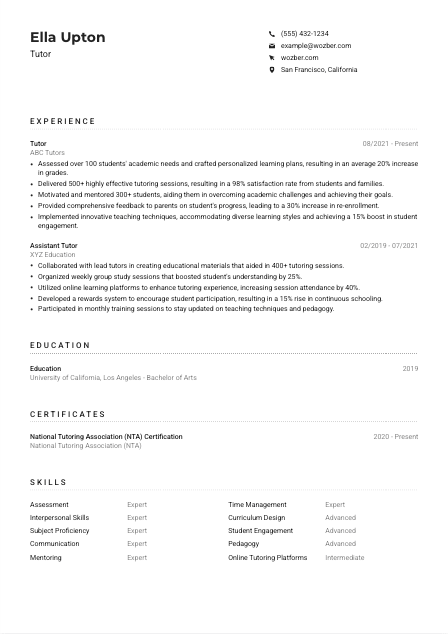
Place your full name at the top in a clear, readable font. For tutoring roles, you do not need design flourishes. What matters is a professional presentation that feels steady and credible, the same way a parent, student, or program manager would expect a tutor to show up.
Add "Tutor" directly below your name unless a more specific version fits the opening, such as Math Tutor or Academic Tutor. Matching the posted title helps both ATS screening and human readers immediately connect your resume to the role.
List a current phone number and a professional email address. Because this role depends on regular communication with students and families, even small details matter here. An email in a straightforward format such as firstname.lastname@email.com supports the professional tone you need for parent updates, scheduling, and follow-up.
If the employer asks for a local candidate, show your city and state. In this example, listing San Francisco, California directly answers the posting's location requirement and avoids questions about relocation or availability for in-person sessions.
Include a website or profile only if it supports your candidacy. A LinkedIn page, tutoring site, or portfolio with testimonials, subject areas, or student success examples can strengthen your application. Keep it updated and consistent with the experience, certifications, and teaching focus shown on your resume.
This section should confirm that you are easy to reach, locally aligned when required, and professionally presented. That is exactly the kind of practical reliability tutoring employers look for before they review your teaching background.




Tutoring employers look past job titles quickly. They want to know how you assessed needs, what kinds of sessions you delivered, how you adapted instruction, and whether students improved. Your experience section should answer those points with concrete examples and measurable outcomes.
Read the job description for the actions it emphasizes, then mirror those actions in your bullets. Here, the employer highlights assessing academic needs, creating personalized learning plans, delivering sessions, motivating students, and giving feedback to families. If you have done that work, make those verbs and responsibilities easy to find in your experience section.
List your positions in reverse chronological order with job title, organization, and dates. That structure lets hiring teams quickly see whether you meet the requested 2+ years of tutoring or teaching experience and whether your work has progressed from support roles into more independent instructional responsibility.
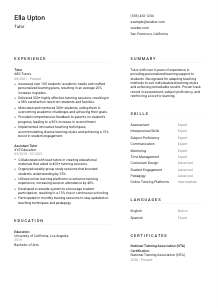
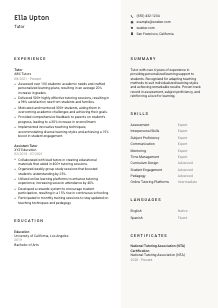
Focus each bullet on work that matters in tutoring: assessment, lesson planning, subject instruction, engagement strategies, and parent communication. The sample resume does this well by pairing responsibilities with results, such as assessing more than 100 students and building individualized plans that led to an average 20% grade increase.
Numbers help tutoring experience feel real. Include student caseload, session count, improvement rates, satisfaction scores, re-enrollment, attendance, or engagement gains when you can support them. Examples like 500+ tutoring sessions, a 98% satisfaction rate, or a 30% increase in re-enrollment tell a hiring manager that your work had measurable follow-through.
Prioritize experience that proves you can teach, coach, and track progress. Group study support, instructional material creation, online tutoring, and mentoring all belong if they connect to student learning. Less relevant work can stay brief or drop off entirely. For ATS optimization and human review alike, your strongest resume keeps the focus on educational outcomes and instructional skill.
Your experience section should make it easy to see the students you supported, the methods you used, and the progress that followed. That combination tells a far stronger story than duties alone.
A tutoring resume usually needs to establish two things through education: that you meet the baseline academic requirement and that your background supports the subjects or age groups you teach. Keep this section straightforward, and let it reinforce your instructional credibility.
When a posting calls for a bachelor's degree in Education, a related field, or subject matter expertise, make that match obvious. If your degree aligns directly, as in the sample's Bachelor of Arts in Education, place the degree, field, and school in a format that is easy to scan.
List your degree, field of study, school, and graduation year or date. This is one section where clean formatting matters more than style. A simple structure helps both ATS parsing and quick review by tutoring coordinators or school administrators.
If your studies connect to how you teach or what you tutor, make that visible. Education degrees support pedagogy and learning theory. Subject-specific degrees support content mastery. Either can work well, depending on the tutoring role and the student population.
Coursework is most useful if you are early in your career, changing fields, or applying for subject-specific tutoring. Courses in child development, literacy instruction, mathematics education, curriculum design, or adolescent learning can strengthen the connection between your academic background and the tutoring work you want.
Awards, scholarships, honors, or academic projects are worth adding when they reinforce teaching ability, subject expertise, or commitment to learning. Keep them brief and relevant. For an experienced tutor, these details should support the section, not overpower your teaching record.
This section should answer two practical questions fast: do you meet the degree requirement, and does your academic background support the tutoring you want to do. If both are clear, the reader can move on to your teaching experience with confidence.
Tutoring credentials help when an employer wants proof of formal training, professional standards, or current teaching practice. They are especially useful for roles that involve structured programs, parent-facing communication, or specialized support for K-12 and college learners.
When a job mentions tutoring or teaching certifications, move those to the top of this section. In the example, National Tutoring Association certification directly matches the employer's preference, so it deserves clear placement.
Choose certifications that support your work with students, not just general professional development. Tutoring certifications, teaching credentials, subject-area endorsements, test prep qualifications, or training in learning differences can all add value when they connect to the role.
Show the certifying organization and the date earned, plus expiration or renewal details if relevant. That helps employers understand whether the credential is current and whether you are actively maintaining your professional standards.
Tutoring methods, curriculum expectations, and digital learning tools change over time. New certifications or continuing education in instructional strategies, online tutoring platforms, or student support approaches can strengthen your resume, especially if the role emphasizes varied teaching techniques.
List certifications that support how you teach, who you teach, or the standards you work under. When they line up with the posting, they add another clear reason to take your application seriously.
A tutor's skills section should reflect how the work is actually done. That means balancing subject knowledge with instructional judgment, student rapport, communication, and the ability to adjust methods when a learner gets stuck. Keep the list focused on the abilities that matter in sessions and follow-up.
Use the posting to identify the skills the employer values most. Here, that includes subject proficiency, interpersonal skills, communication, and the ability to assess needs and adapt instruction. Those terms should appear in your resume if they accurately reflect your background.
Select skills you can back up through your experience. If you claim assessment, your bullets should show diagnostic work or personalized learning plans. If you list communication, the resume should also show family feedback, student mentoring, or session guidance. The sample resume connects skills like Assessment and Mentoring to specific outcomes in the experience section, which makes the list more believable.
Put the most role-relevant skills first. For tutors, that often includes assessment, subject mastery, communication, student engagement, lesson adaptation, time management, and familiarity with online tutoring platforms. Keep the section tight enough that every skill supports stronger instruction, better progress tracking, or smoother collaboration with students and families.
A skills section works best when it matches both the job description and the way you already describe your teaching results. That consistency helps the reader trust what you can deliver in a real tutoring setting.
Language ability matters in tutoring because so much of the job depends on explanation, listening, and rapport. If the role calls for strong English communication, your languages section should make that easy to confirm without overcomplicating it.
When English communication is specifically required, list English at the top with an accurate proficiency level such as Native or Fluent. That gives the employer an immediate answer on a core qualification for instruction, student support, and family communication.
If English is not your first language, you can still present it strongly by using an honest proficiency label and supporting it through experience in teaching, tutoring, or client-facing roles conducted in English. The key is to remove doubt about your ability to explain concepts clearly and respond in real time.
Additional languages can be valuable, especially in diverse student communities or bilingual tutoring environments. A language like Spanish, as shown in the sample resume, may help with student rapport or family communication, even when it is not required for the role.
Be precise about your level. Native, Fluent, Advanced, Conversational, or Basic are more useful than vague claims. In tutoring, overstatement can create problems quickly if the role includes family updates, reading support, or subject explanation in that language.
If you tutor multilingual learners, support English language development, or work with families across language backgrounds, extra languages become more than a bonus. They strengthen your value as an educator who can connect with students in ways that remove barriers to learning.
For tutoring roles, language ability should clarify how well you can teach, explain, and connect. Keep the section accurate, and let it reinforce your effectiveness with students and families.
Your summary is often the first place a tutoring employer looks for a quick read on your experience, teaching style, and student impact. It should sound grounded in actual tutoring work, not broad enthusiasm for education.
Start with the kind of tutor you are and how much experience you bring. If you have worked with K-12 students, college learners, test prep, or subject-specific instruction, that can help define your scope. The sample summary opens with more than 4 years of personalized learning support, which gives immediate context.
Follow with a sentence that reflects how you teach. Strong themes for tutors include adapting lessons to learning styles, identifying gaps through assessment, improving student confidence, or guiding steady academic progress. Keep it tied to your actual practice, not generic passion statements.
Pull in the abilities this employer cares about most, such as subject proficiency, assessment, communication, or personalized learning plans. If you have measurable results, mention them briefly. A short phrase about grade improvement, engagement gains, or strong family satisfaction can give the summary more weight.
Aim for 3 to 5 lines with clear language and no filler. This section should quickly tell the reader whether you have the right teaching background, the right instructional approach, and the right level of professionalism for the tutoring environment.
A good summary gives a quick, credible picture of your teaching style and results. When it aligns with the posting, the rest of your resume lands with much more clarity.
A tutor resume works best when it shows how you assess learning needs, adapt instruction, communicate progress, and help students improve over time. If each section points back to those outcomes, your application will read as grounded, capable, and ready for real student support.
Use Wozber's free resume builder to organize your content in an ATS-friendly resume format, then refine the language with its ATS resume scanner so your teaching experience, certifications, and student results align closely with the posting. The finished resume should make one thing easy to judge: you can help students learn, progress, and stay engaged.




