



Use Wozber and land your dream job
Create Resume
No registration required
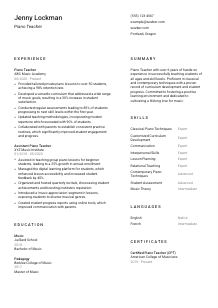
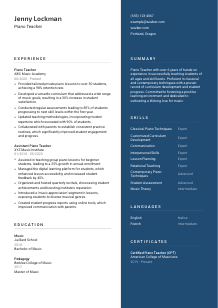
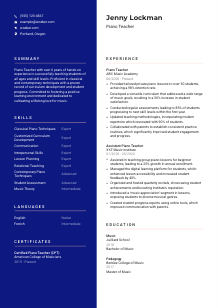
Tuning keys, but your resume feels offbeat? Strike a chord with this Piano Teacher resume example, created with Wozber free resume builder. Learn how to present your musical mastery in a way that resonates with job expectations, turning your career melody into a standing ovation!
Piano teaching is judged in the lesson room long before a recital or exam result appears. Schools and studios want to see whether you can teach beginners and advanced students, adjust technique and repertoire to different ages, and keep progress moving through steady practice, feedback, and clear lesson planning. Your resume should make that teaching range visible from the start.
A tailored resume helps hiring teams quickly separate a performer who teaches occasionally from an educator who can build curriculum, track student development, and communicate well with families. Wozber's free resume builder helps you shape that story in an ATS-friendly resume format, so terms like curriculum development, assessments, group lessons, and pedagogical methods are easy to scan and tied to real classroom results.
For a Piano Teacher, the contact section does more than identify you. It sets up practical details a school, academy, or private studio may screen for immediately, including role alignment, professional presentation, and location when the posting names one.
Use your full name in a clean, readable font so it is easy to spot on the page and in a digital file. Music schools and arts organizations often review many applications at once, so clarity matters more than styling tricks.
Place "Piano Teacher" directly under your name when that is the role you are applying for. This keeps your positioning consistent with the posting and helps ATS software connect your resume to the opening without making the reviewer guess whether you are applying as a performer, accompanist, or general music instructor.
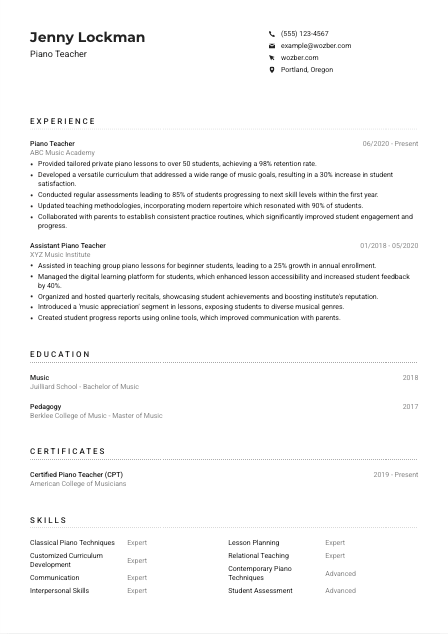
If the employer asks for a local candidate or someone willing to relocate, include your city and state. In the example, listing Portland, Oregon directly answers a stated requirement and removes an early logistical question for the employer.
A website, portfolio, or LinkedIn profile can help if it includes useful material such as teaching philosophy, recital highlights, student performance videos, or parent testimonials. Keep it current and consistent with your resume, especially if it shows your lesson style or breadth across classical and contemporary repertoire.
When this section is clean and complete, the employer can move straight to your teaching background instead of pausing over basic details. That keeps the focus where it belongs, on your instruction, student progress, and professional fit.




This is the section most likely to decide whether your application moves forward. For Piano Teacher roles, employers look for signs that you can teach across levels, build lesson plans around student goals, monitor improvement, and maintain a productive relationship with families or guardians.
Before writing bullets, mark the responsibilities and requirements the employer repeats or emphasizes. Here, the clear priorities are private and group instruction, customized curriculum, regular assessment, range across age groups, strong communication, and fluency in both classical and contemporary techniques. Those themes should appear in your experience section in language that reflects your real work.
Start with your most recent teaching position and work backward. For each entry, include your title, the school or studio name, and your dates of employment. This format helps reviewers follow your development from assistant or junior teaching work into fuller responsibility for lesson planning, student load, and parent communication.
Avoid filling this section with generic statements like "taught piano lessons." Show what your instruction changed. Strong bullets mention student count, age range, lesson format, curriculum design, exam or skill progression, recital preparation, or retention. The sample resume does this well by linking tailored instruction to more than 50 students and a 98% retention rate.
Piano instruction produces results that can often be measured: retention, advancement to the next level, recital participation, parent satisfaction, enrollment growth, or engagement with practice routines. Use numbers when they are meaningful. For example, noting that 85% of students advanced within a year says far more than simply claiming you "supported progress."
Select the work that best supports your case as a teacher. Accompanying, performing, or broader music education can help when it strengthens your profile, but the main emphasis should stay on lesson delivery, curriculum, assessments, repertoire choices, and student development. If you have limited direct teaching history, include related work that shows instructional skill, such as group beginner classes, recital coaching, or digital progress reporting.
By the end of this section, a hiring team should be able to see who you taught, how you taught, and what improved under your instruction. That is the standard your experience section needs to meet.
Music schools and private academies usually want formal training that supports both musicianship and instruction. For a Piano Teacher, your education section should quickly show whether you meet the academic baseline and whether your studies connect directly to piano performance, pedagogy, or music education.
If the posting asks for a bachelor's degree in Music, place that degree clearly in this section. When your focus was piano, pedagogy, music education, or a closely related field, make it easy to see. If you also hold graduate training, include it as added depth, especially if it strengthens your teaching profile.
List each institution accurately, especially if it is a conservatory, music school, or university known for strong performance or pedagogy programs. Recognizable institutions can add context, but they matter most when paired with studies that support the teaching work you want to do.
For every degree, include the school, degree type, field of study, and graduation year. That simple structure works well for both human review and ATS parsing. In the example, "Bachelor of Music" and "Master of Music" immediately reinforce formal preparation for piano instruction and pedagogy.
If your teaching experience is still growing, coursework can help fill in useful detail. Subjects such as piano pedagogy, keyboard literature, music theory, child development in music learning, or studio teaching methods can strengthen the section when they relate directly to the role.
Honors, scholarships, or standout music activities can support your application when they point to discipline, musicianship, or instructional promise. Keep them concise and relevant. The main purpose of this section is still to confirm the educational background that supports your work as a piano instructor.
This section should confirm that your teaching rests on solid musical training, not just informal experience. Once that is clear, employers can focus on how you apply that foundation in lessons and student development.
Certifications matter most when they reinforce how you teach. In piano instruction, that often means recognized pedagogical methods, teaching credentials, or professional development that shows you stay current with instructional practice and student learning approaches.
If an employer mentions methods such as Suzuki or Royal Conservatory of Music, give those credentials clear space when you have them. Even when a posting lists them as preferred rather than required, they can help show that your teaching approach is structured and method-aware.
Prioritize certifications that support lesson planning, technical instruction, early learner development, exam preparation, or studio teaching. A general music certificate may be worth listing, but a piano-specific teaching credential usually carries more weight for this kind of role.
Add the issue date or active date range when it helps show that your training is recent or ongoing. In the example, listing the Piano Teacher certification with dates makes continued professional standing easier to understand at a glance.
Studios and schools often value teachers who continue refining their approach through pedagogy workshops, graded exam systems, repertoire updates, and child or adult learning methods. Updating this section over time shows that your instruction evolves with the field rather than staying fixed in one teaching style.
A focused certificate section tells employers that your lessons are informed by more than personal playing experience. It points to training you can apply in curriculum design, technique development, and student progression.
The best skill lists for Piano Teachers combine musical ability with instructional practice. Employers need to see both how well you play and how effectively you translate that knowledge into lessons, feedback, motivation, and student progress.
Scan the description for both explicit and implied skills. Here, the essentials include classical and contemporary piano techniques, customized curriculum development, lesson planning, student assessment, communication, and interpersonal ability. Those should shape the top of your list if they match your background.
Lead with capabilities that matter in day-to-day teaching, such as technique instruction, curriculum customization, sight-reading support, repertoire selection, progress assessment, and parent communication. The sample resume handles this well by pairing musical skills with teaching functions like curriculum development and assessment.
A Piano Teacher needs more than musicianship alone. Blend hard skills and teaching skills in a way that reflects the actual job. For example, "Classical Piano Techniques" and "Contemporary Piano Techniques" belong alongside "Lesson Planning," "Student Assessment," and "Communication." That mix shows you can both perform the material and teach it effectively.
When this section is tailored well, the employer can quickly see your technical range, instructional methods, and ability to run lessons productively. Keep every listed skill tied to work you can demonstrate elsewhere in the resume.
Language skills matter in music teaching when they support instruction, parent communication, studio administration, or a diverse student base. For this role, English proficiency is directly relevant because lesson coordination, feedback, and business communication all depend on it.
If the posting asks for English for business communication, list English prominently with an accurate proficiency level. This matters for emails, progress updates, scheduling, and conversations with parents or guardians, not just for teaching at the keyboard.
Additional languages can be useful in private studios, community music schools, and multicultural teaching environments. Include them when they are real strengths, especially if they help you communicate with students or families from different backgrounds.
Terms such as "Native," "Fluent," "Intermediate," and "Basic" work well because they are easy to understand quickly. Avoid vague wording. A school deciding who can handle parent communication or student support needs a practical sense of your comfort level.
Not every Piano Teacher job will depend on multilingual ability, but some programs serve international families or diverse communities where extra language skills can support retention and rapport. Treat this as a bonus unless the posting makes it central.
Music may be universal, but piano lessons still rely on clear instruction, correction, encouragement, and expectation-setting. Listing languages is most helpful when it strengthens that picture of you as an effective teacher and communicator.
This section should confirm that you can communicate clearly in the language the role requires and, when relevant, connect with a broader student community. That is what makes it useful on a Piano Teacher resume.
Your summary needs to do one job well. It should tell the reader, in a few lines, what kind of Piano Teacher you are, how much experience you bring, and what teaching strengths define your work. Keep it grounded in instruction, student development, and musical range.
Start with your title and years of relevant teaching experience. A line such as "Piano Teacher with 6+ years of experience" works because it gives immediate context and positions you as an educator rather than only a musician.
Use the next sentence to name the strengths that match the role, such as experience across age groups, fluency in classical and contemporary techniques, curriculum development, or student assessments. The sample summary does this effectively by combining teaching range with proven progress and curriculum work.
This is a good place to mention traits that matter in piano instruction, such as creating a positive learning environment, building long-term student commitment, or helping students develop confidence and musical curiosity. Keep these claims believable and tied to your teaching practice.
Aim for a short paragraph that sounds tailored to the role you want. Avoid generic lines about being passionate or hardworking unless you pair them with concrete teaching context. A hiring manager should finish the summary with a clear sense of your student range, instructional style, and musical strengths.
A well-written summary frames everything that follows, from lesson outcomes to pedagogy and repertoire range. It should make the reader expect a teacher who can lead productive lessons, communicate clearly, and help students keep progressing.
A Piano Teacher resume works best when it shows more than musical background. It should connect your training, lesson experience, teaching methods, and student results in a way that feels specific to the program, studio, or school you are targeting.
Use Wozber's free resume builder to organize that information into an ATS-compliant resume, then refine the language with Wozber's AI resume builder and ATS resume scanner so the right teaching terms, methods, and outcomes appear in the right sections. The finished resume should make it easy to judge your range as an instructor and your ability to help students progress.




