



Use Wozber and land your dream job
Create Resume
No registration required
Crafting sagas, but your resume reads like a limerick? Explore this Literature Teacher resume example, created with Wozber free resume builder. Learn how to weave your literary prowess into your career story, making sure your resume narrative resonates with the role's contours!
Literature teaching is judged in the classroom long before anyone reaches a poem or novel on the syllabus. Schools want to see how you turn reading into discussion, analysis, writing, and measurable student growth. Your resume needs to show more than subject knowledge. It should make your lesson planning, assessment practice, curriculum work, and student engagement visible from the first scan.
A tailored resume helps a school quickly separate an English specialist who can actually lead literature instruction from a broader teaching candidate. With Wozber's free resume builder and an ATS-compliant resume workflow, you can align your wording with the posting's language around literary analysis, feedback, progress tracking, and parent communication, so hiring teams can immediately see your classroom scope and instructional strengths.
School hiring teams start with practical basics. They need to know who you are, what role you teach, and whether you meet straightforward requirements such as location and contact availability. Keep this section clean, professional, and easy to read.
Place your full name at the top in a clear, readable format. This is simple, but it matters. Department chairs and school administrators often review many applications in one sitting, and your name should be easy to spot on both screen and print. Wozber's ATS-friendly resume template helps keep the layout clear without distracting formatting.
Add "Literature Teacher" directly under your name if that is the role you are targeting. Matching the posted title helps frame the rest of the resume immediately, especially when the school is hiring specifically for literature instruction rather than a more general English teaching position.
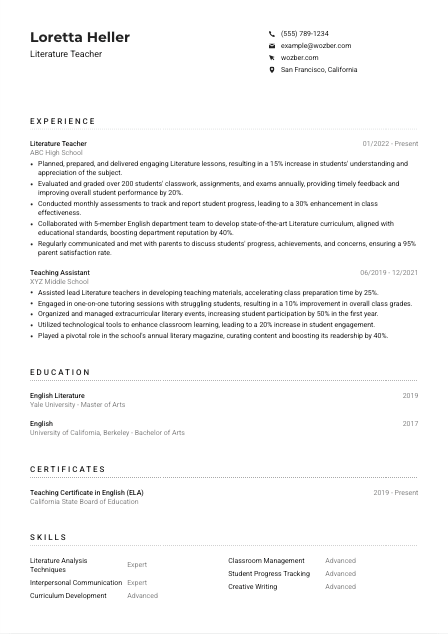
List your phone number, professional email address, and, when relevant to the posting, your city and state. In the example opening, San Francisco, California matters because the job specifically asks for local availability. If a posting includes a location requirement, showing it here removes an early question before the hiring team gets to your experience.
If you include a website or profile, make sure it supports your teaching candidacy. A professional page with curriculum projects, literary magazine work, teaching philosophy, or classroom resources can add value. Keep it current and consistent with the dates, roles, and credentials on your resume.
Do not include age, marital status, gender, or other personal details unrelated to teaching performance. Schools need to see your qualifications, classroom record, and credentials, not information that does not strengthen your application.
This section should answer the practical questions fast: who you are, what you teach, and how the school can reach you. When those basics are handled well, the hiring team can move straight to your classroom background.




For a Literature Teacher, experience carries the most weight when it shows what happened in the classroom. Hiring teams look for evidence of lesson delivery, literary analysis instruction, assessment habits, collaboration with English departments, and communication with families. Broad statements about loving literature are not enough here.
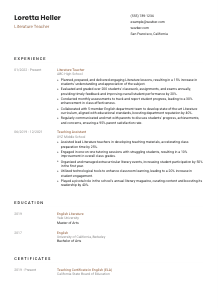
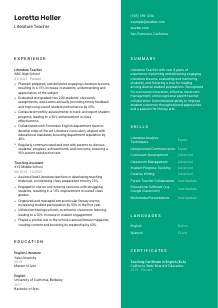
List your positions in reverse chronological order and make the teaching scope clear in each one. If you taught Literature directly, say so in the title or bullet points. If part of your background was adjacent, such as a teaching assistant role, focus on the parts that involved reading instruction, tutoring, classroom support, or literary activities. The example resume does this well by moving from a current Literature Teacher role to a Teaching Assistant position that still supports the teaching story.
Your bullets should describe outcomes, not just duties. Include measurable results tied to student learning, engagement, or performance when you have them. In the sample, a 15% increase in students' understanding and appreciation of literature and a 20% improvement in performance give the reader something concrete to work with. Use metrics that are natural in education, such as assessment gains, participation rates, reading outcomes, turnaround time for feedback, or number of students supported.
Literature teaching rarely happens in isolation. Schools want teachers who can work with an English department on pacing, text selection, standards alignment, and shared assessments. If you helped revise units, build reading lists, align instruction to state standards, or contribute to department planning, include it. The example's curriculum development bullet works because it connects collaboration to educational standards rather than naming teamwork in a vague way.
Avoid generic claims like "created engaging lessons" unless you show how. Mention seminar-style discussion, close reading, writing workshops, differentiated instruction, multimedia texts, or technology platforms you used to increase participation. A bullet about using instructional technology or organizing literary events tells a school much more than a broad statement about being dynamic in the classroom.
This role includes grading, feedback, and regular progress reporting, so your experience section should reflect that part of the job. Include the volume of students or coursework managed, the frequency of assessment, and any parent communication that was part of your routine. In the sample, grading over 200 students' assignments annually and conducting monthly assessments gives hiring teams a realistic sense of classroom load and follow-through.
The best bullets make it easy to picture you running a literature classroom, tracking progress, and contributing to the department. If a school can see your instructional habits and student results here, the rest of the resume becomes much easier to trust.
Literature teachers are expected to bring real academic grounding to the classroom. Your education section should quickly confirm that you studied English, Literature, or a related field, and should make any advanced study in literary analysis or teaching especially easy to find.
If the posting asks for a bachelor's degree in English, Literature, or a related subject, list that qualification clearly. Use the full degree name, school, field of study, and graduation year. This is one of the first checkpoints for school hiring and ATS screening.
Present your highest or most relevant degree first if your format allows, especially when you have graduate study in English or Literature. A Master of Arts in English Literature, like the one in the example, immediately reinforces subject depth and can matter in secondary school hiring where text analysis and writing instruction are central.
Graduate work can help distinguish you from candidates whose background is broader or less focused on literature. If you completed advanced coursework in literary criticism, pedagogy, composition, or curriculum, that context can support your candidacy, particularly for high school instruction where close reading and analytical writing are core parts of the job.
If you are early in your teaching career, selected coursework, honors, academic publications, thesis work, or literary societies may still add value. Keep these details tied to classroom relevance, such as deep study of classic and contemporary literature, writing-intensive work, or education-related projects. As your teaching experience grows, these details become less important than classroom results.
Awards and extracurriculars can stay if they support your role as a literature educator, but avoid turning this section into a full academic biography. Prioritize information that helps a school understand your preparation to teach texts, lead analysis, and support student writing.
This section should reassure the school that your academic foundation matches the level of literature instruction they need. Once that is clear, your experience can carry the heavier argument.
In K-12 hiring, certification is a gatekeeping detail, not a bonus line. A school may like your classroom background, but without the right license or teaching certificate, your application can stall early. Make this section precise and current.
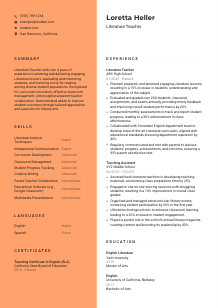
When the posting asks for a state-issued certificate or license in English or ELA, list that credential prominently and use the exact wording where appropriate. The example includes a California teaching certificate in English, which directly answers the requirement. If your credential is pending renewal or tied to a particular grade band, clarify that accurately.
Extra certifications can help when they reinforce your classroom value, such as reading intervention, special education support, gifted education, or instructional technology. Only include them if they strengthen your profile for literature teaching rather than filling space.
Include issue dates and expiration dates when relevant. School employers need to know whether your credential is current, especially in regulated teaching environments. A date range like "2019 - Present" works well when the credential remains active.
Licensure status, endorsements, and renewals should always be current before you apply. An outdated certificate section can create doubt immediately, even if the rest of your resume is strong. Review it the same way you would review lesson materials before the school year starts.
A clear certificate section removes administrative friction and keeps attention on your teaching ability. For school roles, that matters more than many candidates realize.
A Literature Teacher's skills section should reflect what happens in an actual English classroom. That includes textual analysis, lesson design, class management, student feedback, and collaboration with families and colleagues. Generic soft skills alone will not carry this section.
Start with the skills the school has already named. In this case, that includes literary analysis, communication, interpersonal skills, curriculum collaboration, assessment, and student progress tracking. If those are part of your real background, use the employer's language so both ATS screening and human reviewers can connect the match quickly.
Show a mix that reflects the role realistically. For literature teaching, that may include curriculum development, classroom management, close reading instruction, writing feedback, discussion facilitation, parent-teacher communication, and educational tools such as Google Classroom or presentation platforms. The example skill list works because it combines subject expertise with classroom operations.
Order your skills so the most role-critical ones come first. If the job emphasizes literary analysis and student engagement, those should sit above less central abilities. An ATS-friendly resume format from Wozber helps keep the section readable while preserving the keywords that matter for this teaching opening.
When this section is tailored well, it reads like the toolkit of someone who can teach texts, manage a classroom, and communicate progress clearly. That is exactly what schools look for in a literature hire.
For Literature Teachers, language proficiency matters first in relation to instruction, communication, and school community needs. English fluency is assumed for the subject area, but additional languages can strengthen your profile in districts serving multilingual students and families.
List English clearly and indicate proficiency honestly. For a Literature Teacher, this matters because your work depends on leading discussion, teaching analysis, responding to writing, and communicating complex ideas with precision.
If you speak another language well enough to support students or speak with families, include it. In the example, fluent Spanish is useful because it can support communication in a diverse school community. That will not be required in every literature opening, but where it is relevant, it can add practical value.
Terms like Native, Fluent, Advanced, or Conversational are more useful than vague descriptions. Be accurate. School leaders may rely on this information when thinking about parent communication, student support, or team collaboration.
If you claim a language skill, assume you may need to use it in meetings, emails, or family conversations. An honest rating helps avoid awkward situations and builds trust from the start.
Additional languages are most persuasive when they connect to real classroom or community needs. If they helped with tutoring, family outreach, or more inclusive instruction, that is where their value becomes clear.
This section can quietly strengthen your application when it reflects how you connect with students and families, not just what languages you have studied.
Your summary should quickly establish your teaching level, subject expertise, and classroom strengths. For this role, the most effective summaries combine years of experience with a few specific points about instruction, student outcomes, and collaboration.
Start with your job title and years of relevant experience. A line such as "Literature Teacher with 4+ years of experience" gives immediate context and helps position you for roles that specify a minimum experience level, such as the 3+ years requested here.
Add concise achievements that reflect how you teach. This might include stronger student performance, improved engagement with literary texts, successful assessment routines, or curriculum contributions. The sample summary works because it points to lesson delivery, student mentoring, and better outcomes without turning into a list of every responsibility.
Choose skills that matter for the role you are targeting, such as literary analysis instruction, classroom management, curriculum development, and parent communication. This gives the hiring team a quick sense of your classroom profile before they reach the fuller experience section.
Aim for 3 to 5 lines. Avoid broad statements about passion for books unless they are backed by teaching practice. Use the space to show that you can plan instruction, guide analysis, monitor progress, and contribute to the English department from day one.
A focused summary helps the school understand your level and teaching strengths within seconds. Wozber's AI resume builder and ATS resume scanner can help tighten this section around the exact language of the posting, making your resume easier to read both in ATS screening and in the hands of a department lead.
A Literature Teacher resume works when it shows how you teach, how you assess, and how you help students engage with texts in a structured classroom setting. Every section should reinforce that picture, from your credential and degree to your lesson outcomes, curriculum work, and communication with families.
Use Wozber to build an ATS-friendly resume format that reflects the posting accurately, surfaces missing requirements, and sharpens your wording for literature instruction. When your resume is tailored this way, a school can quickly judge your readiness to step into the classroom and contribute to the English department.




