



Use Wozber and land your dream job
Create Resume
No registration required
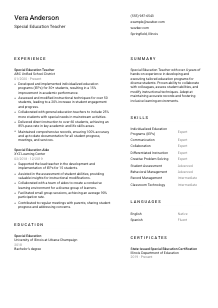
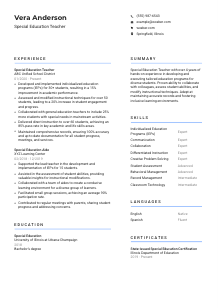
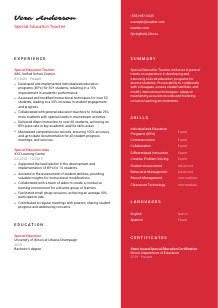
Nurturing unique potential, but your resume doesn't make the grade? Check out this Special Education Teacher resume example, created with Wozber free resume builder. Learn how to seamlessly match your adaptability and instructional skills to job criteria, turning your career path into a special success story!
Special education hiring turns quickly on whether a candidate can manage the full instructional cycle for students with disabilities. Schools look for teachers who can build workable IEPs, track progress against goals, adapt instruction, coordinate with general education staff and families, and keep documentation accurate enough for services, meetings, and compliance.
When those details are tailored clearly, your resume is easier to route through ATS screening and easier for a principal or special services director to read as a classroom-ready profile instead of a general teaching resume. Wozber's free resume builder helps organize that language into an ATS-compliant resume, so your experience with IEPs, student progress monitoring, and inclusive support is visible early.
School administrators move fast through the top of a resume. Your contact section should confirm who you are, what role you hold, and any practical requirement that affects hiring, such as location for an in-person school assignment.
Use your full name in a larger, clean font so it anchors the page right away. In education hiring, resumes are often reviewed alongside licenses, transcripts, and interview notes, so make your name easy to find and consistent across every document.
Place "Special Education Teacher" directly under your name if that is the role you are pursuing. This helps distinguish you from paraprofessionals, aides, interventionists, and general classroom teachers, especially when schools are sorting applicants by certification area.
Use contact information that supports quick outreach for screenings, interview scheduling, and reference checks.
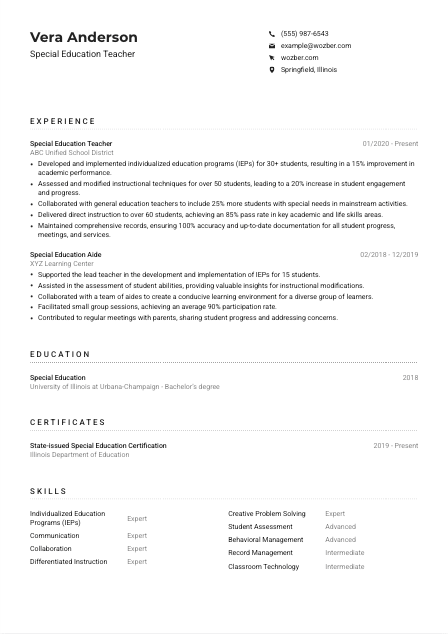
If the posting names a city or state requirement, reflect it in this section. In the example, Springfield, Illinois appears on the resume because the school asked for a candidate located there or willing to relocate. That kind of detail belongs here, not repeated throughout the resume.
Include LinkedIn or a professional website only if it reinforces your classroom work. For a Special Education Teacher, that might mean a profile that matches your resume with certification details, teaching history, endorsements, or professional development rather than a generic social link.
This section should answer the school's first practical questions in seconds: who you are, what role you teach, how to reach you, and whether you meet any immediate logistical requirement. Wozber's free resume builder keeps these details clean in an ATS-friendly resume format so the hiring team can move straight to your qualifications.




For Special Education Teachers, experience is not just a list of schools and dates. Hiring teams want to see how you planned instruction, managed IEP responsibilities, supported student growth, and worked with families and staff around real learning needs.
Read the job description closely and mark the actions that define the role. For this kind of position, that usually includes developing IEPs, assessing progress, modifying instruction, collaborating with general education teachers and parents, and maintaining service records. Those exact responsibilities should appear in your own experience when they reflect work you have actually done.
List each job in reverse chronological order with title, school or organization, and dates. Clear structure matters in education because reviewers often compare years of special education experience, role progression, and whether your background lines up with the student support level the school needs.
Each bullet should show what you handled and what changed because of your work. Good Special Education Teacher bullets mention IEP implementation, differentiated instruction, behavior or academic support, inclusive classroom coordination, and progress reporting. In the sample resume, bullets do this well by naming IEPs, instructional modification, collaboration, direct instruction, and recordkeeping instead of using vague teaching language.
Use numbers where they are natural to the work: student caseload, percentage improvement, pass rate, engagement growth, documentation accuracy, or number of students served. The example's "30+ students" and "15% improvement in academic performance" work because they connect special education responsibilities to measurable student results and service scope.
Prioritize experience that proves you can support students with disabilities in academic, behavioral, social, or life-skills settings. Earlier roles such as aide, paraprofessional, or support staff positions are worth keeping when they show hands-on work with student assessment, small-group instruction, parent communication, or IEP support. Less related work can stay brief or come off the page if it distracts from your classroom and case-management experience.
A hiring team should be able to picture you running instruction, supporting student goals, documenting services, and collaborating across the school. Use this section to make your caseload, methods, and student outcomes easy to read and easy to trust.
For a Special Education Teacher, the education section usually serves one clear purpose first: confirming that your degree supports the classroom and compliance responsibilities tied to the role. Keep it direct and closely aligned with the posting.
If the posting asks for a bachelor's degree in Special Education or a related field, make sure that information is unmistakable. This is one of the first qualification screens, so the degree and field should be easy to spot without extra interpretation.
List degree, field of study, school name, and graduation year. School systems and district HR teams often review large volumes of applications, so a straightforward layout helps them confirm eligibility quickly.
Use the formal wording from your transcript when possible, especially if it directly matches the requirement. In the example, "Bachelor's degree" and "Special Education" work well because they align cleanly with what the employer requested.
Most experienced teachers do not need course lists. Include coursework if you are early in your career or if it clarifies preparation in areas such as behavior intervention, assessment, inclusive instruction, assistive technology, or literacy support for diverse learners.
Honors, capstone projects, student teaching placements, or education-related leadership can help if they strengthen your teaching profile. Keep the focus on items that connect to special education practice, classroom readiness, or collaboration with school teams.
Your degree should confirm that you meet the role's academic requirement without slowing the reader down. Once that is clear, the rest of your resume can carry the stronger story about instruction, student support, and IEP execution.
Certification is often a gatekeeping item in special education hiring. If the school requires a state-issued license or endorsement, that credential should be visible, current, and presented with enough detail to remove doubt.
Check the posting for any exact certification language and mirror it accurately. Here, the school asks for a state-issued Special Education certification or license, so that credential belongs at the top of the section.
List certifications in order of hiring importance, not personal preference. A special education license, endorsement area, or state credential should come before unrelated training because it determines whether you can legally and practically step into the classroom.
If a credential is active, show the issue date or active range. The sample resume uses "2019 - Present," which helps indicate that the certification is current and maintained.
Special education practice changes with policy, service models, and instructional approaches. Renew required licenses on time and add newer training that supports your work, such as behavior support, autism education, transition planning, or assistive technology, when it strengthens the application.
A school should not have to search your resume to confirm that you hold the right credential. Put your teaching license in plain view and keep the details current so attention stays on your classroom impact, not on missing paperwork.
The best skills sections for Special Education Teachers read like the toolkit of someone who can run instruction, manage student plans, and work effectively across a school team. Focus on skills that connect directly to student support and classroom execution.
Start with the language in the job description, then add closely related skills you use in daily work. In this posting, that includes IEP proficiency, communication, and collaboration. Related classroom skills might include differentiated instruction, progress monitoring, behavior management, life-skills instruction, and recordkeeping if they reflect your experience.
Special education work depends on both instructional and interpersonal skill. Pair concrete classroom capabilities such as student assessment, IEP development, and instructional modification with communication skills needed for parent meetings, multidisciplinary coordination, and support of inclusive learning environments.
Do not turn this into a master inventory. Choose the skills that best support the role you want and the students you serve. The example does this effectively by emphasizing IEPs, differentiated instruction, student assessment, behavioral management, and collaboration instead of filling the section with generic traits.
Your skills should confirm that you can plan, teach, adapt, document, and collaborate in a special education setting. If you are using Wozber's ATS resume scanner, check whether the language here matches the posting closely enough to support stronger ATS optimization without sounding forced.
Language ability can matter in special education settings, especially when teachers work with multilingual students, communicate with families, or need to meet a stated English-language requirement in the posting. Keep this section factual and relevant.
If the role names a language expectation, include it clearly. This posting specifies the ability to read complex texts in English, so English proficiency should appear on the resume rather than being assumed.
List the language and your level in familiar terms such as Native, Fluent, Intermediate, or Basic. For this role, "English - Native" or another accurate level makes the requirement easy to confirm at a glance.
Additional languages can be valuable when they help with family engagement, community communication, or support for multilingual learners. Spanish, for example, can be relevant in many districts when used accurately and honestly.
Do not overstate your ability. Schools may rely on you for parent communication, meetings, written follow-up, or interpreting classroom concerns, so your stated proficiency should match what you can actually handle.
If another language strengthens your work with students or families, let that be the reason it stays on the resume. In special education, language skills are most useful when they improve communication, trust, and access to services, not when they are listed as filler.
This section matters when it helps a school understand how you meet stated language requirements or support a diverse student population. Keep it accurate, practical, and tied to the communication demands of the job.
A Special Education Teacher summary should quickly establish your experience level, student support strengths, and the kind of instructional and collaborative work you handle well. Keep it short, but make it specific enough that the reader knows what you do beyond general teaching.
Start with the title and the core work the position requires. For this profession, that often means IEP development, instructional adaptation, student assessment, direct support, and collaboration with teachers and families.
A line such as "Special Education Teacher with 4+ years of experience" works because it tells the reader where you are professionally before they scan the rest of the page. Use your real level and keep it accurate.
Choose strengths that connect directly to the school's needs. In this example, strong options include developing IEPs, modifying instructional techniques based on student progress, maintaining records, and supporting inclusive classroom participation. Add one concrete outcome if it fits naturally.
Aim for three to five lines with no filler. A concise summary is especially effective when it combines scope, core skills, and a clear teaching focus, as in the sample resume's emphasis on tailored programs, collaboration, assessment, and inclusive learning environments.
Your summary should read like an experienced special educator introducing their classroom work, not like a list of soft traits. Wozber can help shape this into an ATS-compliant resume opening that surfaces your IEP, instruction, and student-support strengths early.
A well-tailored Special Education Teacher resume makes the essentials easy to confirm: the right degree and certification, direct experience with students with special needs, strong IEP work, measurable student support, and dependable collaboration with teachers and families.
Use Wozber to organize your content in an ATS-friendly resume template, refine wording with AI-assisted tailoring, and check alignment with an ATS resume scanner. The finished resume should make one thing clear quickly: you can step into the role and manage both instruction and documentation with confidence.




