



Use Wozber and land your dream job
Create Resume
No registration required
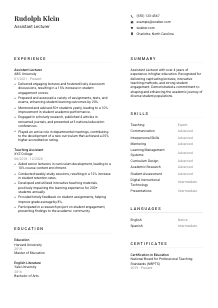
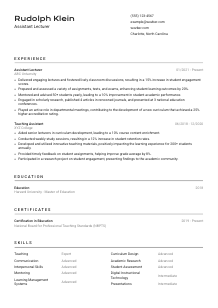
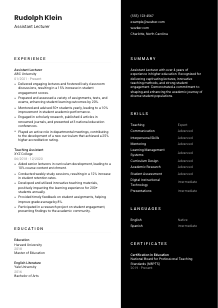
Guiding classrooms, but your resume gets graded "needs improvement"? Check out this Assistant Lecturer resume example, created with Wozber free resume builder. Learn to present your instructional strengths to match academic requirements, ensuring your career gets an A+ in success!
Assistant Lecturer hiring usually turns on one question quickly: can you step into a classroom, carry the curriculum, and help students progress. That means your resume has to show more than subject knowledge. It should make your teaching record visible through lecture delivery, student support, assessment work, and the academic service that keeps a department running.
A tailored resume changes how your background is read, especially when institutions screen for teaching experience, degree level, and classroom technology through ATS filters before a department head ever reviews it. Wozber's free resume builder helps you align your wording with the posting, keep an ATS-friendly resume format, and surface the parts of your experience that show you can teach effectively, advise students well, and contribute to faculty work from day one.
For an Assistant Lecturer, the top of the resume should look straightforward and professional. Academic hiring teams do not need branding language here. They need clean contact details, the target title, and any location information that removes friction for a role tied to campus-based teaching.
Use your full name as the most visible text on the page. A simple, readable format works best because this role sits in a formal academic setting where clarity matters more than design flourishes. Your header should feel consistent with the rest of a document that may be reviewed by HR, department administrators, and faculty.
Place "Assistant Lecturer" directly below your name when that is the role you are pursuing. Matching the title used in the posting makes your direction immediately clear and helps position your background around teaching, student advising, grading, and departmental contribution instead of more general education work.
List a phone number and a professional email address that you check regularly. If you include a LinkedIn profile or academic webpage, make sure it supports your application with teaching experience, publications, conference activity, or course-related work rather than a generic online presence.
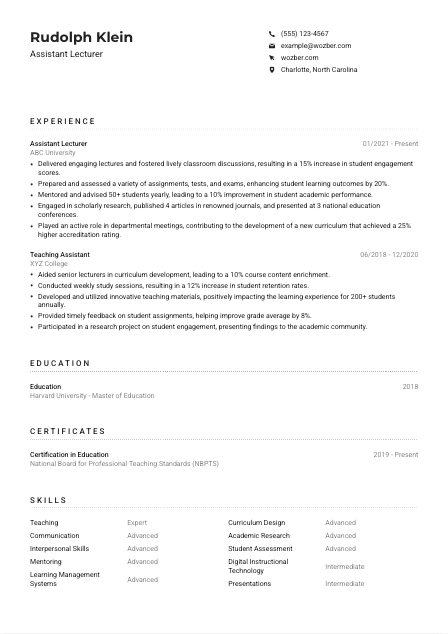
Some academic roles are location-flexible, but this posting asks for candidates based in Charlotte, North Carolina. Including Charlotte, North Carolina in your header answers that point immediately and avoids unnecessary questions about relocation or local availability for on-campus teaching and meetings.
A personal website, faculty profile, or digital portfolio can add depth if it contains material that supports an Assistant Lecturer application. Useful examples include publications, conference presentations, teaching philosophy, sample syllabi, or evidence of work with learning platforms and instructional materials.
This section does quiet but important work. When your header confirms who you are, what role you want, and where you are based, the reader can move straight to your teaching record and academic contributions.




Experience carries the most weight on many Assistant Lecturer resumes because it shows how you actually perform in front of students and within a department. Hiring teams look for teaching scope, assessment responsibilities, student support, and signs that you can contribute to curriculum discussions and academic life without a long ramp-up.
Start with the responsibilities the institution cares about most, then reflect them in your bullet points using honest, role-accurate language. For an Assistant Lecturer, that usually means lectures, classroom discussion, grading, mentoring, curriculum support, and scholarly activity. In the example resume, the strongest bullets mirror that pattern by covering lecture delivery, student advising, assessment, research, and departmental curriculum work.
List roles in reverse chronological order and make the path toward college-level instruction easy to follow. Teaching Assistant, Tutor, Graduate Instructor, or Lecturer-related roles all count when they show direct instructional responsibility. What matters is that each entry clarifies your teaching environment, your student-facing work, and the level of ownership you had in course delivery.
Academic resumes improve when bullets show what changed because of your work. Instead of stopping at "delivered lectures" or "graded assignments," add outcomes such as stronger engagement, improved course performance, better retention, or more effective feedback cycles. The sample does this well with results like a 15% increase in engagement scores and a 20% improvement in learning outcomes.
Numbers are especially helpful when they reflect how instructional work is measured. Good examples include number of students advised, sections taught, grade improvement, retention gains, course completion, publications, conference presentations, or curriculum outcomes. In the sample, mentoring 50+ students yearly and contributing to a curriculum change tied to a 25% higher accreditation rating gives the reader a concrete sense of scale and impact.
Prioritize experience that supports the actual job over older or less relevant accomplishments. If you have work outside higher education, keep only the parts that translate well, such as instruction, facilitation, assessment, or student guidance. Each bullet should help the reader picture you handling lectures, supporting student progress, and participating in departmental responsibilities with confidence.
By the end of this section, a department should be able to see how you teach, how you support learning, and what kind of results follow from your involvement in the classroom and beyond it.
For an Assistant Lecturer role, education is not a background detail. It is a core qualification. The degree section needs to confirm that you meet the institution's academic standard quickly, especially when a master's degree or higher in a relevant field is a stated requirement.
Put your highest and most relevant degree first so the hiring team can confirm eligibility immediately. In this posting, a master's degree or higher is required, so a degree such as Master of Education should appear before undergraduate study. If your master's is in the subject you will teach or in education, that connection should be easy to read at a glance.
List degree, field of study, institution, and graduation year in a consistent order. Academic hiring often involves fast cross-checking of credentials, so a clean structure helps readers confirm the essentials without hunting through the page.
Degree titles matter, but so does the field attached to them. "Master of Education" or a subject-area master's can directly support an Assistant Lecturer application depending on the teaching discipline. If your degree aligns with the posting's academic area, make that relevance obvious instead of leaving the reader to infer it.
If you are early in your teaching career, relevant coursework in pedagogy, curriculum design, assessment, or your subject area can add useful context. Honors, thesis work, or graduate research can also help when they connect to teaching responsibilities, scholarly development, or the content area you would teach.
Current doctoral work, graduate certificates, or structured professional learning can reinforce your long-term academic development. This is particularly useful when it deepens your teaching field, expands your instructional methods, or shows active engagement with higher education practice.
Your education section should answer the institution's first academic question immediately: do you have the level and field of study needed to teach in this department. When that answer is clear, the rest of the resume can focus on how well you teach.
Certificates matter most when they reinforce how you teach, advise, or work within academic standards. They will not replace the required degree, but they can strengthen your profile by showing formal preparation in education, pedagogy, or related professional development.
Review the posting for stated or preferred credentials, then include certificates that directly strengthen your candidacy. Here, a certification in education is listed as a plus, so an entry like the sample's "Certification in Education" is worth featuring because it supports instructional credibility and professional commitment.
A short list of targeted certificates is more useful than a crowded section of loosely related training. Prioritize credentials connected to teaching practice, student assessment, instructional design, online learning, or advising. The reader should immediately understand how each certificate supports your work in higher education.
Dates are helpful when a credential is active, recently earned, or part of ongoing professional development. In education, current training can signal that you stay engaged with evolving teaching methods, standards, and classroom technology.
Certificates can also show that you keep building your teaching toolkit outside formal degree programs. Workshops or credentials in LMS use, digital pedagogy, inclusive teaching, or assessment design can be especially relevant for institutions that expect faculty to teach across in-person and online environments.
When chosen well, certifications show a lecturer who keeps developing as an educator. Keep the focus on credentials that support real classroom practice, student learning, and professional contribution.
The skills section should reflect how teaching gets done in practice. For an Assistant Lecturer, that means balancing classroom delivery with student communication, assessment work, and comfort with the digital systems that support modern instruction.
Use the job description to identify the exact capabilities the institution is screening for, then match them only where you have genuine experience. In this case, instructional technology, learning management systems, communication, presentation, and interpersonal skills are all explicit priorities. The sample resume supports that language with skills such as Learning Management Systems, Student Assessment, Mentoring, and Digital Instructional Technology.
Choose skills that reflect how you run classes and support students, not just broad personal traits. Strong options for this type of role include lecture delivery, classroom facilitation, curriculum design, assessment and grading, academic advising, LMS use, educational technology, and research or scholarly writing where relevant.
Order matters. Lead with the skills that match the posting most closely so the academic and HR readers see the core fit early. For this role, teaching, communication, learning management systems, mentoring, and presentation skills should usually appear before more secondary capabilities. This also improves ATS optimization when the same language appears naturally across your skills and experience sections.
This section should confirm the tools and teaching capabilities behind your experience. Keep it aligned with the posting and grounded in work you have actually done in classrooms, tutorials, labs, or student support settings.
Language ability is especially relevant in education because so much of the role depends on clear explanation, feedback, discussion, and written evaluation. When a posting names a required language, your resume should make that qualification easy to confirm.
If the institution specifies a language requirement, list it at the top of this section. Here, English is essential, so it should appear first with an accurate proficiency level that supports teaching, writing feedback, and classroom communication.
Use plain levels such as Native, Fluent, Advanced, or Intermediate rather than vague descriptions. For an Assistant Lecturer, the standard is not casual conversation alone. Your stated level should reflect whether you can lecture, answer student questions, write comments on assignments, and communicate professionally with colleagues.
Extra languages can strengthen your application when they support work with diverse student populations or multilingual campuses. In the example, Spanish is a useful secondary language because it broadens communication potential, even though English remains the core requirement.
Overstating language ability creates risk in teaching roles where communication is central. Choose levels you can back up in classroom interaction, written correspondence, and student advising conversations.
Some colleges place added value on candidates who can connect with varied student communities or international learners. If multilingual communication is part of your real strength, include it in a way that supports your teaching profile rather than distracting from your core instructional qualifications.
For this kind of role, language proficiency is part of classroom effectiveness. Make the required language easy to confirm, then let any additional languages reinforce your ability to support a broader student community.
The summary sets the tone for the rest of the resume. For an Assistant Lecturer, it should quickly frame your teaching experience, academic background, and the outcomes you create for students without slipping into generic statements about passion for education.
Start from the actual priorities of the role: teaching, student support, assessment, and academic contribution. Your summary should show that you understand the day-to-day work of an Assistant Lecturer and already operate comfortably in that environment.
A direct opening gives the reader immediate context. The sample's "Assistant Lecturer with over 4 years of experience in higher education" works because it states role identity and scope in one line. Follow that approach with your own accurate years of experience and academic setting.
Choose achievements that reflect how lecturers are evaluated. Good examples include stronger student engagement, improved learning outcomes, effective mentoring, research activity, or curriculum contributions. The sample summary points to engaging lectures and student engagement, which can be even stronger when paired with a metric or two from the experience section.
Aim for a short paragraph that sounds specific to higher education hiring. Three to five lines is usually enough. If you are using Wozber's AI resume builder, this is a good place to tighten phrasing so the summary reflects the posting's language naturally and supports an ATS-compliant resume without sounding copied from the job ad.
By the time someone finishes these opening lines, they should understand your teaching level, your classroom strengths, and the kind of contribution you are ready to make to students and the department.
An effective Assistant Lecturer resume makes a few things easy to see right away: you meet the academic requirement, you have real instructional experience, and you can support students through teaching, assessment, and guidance. That clarity matters in faculty hiring, where committees often compare candidates with similar degrees but very different records of classroom impact.
Use Wozber's free resume builder to organize that experience into an ATS-friendly resume template, refine your language with role-specific terms, and check alignment with the posting through ATS resume scanner tools. When the final draft clearly connects your degree, teaching practice, LMS proficiency, and student outcomes, you are ready to apply with confidence.




