



Use Wozber and land your dream job
Create Resume
No registration required
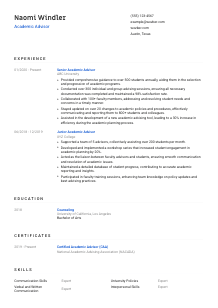
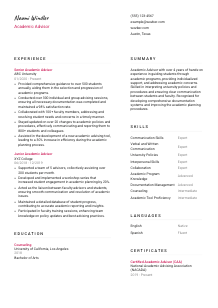
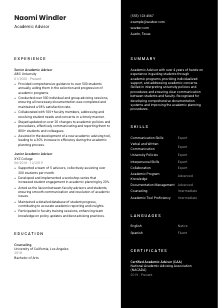
Guiding academic paths, but feeling lost on your resume? Navigate this Academic Advisor resume example, created with Wozber free resume builder. Learn how to align your educational insights with job requirements, plotting a career course where success and guidance intertwine!
Academic advising sits at the point where student goals, degree requirements, and institutional policy all meet. Hiring teams want to see whether you can guide students through course selection, planning, and progress issues without losing track of documentation, escalation paths, or graduation timelines, and your resume should make that operating range visible quickly.
A tailored resume changes how your background is read in both human review and ATS screening. When section wording reflects advising work such as academic planning, policy interpretation, student progress tracking, and faculty collaboration, Wozber's free resume builder helps you shape an ATS-compliant resume that immediately reads as advising experience rather than general student support or administrative work.
For Academic Advisor roles, the header needs to answer a few practical questions right away: who you are, how to reach you, and whether you meet straightforward requirements such as location and communication readiness. Keep it clean, professional, and easy to scan.
Use your full name as the most visible element, followed by the exact job title you are pursuing when it matches your background. Listing "Academic Advisor" under your name helps place your experience in the right lane from the start, especially if your past titles include broader student services or counseling support work.
Include a reliable phone number and a professional email address that uses your name. Academic advising is a communication-heavy role involving student outreach, session follow-up, and coordination with faculty or registrar teams, so even basic contact details should reflect the same level of professionalism you would bring to student-facing correspondence.
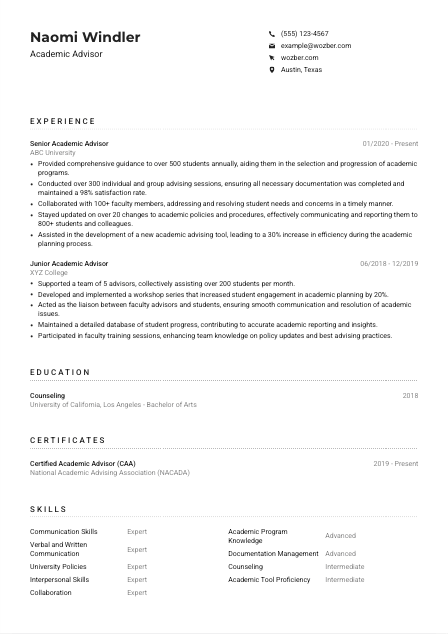
If a posting specifies a location, include it clearly in your header. Here, listing "Austin, Texas" directly addresses the employer's stated requirement and removes uncertainty about your availability for campus-based advising, department meetings, or student appointments.
A LinkedIn profile or professional website can strengthen your application if it supports your advising background with consistent titles, education, certifications, or student success work. Make sure it aligns with the resume and does not introduce mixed positioning, especially if your profile still emphasizes unrelated administrative or teaching roles.
Skip information such as age, marital status, photo, or other non-job-related details. Academic advising resumes are stronger when they stay focused on advising scope, student support experience, policy knowledge, and communication strengths rather than personal background.
Your header should answer the basics without distraction. When the contact section already reflects the role, location requirement, and professional presentation expected in student-facing university work, the rest of the resume lands more cleanly.




This is the section that carries the most weight for an Academic Advisor application. Hiring teams look for signs that you have handled real advising volume, guided students through academic decisions, documented sessions correctly, and worked across departments when student issues needed follow-through.
Pull the core duties from the job description and make sure your bullets show comparable work. For this kind of role, that usually means academic planning, course selection support, graduation tracking, individual and group advising, documentation, and policy communication. If your current title is not identical, the bullet content should still make it obvious that you have performed advising functions, not just general student support.
List your most recent advising or education-support position first, followed by earlier relevant roles. Include your title, institution, and dates so the reader can quickly see progression, whether that means moving from junior advising work into a senior caseload, taking on workshop delivery, or handling more complex student concerns over time.
Academic advising is often measured through caseload, session volume, student outcomes, and process efficiency. Numbers such as advising 500+ students annually, conducting 300+ sessions, or supporting 200 students per month tell a hiring team far more than broad claims about being student-centered. The sample resume does this well by tying student volume and satisfaction to actual advising work.
Strong bullets do more than list meetings with students. Show how you helped students select programs or courses, monitored progress toward graduation, resolved concerns with faculty or staff, maintained records according to policy, or improved advising processes. A bullet about helping build an advising tool that increased planning efficiency by 30% works because it shows both operational contribution and student service impact.
Use the same terminology the employer uses when it accurately matches your experience, including phrases such as academic programs, curricula, university policies, advising sessions, student progress, and graduation planning. Wozber's ATS resume scanner can help you spot missing requirements and refine wording so your experience reads clearly in ATS optimization and still sounds natural to a director of advising or student success leader.
Your experience section should show that you have already handled the rhythms of advising work: student conversations, policy interpretation, documentation, and cross-campus coordination. If those elements are visible with real scope and outcomes, your resume will read as ready for the role.
Academic Advisor roles often have clear degree requirements, so this section needs to be direct and complete. It should confirm eligibility quickly while also supporting your professional credibility in student development, counseling, or education-related work.
When a posting calls for a bachelor's degree in Education, Counseling, or a related field, make that match easy to see. If your degree aligns directly, as in a bachelor's in Counseling, place the degree and field clearly so the requirement is confirmed without extra interpretation.
List your degree, field of study, school, and graduation year in a consistent format. Hiring managers reviewing many applications for campus roles usually want to confirm qualifications quickly, not decode an overly stylized education section.
If your studies connect directly to advising responsibilities, let that relevance speak for itself through accurate naming. A degree in Counseling, Education, Psychology, or a related discipline helps position you for student-facing work that requires guidance, communication, and developmental support. The example's Bachelor of Arts in Counseling is a clear match.
Honors, leadership roles, or student support involvement can be useful if they reinforce advising-related strengths such as peer mentoring, orientation leadership, tutoring, or education-focused campus involvement. Leave them out if they crowd the section or pull focus away from more important advising experience.
If you have graduate coursework, continuing education, or formal training tied to counseling, student success, higher education administration, or advising practice, include it where appropriate. That added learning can help if you are competing against candidates with similar years of experience.
This section does not need embellishment. It needs to show, quickly and clearly, that your academic background supports the advising work the institution needs covered.
Certifications matter most when they reinforce your ability to guide students within an academic setting. For Academic Advisor roles, they can strengthen your profile by showing formal training in advising practice, counseling, or student support standards.
Review the posting for preferred credentials and feature those first when you have them. In this case, certification or licensure in counseling or advising is preferred, so a relevant credential should be easy to find on the page rather than buried after unrelated training.
Prioritize certifications that connect to academic advising, counseling, student development, case documentation, or higher education support. A credential such as Certified Academic Advisor is stronger here than a general workplace certificate because it speaks directly to advising practice and professional standards.
Add the year earned and, if relevant, the validity range or current status. That helps the employer understand whether the certification reflects current practice, especially in roles where policy interpretation, student guidance, and institutional compliance are part of daily work.
If you are actively maintaining a certification or completing advising-related training, include that as part of your professional profile. Ongoing learning matters in academic advising because policies, degree structures, and student support frameworks change over time. The sample credential from NACADA works well because it shows continued connection to the field.
Certifications are most effective when they strengthen the picture already established by your experience. Put forward the ones that show current engagement with advising practice and student support standards.
The best skills sections for Academic Advisors do not read like generic soft-skill lists. They reflect the actual work: guiding students, interpreting academic policy, documenting advising activity, coordinating with faculty, and communicating clearly in both one-on-one and group settings.
Start with the capabilities the job actually depends on, such as knowledge of academic programs and curricula, understanding of university policies and procedures, interpersonal communication, written communication, documentation, and collaboration across departments. These are more useful than broad terms that could apply to any office role.
Every important skill should be backed up somewhere else on the resume. If you list communication, there should be bullets showing advising sessions, workshops, or policy updates delivered to students. If you list policy knowledge, your experience should show work with curriculum rules, records, or graduation planning. The sample resume supports this well by pairing skills like university policies and collaboration with concrete advising accomplishments.
Keep the list focused on abilities that matter in advising performance. That usually means student-facing communication, policy interpretation, academic planning support, recordkeeping, counseling-related strengths, and relevant systems or advising tools. Cut vague or repetitive items so the section stays useful rather than inflated.
A focused skills section should sound like the work happens on campus, with students, records, policies, and faculty conversations in the mix. That kind of specificity helps your resume feel grounded in advising rather than general support work.
Language ability can matter in academic advising because the work depends on trust, clarity, and accurate explanation of policies and options. When a posting names a required language, this section should make your proficiency unmistakable.
If the employer requires fluent English, list English clearly with the appropriate proficiency level. For advising roles, this matters because much of the work involves explaining degree requirements, documenting appointments, writing follow-up notes, and corresponding with students and faculty without ambiguity.
Place the required or most useful language first, then list additional languages by realistic proficiency level. If you are fluent in another language that is commonly spoken in the student population you serve, that can strengthen your application, especially for offices with broad advising access needs.
Extra language skills can be valuable even when they are not listed in the posting. In higher education settings, they may help with student outreach, rapport-building, and clearer conversations during advising appointments. Spanish, for example, can be a practical asset in many campus communities, as shown in the sample resume.
Use honest labels such as Native, Fluent, Advanced, or Conversational only if they match how you would perform in a real advising interaction. Overstating proficiency can create problems quickly in student meetings or written communication.
Some advising offices serve a largely local student body, while others support international, multilingual, or highly diverse populations. Tailor what you include based on the institution and the role. Additional languages are not always required, but in the right setting they can strengthen how your resume speaks to student access and support.
For Academic Advisors, language skills matter when they improve communication with students and colleagues. Present them clearly, rate them honestly, and let them support the kind of advising environment you are applying to join.
Your summary should quickly position you within academic advising. In a few lines, show your experience level, the kind of student support work you handle, and the institutional knowledge or communication strengths that make you effective.
Before writing, identify the role's most important themes. Here, those include academic planning, student guidance, policy knowledge, communication, and progress monitoring. Use that mix to decide what belongs in the summary instead of defaulting to generic statements about being passionate or hardworking.
Start with your title or closest equivalent, then note your years of relevant experience. A line such as "Academic Advisor with 4+ years of experience supporting student academic planning and progress" gives immediate context and places you in the right professional category.
Choose strengths that matter in this field and support them with outcomes or recognizable scope. That could mean handling a large annual caseload, improving advising processes, communicating policy changes effectively, or coordinating with faculty to resolve student concerns. The sample summary works because it connects advising support, policy interpretation, and process improvement in a compact way.
Aim for a short paragraph that can be read in seconds. Four or five lines is usually enough to show advising experience, core strengths, and one meaningful result without repeating the experience section. Every sentence should sound like higher education advising work, not general administration.
A well-written summary gives the reader an immediate picture of your advising scope, communication strengths, and institutional fluency. If it is specific enough, the rest of the resume feels like proof rather than explanation.
When your resume clearly shows student advising volume, academic planning support, policy knowledge, documentation discipline, and collaboration with faculty or staff, hiring teams can quickly see that you understand the work beyond the title alone.
Use Wozber's free resume builder and ATS resume scanner to sharpen wording, align your sections with the posting, and present your background in an ATS-friendly resume format that keeps the focus on what matters most for Academic Advisor hiring.
The final version should make one thing easy to judge: you can guide students accurately, communicate clearly, and help them move toward graduation with confidence.




