



Use Wozber and land your dream job
Create Resume
No registration required
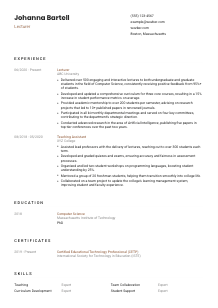
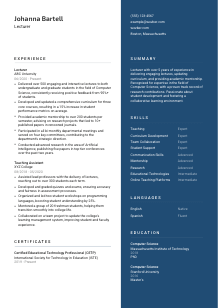
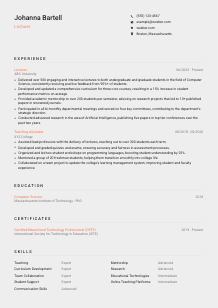
Imparting wisdom, but your resume isn't getting the highest grades? Learn from this Lecturer resume example, created with Wozber free resume builder. It shows how to shape your teaching journey to fit the job spec, and discover that career advancement isn't just confined to the syllabus!

University hiring for lecturers turns quickly on whether your resume shows you can handle the full rhythm of academic teaching: delivering clear lectures, maintaining course quality, supporting students outside class, and contributing to the department as a colleague. A vague teaching profile is easy to overlook. Your resume should make your subject expertise, classroom results, and academic contribution visible from the first screen.
Search committees often need to separate candidates with general teaching backgrounds from those who have already worked at university level, built courses, and supported research or capstone work. Wozber's free resume builder helps you shape that story into an ATS-compliant resume by aligning your language with the posting and keeping the structure easy to scan. The result is a clearer read on whether you can step into the classroom, advise students, and contribute to academic life right away.
Academic resumes start with simple facts, but those facts still carry screening value. For a Lecturer role, your header should immediately confirm who you are, what role you are pursuing, and whether practical requirements such as location and contact accessibility are already covered.
Use your full name as the clearest identifier on the page, placed prominently at the top in a clean, readable style. In higher education, your name often becomes the anchor for everything else a committee may review later, including publications, conference activity, teaching evaluations, or an online faculty profile.
Place "Lecturer" directly under your name when that is the title in the posting. This keeps your positioning clear and avoids looking misaligned with the appointment being advertised. If your current title differs slightly, keep the resume headline targeted to the role you are applying for while your experience section shows your formal academic titles.
List a reliable phone number and a professional email address, ideally something simple such as firstname.lastname. Committees move between teaching reviews, departmental discussion, and interview scheduling quickly, so your contact information should never create friction. If you include a website or profile, make sure it supports your academic credibility rather than duplicating weak or outdated information.
When a university specifies a location requirement, show it clearly in your header. Here, listing "Boston, Massachusetts" directly addresses the stated need to be located there. That kind of detail belongs in the personal section because it resolves a practical filter early without distracting from your teaching and scholarly record elsewhere on the page.
A personal academic website, faculty page, LinkedIn profile, or research profile can strengthen your application when it contains publications, conference presentations, teaching interests, or course materials. For lecturers, this is especially useful if your scholarly work or teaching portfolio extends beyond what fits on one resume. Keep the content aligned with your resume dates, titles, and achievements.
Your header should answer the basic questions fast: who you are, what role you want, how to reach you, and whether any stated location requirement is already met. Once those basics are clear, the rest of the resume can focus on your teaching record and academic contribution.




For lecturer hiring, experience carries the most weight when it shows actual academic delivery. Committees want to see more than classroom presence. They look for course ownership, student outcomes, advising, assessment work, departmental participation, and, in many cases, a continuing scholarly agenda.
Start by identifying the work the department needs done now. In this posting, that includes delivering lectures to undergraduate and graduate students, updating curriculum, mentoring students, participating in department life, and contributing through research. Your experience bullets should reflect those same functions using language that matches your real work, not generic teaching descriptions.
List positions in reverse chronological order and include the institution, your title, and dates of employment. For lecturer candidates, the distinction between university lecturer work, teaching assistant experience, adjunct teaching, and research appointments matters. A clear timeline helps the committee understand how much independent teaching responsibility you have held and at what level.
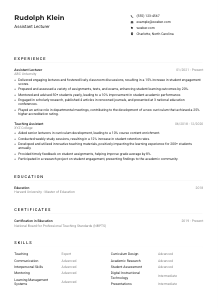
Each bullet should show what you taught, built, supported, or improved. Strong lecturer bullets often mention course level, class volume, curriculum development, assessment design, student advising, committee service, or publication activity. The sample resume handles this well with points such as delivering more than 500 lectures, mentoring over 200 students per semester, and contributing to published research. Those details tell a committee how the candidate operates in an academic setting.
Numbers make academic work easier to evaluate when they reflect real teaching scope and outcomes. Lecture counts, number of students advised, courses redesigned, improvement in student performance, publication totals, or committee participation all help. A line such as "resulting in a 15% increase in student performance metrics" is stronger than saying you "improved learning" because it ties curriculum work to a measurable teaching result.
Keep the emphasis on teaching, mentorship, subject expertise, and scholarly engagement. If you have broader experience, select the parts that support university instruction and student development most directly. For example, teaching assistant work can stay if it shows assessment support, workshop delivery, LMS collaboration, or student mentoring, because those tasks still map well to lecturer expectations.
By the end of this section, a department should be able to see your teaching level, your course-related responsibilities, the scale of students you support, and the academic results tied to your work. That is the kind of experience profile that helps a lecturer resume move forward.
Education carries particular weight in lecturer applications because degree level is often a formal requirement, not a nice-to-have detail. Your education section should make it easy to confirm that you meet the baseline credential, while also reinforcing your depth in the discipline you teach.
If the posting asks for a Master's degree and notes that a PhD is preferred, make those credentials easy to spot. List your highest degree first and avoid burying it behind extra detail. In the example, the PhD in Computer Science followed by a Master's in the same field directly answers both the required and preferred qualifications.
Include degree, field of study, institution, and graduation year. That is usually enough for experienced lecturer candidates. Keep the formatting consistent so the committee can scan quickly, especially when comparing applicants across related disciplines or different university systems.
Your degree should connect clearly to the subject you plan to teach. If your specialization is closely related rather than identical, make that connection obvious through the wording in your summary, experience, or publications. When the discipline aligns cleanly, as it does with advanced Computer Science degrees for a Computer Science lecturer post, your academic preparation is easier to validate.
Most experienced lecturers do not need to list courses. Still, it can help early-career applicants or candidates moving into a niche teaching area. Use it only when the modules, research focus, or specialization directly support the subject area in the posting, such as machine learning, rhetoric, public health policy, or another discipline-specific domain.
Honors, dissertation topics, major research projects, fellowships, or scholarly awards can add useful context when they reinforce your authority in the field. Keep them relevant. Choose distinctions that support your teaching discipline, research credibility, or academic progression rather than turning the section into a full biography.
A hiring committee should be able to confirm your academic qualifications in seconds. When your degrees, field, and any relevant distinctions are presented clearly, your education section strengthens both your subject credibility and your eligibility for the appointment.
Certificates are usually secondary in lecturer hiring, but they can strengthen your case when they support how you teach, assess, advise, or use educational technology. This is especially useful when a posting mentions online instruction tools, learning platforms, or pedagogical development.
If the posting does not require certifications, only include them when they sharpen your profile. For lecturer roles, the most useful ones tend to relate to online teaching, instructional design, assessment methods, accessibility, or discipline-specific professional training. They should add practical teaching value rather than fill space.
Choose credentials that support stated responsibilities. In this case, familiarity with educational technologies and online teaching platforms is part of the role, so a certification such as "Certified Educational Technology Professional (CETP)" strengthens the match. It shows applied engagement with digital teaching environments, not just general professional development.
List the year earned and, if relevant, whether the certification is current. Recency matters for tools and teaching methods that evolve quickly, including LMS platforms, digital assessment systems, and online course delivery practices. Clear dates also help distinguish active credentials from older training that may no longer reflect your current methods.
Review your certifications regularly and remove anything outdated or marginally relevant. One current certificate in educational technology or university teaching practice is often more useful than a long list of unrelated workshops. The section should support your teaching profile, not distract from your core academic qualifications.
A short, relevant certifications section can strengthen your lecturer resume when it points to current teaching tools, digital delivery, or pedagogical development. Keep it focused on credentials that support the way you teach now.
A lecturer's skills section should read like a practical teaching toolkit, not a soft-skills inventory. The best selections combine instructional ability, subject delivery, student support, academic collaboration, and the technology used to run contemporary courses.
Start with the skills the university names directly, then add the ones the work clearly requires. Here that includes teaching, curriculum development, mentorship, communication, educational technology, and online teaching platforms. You can also infer related strengths such as assessment design, student advising, research supervision, and departmental collaboration when your experience supports them.
Select skills that genuinely reflect your background and phrase them in terms the posting uses. The example resume does this well by listing Teaching, Curriculum Development, Student Support, Mentorship, Educational Technologies, and Online Teaching Platforms. That kind of alignment helps both ATS parsing and human review, as long as the experience section backs each item up.
Avoid padding this section with generic traits such as "hardworking" or "multitasking." Prioritize the capabilities that matter in lecturer work: leading classes, designing course materials, grading and assessment, mentoring students, conducting research, collaborating with faculty, and using digital learning systems effectively. A shorter, better-targeted list gives a more credible academic profile.
This section should make it easy to see that you can teach, support students, work within a department, and handle the tools used in university instruction. When those skills echo the posting and match your experience, the resume reads as grounded and credible.
Language skills matter more in lecturer hiring than they do in many other professions because teaching, advising, feedback, and scholarly communication all depend on precision. If the posting specifies English, state your proficiency clearly and keep the section factual.
When a role states that English communication is essential, include English clearly in your languages section with an accurate proficiency level. This matters for lecture delivery, office-hour discussions, assessment feedback, and professional communication with students and faculty. Do not assume your degree history makes this obvious enough on its own.
Put the required language first, then add any others that may support student engagement or departmental collaboration. In the example, English appears first, followed by Spanish. That ordering keeps the university's main requirement front and center while still showing broader communication range.
Additional languages can be useful when they help you work with international students, multilingual cohorts, or cross-border research networks. They are a secondary advantage, though, so keep the emphasis on the language required for teaching and academic communication in the role.
Use straightforward labels such as Native, Fluent, Advanced, or Intermediate, and be honest. Overstating language ability creates risk in a profession where spoken clarity, written feedback, and discussion leadership are central parts of the job.
Even when multiple languages are not required, they can add context if the university serves a diverse student body or has strong international activity. That does not replace teaching credentials, but it can support your profile as an accessible and effective educator in a broad academic community.
For a lecturer resume, languages should clarify your teaching communication first and add broader value second. A short, accurate section is enough to show you can communicate effectively in the classroom and beyond.
Your summary should quickly define the kind of lecturer you are. The most effective versions combine teaching scope, subject expertise, student-facing work, and scholarly activity in a few lines that sound grounded in actual university practice.
Before writing, identify the two or three themes the department is hiring for. In this case, those themes include university-level teaching, student mentorship, subject expertise, and research contribution. Your summary should reflect that mix rather than defaulting to a generic statement about being passionate about education.
Your first sentence should establish your academic role, years of experience, and teaching context. The sample summary starts effectively with "Lecturer with over 5 years of experience" and then moves into lecture delivery and mentorship. That tells a committee right away that the candidate has already been working in the core functions of the job.
Follow the opening with one or two details that sharpen your profile, such as subject-area expertise, curriculum development, student advising, publication record, or experience teaching both undergraduate and graduate learners. These details help distinguish you from applicants whose resumes show teaching exposure but not full lecturer-level contribution.
Aim for a compact paragraph that can be scanned in seconds. Three to four lines is usually enough. The summary should create a focused academic profile, then hand off to the experience section where you prove lecture volume, course design work, mentoring scale, and research output in greater detail.
A well-built summary gives the committee an immediate sense of your teaching level, disciplinary grounding, and academic contribution. If it is tailored to the posting, the rest of the resume becomes easier to read in the context that matters most.
A lecturer resume works best when it makes your teaching record, course development, student mentorship, and scholarly contribution easy to trace section by section. Keep the language close to the posting, keep the structure clean, and use metrics where they reflect real academic work.
Wozber supports that process with ATS-friendly resume format, AI-assisted tailoring, and an ATS resume scanner that helps you map job requirements to the right parts of the resume. When your final version is aligned and specific, a hiring committee can quickly judge whether you are prepared to teach, advise, and contribute at university level.




