



Use Wozber and land your dream job
Create Resume
No registration required
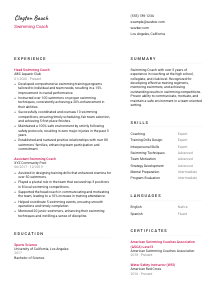
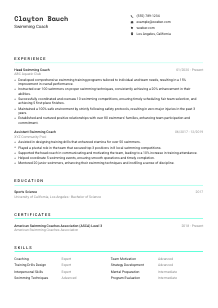
Into swimming, but your resume is just treading water? Glide through this Swimming Coach resume example, created with Wozber free resume builder. Learn how to match your poolside prowess to job requirements, setting your career voyage on a winning course!
Swimming coaching is judged in the water, on the deck, and across an entire season. Hiring teams want to see whether you can build training plans that improve technique, manage competition preparation, keep athletes safe, and communicate well with swimmers, families, and assistant coaches. Your resume should make that coaching range visible from the first few lines.
A tailored resume changes how quickly your coaching profile comes into focus, especially when an employer is sorting candidates through an ATS before a human review. Wozber's free resume builder helps you align your wording with the job description, keep an ATS-friendly resume format, and surface the specifics that matter here, such as training program design, meet oversight, swimmer development, and safety leadership.
For swimming coach roles, the header needs to do one practical job well. It should identify you clearly, show that you are reachable, and confirm any location or communication requirements the employer listed. Keep it clean, professional, and easy to scan.
Use your full name as the most prominent text in the header. Keep it slightly larger than the body text so it is easy to find when a hiring manager is reviewing several coaching resumes in a row. This is simple formatting, but it helps your application feel organized from the start.
Place "Swimming Coach" directly beneath your name if that is the role you are targeting. Matching the title used in the posting helps frame your experience immediately, especially if your background includes related roles such as Head Coach, Assistant Coach, or Aquatics Instructor.
List a phone number and email address that you check regularly. For coaching jobs, responsiveness matters because interviews, tryout observations, and facility scheduling can move quickly. A straightforward email format such as "first.last@domain.com" keeps the focus on your qualifications.
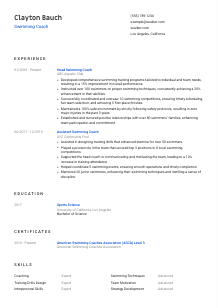
If the employer wants someone already based in a specific area, say so in your header. In this example, listing "Los Angeles, California" directly addresses the stated location requirement and removes a common point of uncertainty early in the review.
Include a website or LinkedIn profile if it supports your coaching candidacy. This works well when the page shows team results, coaching history, certifications, athlete development work, or your broader involvement in competitive swimming.
Your personal details should answer the practical basics at a glance: who you are, what role you do, how to reach you, and whether you meet obvious requirements such as location. That gives the rest of the resume room to focus on coaching results.




This section carries the most weight for a swimming coach. Employers are looking for proof that you can improve swimmer performance, run structured training, prepare athletes for meets, and keep the program operating safely and smoothly. Write your experience like a record of coaching outcomes, not a list of duties.
Read the description closely and underline the work that defines success in the role. For this opening, that includes building training programs, teaching technique, coordinating competitions, maintaining facility safety, and managing relationships with swimmers, families, and assistant coaches. Those are the themes your bullet points should reflect.
List positions in reverse chronological order, starting with your most recent coaching work. Include the job title, organization, and dates, then make it easy to see how your scope grew over time, whether that meant leading a full program, coaching larger athlete groups, or taking on meet management responsibilities.
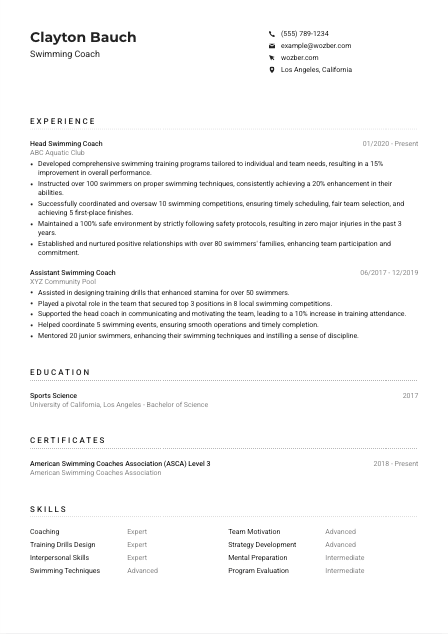
Strong bullets show what changed because of your coaching. The sample resume does this well by pairing actions with outcomes, such as improving overall performance by 15 percent, coaching over 100 swimmers, and helping secure five first-place finishes. Those details tell a hiring team far more than "responsible for swimmer development."
Swimming coaching offers plenty of natural metrics. Include swimmer count, attendance improvement, competition placements, performance gains, injury reduction, event volume, or progression rates where you can support them. Numbers make your workload and impact easier to understand, especially for competitive programs that care about results over a season.
Cut achievements that do not strengthen your case for this kind of role. Prioritize training design, stroke instruction, race preparation, athlete motivation, safety compliance, and team coordination. If you have broader sports or education experience, include only the parts that support your work with swimmers and team operations.
By the end of the experience section, the reader should understand the level you have coached, the size of the groups you have handled, and the results you have produced in training and competition. That is what moves a swimming coach resume into the interview pile.
Education matters most here when it confirms the technical foundation behind your coaching. Degrees in sports science, kinesiology, physical education, or related fields show that your training plans and athlete development work rest on more than practical experience alone.
When a posting asks for a bachelor's degree in Sports Science, Kinesiology, or a related field, list that information clearly. Do not make the reviewer hunt for it. In the example, "Bachelor of Science" and "Sports Science" are both visible right away, which directly supports the requirement.
Present each entry with the degree, school, field of study, and graduation year. This is one of the most straightforward parts of the resume, so clarity matters more than extra description.
If your degree connects directly to athletic performance, movement, physiology, or coaching, name that field precisely. A Sports Science degree is especially relevant for roles that involve technique correction, training load planning, and athlete development.
Relevant coursework can help if you are early in your coaching career or if the classes connect directly to the role, such as exercise physiology, biomechanics, sports psychology, or motor learning. Keep it selective and tied to what the employer is likely to value in a swim program.
You can mention leadership roles, athlete support work, or sports-related academic projects if they add context to your coaching profile. For more experienced coaches, though, this section should stay compact and let your results on deck carry more of the weight.
Your education should confirm that you meet the stated requirement and reinforce the technical side of your coaching. Once that is clear, let your experience and certifications do the deeper work of proving program leadership.
For swimming coach jobs, certifications are operational, not decorative. They show that you meet recognized coaching standards and that you are current on the credentials programs rely on for athlete development and poolside responsibility.
Start with the certification that directly matches the posting. Here, the employer asked for ASCA Level 2 or higher, so that should be the first certificate listed. The sample resume goes a step further with ASCA Level 3, which clearly exceeds the minimum.
Prioritize certifications tied to swim instruction, athlete development, and safe facility operation. Along with ASCA credentials, items such as water safety, first aid, CPR, or lifeguard-related certifications can strengthen your application when they are current and relevant to the role.
Include dates or validity ranges so the employer can see that your certification is active. This matters for coaching and safety credentials because expired qualifications can raise immediate concerns, even if your experience is otherwise strong.
Competitive swimming programs change with training methods, athlete needs, and governing standards. Continue adding certifications that reflect where your career is heading, whether that is higher-level coaching education, specialized technique clinics, or athlete safety training.
This section should quickly show that you meet the formal coaching standard for the role and take professional development seriously. For swim programs, that combination carries real weight.
A swimming coach skills section works best when it reflects how the job is actually performed. That means balancing technical coaching ability with communication, motivation, planning, and meet-day execution. Keep the list focused on skills you actively use in swimmer development and program management.
Start with the skills named or strongly implied in the job description. In this case, that includes swimming techniques, training drills, competitive strategy, interpersonal communication, team motivation, and safe facility oversight. Using the employer's language helps both ATS matching and human review.
Add skills that you can support elsewhere in the resume. If you list training drill design, meet that claim with bullets about performance improvement. If you list team motivation, support it with attendance gains, swimmer retention, or successful competition outcomes.
Lead with the abilities most central to the role, such as coaching, stroke technique instruction, program design, competition strategy, and athlete communication. The sample resume gets this mostly right by elevating coaching, drill design, and interpersonal skills ahead of secondary items.
A useful skills section should reinforce the coaching profile already established in your experience. When the priorities line up, the employer can quickly picture how you would run training, guide swimmers, and support competition readiness.
Language ability matters in coaching when it affects instruction, athlete trust, and communication with families. For most swimming coach roles, English proficiency needs to be clear first, then any additional languages can add range, especially in diverse team environments.
If the posting specifies a strong command of English, list English first and state your proficiency level clearly. That confirms you can deliver instruction, communicate corrections, manage safety situations, and coordinate effectively with families and staff.
Order matters here. The language the employer requested should appear at the top so there is no ambiguity about whether you meet that part of the role.
Additional languages can be valuable when working with multilingual swimmers or families, especially in club and community settings. In the example, Spanish is a useful addition because it broadens communication beyond the required English proficiency.
Use clear labels such as "Native," "Fluent," "Intermediate," or "Basic." Avoid vague terms. Coaches need to communicate instructions accurately, so precision about language ability matters.
Only include languages you can use in a real coaching context, whether that means explaining drills, discussing athlete progress, or handling meet-day logistics. Treat this section as an extension of communication strength, not a filler category.
For a swimming coach, language skills are most helpful when they improve instruction, safety, and relationships with athletes and families. Keep the section honest and relevant to the environment you coach in.
The summary should give a fast, accurate read on the kind of coach you are. In a few lines, it needs to cover your level of experience, your coaching strengths, and the results or responsibilities that make you worth a closer look.
Read the posting and identify the two or three themes that matter most. For this role, that means coaching experience, training program development, technical instruction, competition oversight, and strong communication. Build your summary around those priorities rather than writing a generic profile.
Open with your title and years of experience, then name the settings you have coached in if they are relevant, such as club, high school, or collegiate swimming. That quickly tells the reader the level of swimmers and program structure you know.
A short summary gets stronger when it includes one or two outcome-driven ideas, such as performance gains, swimmer development, competition success, or sustained safety standards. The sample summary points in the right direction by mentioning effective training regimens, mentoring, and competition results.
Aim for 3 to 5 sentences with direct language. Skip broad traits unless they connect to coaching work. A hiring manager should finish this section knowing whether you are a technique-focused developmental coach, a competitive program leader, or a coach who brings both athlete improvement and operational reliability.
A good summary should read like a condensed version of your actual work on deck: who you coach, how you coach, and what your athletes or teams achieve. When that is clear, the rest of the resume has a strong foundation.
Your resume should now show the full picture of your coaching work: training design, stroke instruction, meet preparation, swimmer development, safety standards, and day-to-day communication with athletes, families, and staff. That is the combination employers look for when hiring a swimming coach who can lead both performance and program stability.
Use Wozber's free resume builder to sharpen your wording, keep your layout in an ATS-compliant resume format, and check alignment with the posting through its ATS resume scanner. When the language, structure, and coaching evidence all line up, hiring teams can quickly see your readiness to lead swimmers in training and competition.