



Use Wozber and land your dream job
Create Resume
No registration required
Patrolling the waters, but your resume feels adrift? Check out this Lifeguard resume example, built with Wozber free resume builder. Learn how to present your lifesaving skills to make a splash with job requirements, ensuring your career stays afloat at the top of the tide!

Lifeguard hiring moves quickly toward one question: can this person prevent incidents, respond decisively in the water, and keep guests calm when something goes wrong. A resume for this role needs to make that operational judgment easy. Hiring teams look for practical proof of vigilance, rescue capability, emergency response training, and the ability to manage a pool, beach, or waterpark environment without letting small risks turn into emergencies.
Resume tailoring changes which details rise to the top first. When your wording mirrors the post's priorities, such as active surveillance, rescue techniques, equipment checks, and current CPR or First Aid credentials, both the reader and the ATS can immediately connect your background to the work. Wozber's free resume builder helps organize that information into an ATS-compliant resume that highlights the certifications, safety record, and on-deck responsibilities a lifeguard employer needs to see.
For lifeguard roles, the header does more than identify you. It confirms that you are reachable, professionally presented, and, when required, already based where the facility needs coverage. Keep this section clean and factual so the hiring manager can move straight to your certifications and safety experience.
Place your full name at the top in a clear, readable format. Lifeguard hiring often involves quick screening before seasonal peaks or schedule changes, so your header should be instantly legible on both desktop and mobile.
Add "Lifeguard" directly under your name if that is the role you are applying for. Matching the job title helps frame the rest of the resume correctly and supports ATS alignment, especially when employers are sorting candidates across related roles like swim instructor, pool attendant, or junior lifeguard.
List a dependable phone number and a professional email address. If you include a website or profile, make sure it supports the role, such as showing aquatic leadership, coaching work, or related certifications, rather than unrelated content.
If a posting specifies a city or region, reflect that in your header. Here, listing Los Angeles, California directly addresses the employer's stated requirement and removes doubt about commute or relocation timing. For roles without a location filter, city and state are usually enough.
A LinkedIn profile can strengthen your application when it matches your resume and includes lifeguarding, aquatics, recreation, or public safety experience. Use it only if it is current. A sparse or outdated profile creates more questions than value.
Your personal details should answer the basic logistics at a glance: who you are, what role you want, how to reach you, and whether you meet any location requirement. When this section is clean, the hiring team can focus on your rescue experience and certifications without friction.




This is the section that carries the most weight for a lifeguard resume. Employers want to see how you monitored swimmers, enforced rules, handled rescues, supported emergency response, and kept the facility safe between incidents. Daily vigilance, not just rare hero moments, should come through in your bullet points.
Start by marking the responsibilities and requirements that repeat the role's real priorities. For lifeguard jobs, that usually includes swimmer supervision, rule enforcement, rescue response, first aid or CPR, equipment checks, and training participation. Those phrases should guide how you rewrite your experience bullets so the employer sees direct overlap instead of adjacent customer service or recreation work.
List your positions in reverse chronological order with employer name, title, and dates. If your background includes settings with different risk profiles, such as a pool, beach, or waterpark, make that visible because the environment affects staffing, rescue style, and crowd management expectations.
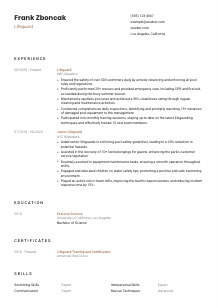
Most lifeguard resumes get stronger when they move past generic statements like "responsible for safety" and show what that looked like in practice. Write bullets around actions and outcomes: monitored high swimmer volume, enforced safety rules, responded to distressed swimmers, administered first aid, completed opening inspections, or trained newer guards. The sample resume does this well by tying daily supervision, rescues, and inspection work to concrete results.
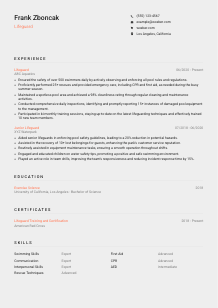
Metrics make your experience more believable when they reflect the realities of the job. Good lifeguard measures include swimmers supervised per shift, rescues completed, incident response improvements, training frequency, cleanliness scores, or equipment issues identified. For example, "ensured the safety of over 500 swimmers daily" and "performed 25+ rescues" show scale and readiness without exaggeration.
Keep the emphasis on water safety, emergency response, facility upkeep, and guest communication under pressure. If you include customer-facing tasks, tie them back to the setting, such as educating children on water safety or calming guests during incidents. Every bullet should strengthen your case for handling active surveillance and emergency situations responsibly.
By the end of your experience section, the employer should be able to picture you on stand, on deck, or in the water handling the actual demands of the shift. Clear role details, strong action verbs, and lifeguard-specific metrics make your background easier to trust and easier to match in an ATS-compliant resume.
Education is usually a supporting section for lifeguard roles, but it still matters. It confirms that you meet baseline requirements and can add context when your studies connect to exercise science, physical education, recreation, health, or youth programming. Keep it concise and relevant.
If the posting asks for a high school diploma or equivalent, make sure your education section clearly shows that you meet or exceed it. When you have higher education, you do not need to overexplain the basics, but the requirement still needs to be satisfied on the page.
List the school, degree or diploma, field of study if relevant, and graduation year or date. Clean formatting matters here because this section is often scanned quickly after the employer checks your certifications and experience.
If your coursework or degree connects naturally to physical conditioning, kinesiology, exercise science, recreation management, or health, let that support your candidacy. In the example resume, a degree in Exercise Science adds useful context for physical readiness and body mechanics, even though it is not a universal requirement for lifeguard work.
You can mention standout coursework, honors, or school activities if they strengthen your case, especially early in your career. Focus on content that relates to fitness, anatomy, coaching, youth supervision, or emergency care, not general academic filler.
Lifeguard employers value people who keep their training current. Formal education does not replace certifications, but if you are completing related coursework or continuing education in safety, health, or recreation, that can reinforce your commitment to the work.
This section should confirm your baseline qualification and, when relevant, add useful context about physical training or health knowledge. It supports the resume best when it is tidy, accurate, and secondary to your certifications and water safety experience.
For lifeguards, certifications are not a nice extra. They are core hiring criteria and often a compliance issue for the facility. If your credentials are hard to find, outdated, or vaguely labeled, the application can stall even if your experience is solid.
Put the most important credentials first, especially lifeguard certification and valid First Aid, CPR, and AED coverage. Use the exact certification names where possible. If the posting mentions providers such as the American Red Cross or YMCA, mirror the wording when it accurately reflects your training.
Keep this section focused on certifications that matter on deck or in the water. Lifeguard training, water safety instruction, first responder preparation, and emergency care credentials should come before less relevant courses or general workplace training.
Include issue or renewal dates so the employer can see that your certification status is current. That is especially important for CPR, AED, and First Aid, where expired credentials can block scheduling or onboarding.
Facilities want guards who refresh their training and stay aligned with current rescue procedures, emergency communication standards, and equipment use. If you have renewed credentials consistently or completed recent refresher training, make that visible because it shows professional maintenance, not just one-time qualification.
A lifeguard resume works better when the reader can confirm certification status in seconds. Keep the names accurate, the dates current, and the most relevant credentials at the top. Wozber's ATS-friendly resume template and ATS resume scanner can help present these requirements clearly so they are easy to match against the posting.
A lifeguard skills section should read like the toolkit you rely on during an actual shift. That means physical capability, rescue technique, emergency response, observation, and communication with swimmers, parents, and team members. Keep it specific enough to support the rest of the resume, not so broad that it becomes filler.
Start with the skills the role depends on every day. For lifeguards, that often includes strong swimming ability, rescue techniques, surveillance, rule enforcement, first aid, CPR, AED use, and verbal communication during both routine supervision and emergencies.
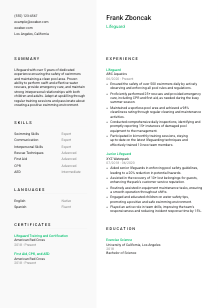
List both operational skills and people-facing ones. A guard may need to execute a rescue, direct bystanders, explain pool rules to families, and coordinate with managers or other guards during an incident. The sample resume handles this balance well by pairing rescue and emergency care skills with communication and interpersonal strengths.
Choose skills that reinforce your fit for the specific environment and level of responsibility. Avoid padding this section with general traits that already appear elsewhere. A shorter list of relevant capabilities is more convincing than a long list that drifts away from safety, supervision, and response work.
This section should quickly confirm that you have the physical, technical, and communication abilities the role depends on. When the wording aligns with the job post and the experience section backs it up, your skills list becomes a useful shortcut for both recruiters and ATS screening.
Communication is a safety function in lifeguarding. You may need to give fast instructions, warn swimmers, reassure children, brief teammates, or explain an incident to parents and supervisors. That makes language ability worth listing when it affects how well you can manage the environment.
If the posting states that professional English proficiency is essential, make sure English appears clearly in this section. For lifeguards, this is not just a formality. It relates directly to giving instructions, enforcing rules, and communicating during emergencies.
Additional languages can be valuable in community pools, waterparks, resorts, and public recreation settings where you interact with diverse groups. In the example resume, Spanish strengthens the candidate's ability to communicate with a broader range of swimmers and families, but that should be treated as an asset, not a universal requirement.
Label your ability accurately with terms such as Native, Fluent, Conversational, or Basic. In a safety role, overstating language proficiency can create real risk if you cannot give or understand instructions under pressure.
If you are applying to a beach, municipal pool, youth camp, or tourist-heavy venue, think about which language abilities would genuinely help with guest interaction and safety messaging. Tailoring here works best when it reflects the population you are likely to serve.
Extra languages are useful because they widen your ability to prevent misunderstandings and keep guests informed. Frame them as part of your service and safety capability, especially if you have used them to explain rules, calm patrons, or support children and families.
A language section is most useful when it shows how well you can communicate in the setting, not when it simply fills space. Clear, honest language details can strengthen your resume by showing that you can deliver instructions and reassurance to the people actually using the facility.
A lifeguard summary has a narrow job: give the reader a fast, credible picture of your experience level, rescue readiness, certifications, and working style. In a role centered on prevention and emergency response, vague personal branding does very little. Specific, safety-focused language does much more.
Before writing, pull out the role's central needs: years of experience, setting type, rescue capability, emergency care credentials, swimmer supervision, and communication with adults and children. Those points should shape the opening lines, not generic statements about being hardworking or passionate.
Start with your title, years of experience, and the kind of environment you have covered. A line such as "Lifeguard with 5+ years of experience in high-volume pool and waterpark settings" tells the reader much more than a broad self-description. The example resume uses this approach effectively by leading with years of experience and swimmer safety.
Use the next sentence or two to mention the strengths that directly support hiring decisions, such as active surveillance, water rescues, CPR and first aid response, facility inspections, or guest communication. If you have a useful metric, include one concise detail rather than crowding the summary with numbers.
Aim for 3 to 5 sentences with tight wording and direct relevance. A hiring manager should finish the summary with a clear sense of your setting, experience level, and emergency readiness. Save full detail for the experience section.
A well-written summary gives the employer an immediate sense that you can supervise water safely, respond when needed, and work professionally with guests and staff. Wozber's free resume builder can help shape this into an ATS-friendly resume format that keeps your certifications, experience, and lifeguard strengths easy to spot from the first lines.
A lifeguard resume should leave little ambiguity about your readiness for the stand. If your document clearly shows current certifications, relevant water safety experience, rescue and emergency response capability, and the communication skills to manage swimmers calmly, you are giving the employer what matters most.
Before you send it, review the language against the job post, tighten any vague bullet points, and make sure the most important qualifications appear early. Wozber's AI resume builder, ATS resume scanner, and ATS-friendly resume format can help you align your content with the posting and present your background in a clean, job-matched structure. The finished resume should make one thing easy to judge: you can protect people in and around the water from day one.




