



Use Wozber and land your dream job
Create Resume
No registration required
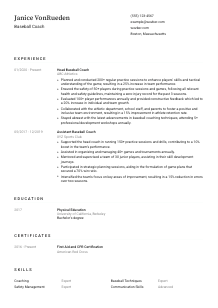
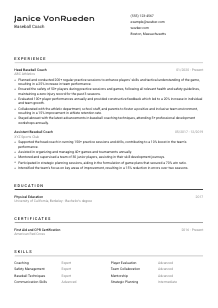
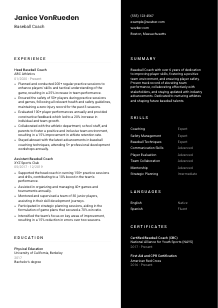
Calling the plays, but your resume is benched? Step up to the plate with this Baseball Coach resume example, created with Wozber free resume builder. Learn how to position your coaching prowess to match team-spirited job requirements and score a career grand slam!
Baseball coaching is reviewed through daily work, not slogans. Hiring teams want to see how you run practices, teach fundamentals, manage game situations, protect player safety, and help athletes improve over a season. Your resume should make those coaching habits visible through real scope, player development outcomes, and the level of competition you have coached.
When the resume is tailored well, the hiring team can quickly separate a coach with hands-on baseball program leadership from someone with general sports instruction experience. Wozber's free resume builder helps you align your wording with the posting, keep an ATS-compliant resume structure, and surface the coaching details that matter first, such as practice planning, player evaluation, and team development.
For a Baseball Coach, the contact section does more than identify you. It should immediately confirm basic alignment for communication, role focus, and any location requirement tied to the school, club, or athletic department.
Use your full name in the largest text on the page so it is easy to find during a quick scan. Keep the presentation clean and professional. Coaching resumes are often reviewed alongside teaching, athletics, or program staff applications, so clear identification matters.
Place "Baseball Coach" directly below your name if that is the role you are targeting. This helps both ATS systems and athletic administrators connect your resume to the opening right away, especially when they are sorting through applicants from broader coaching or physical education backgrounds.
Your phone number and email should be simple, current, and easy to trust. Athletic departments may need to reach out quickly around interview scheduling, season timelines, or credential follow-up, so avoid anything informal or hard to parse.
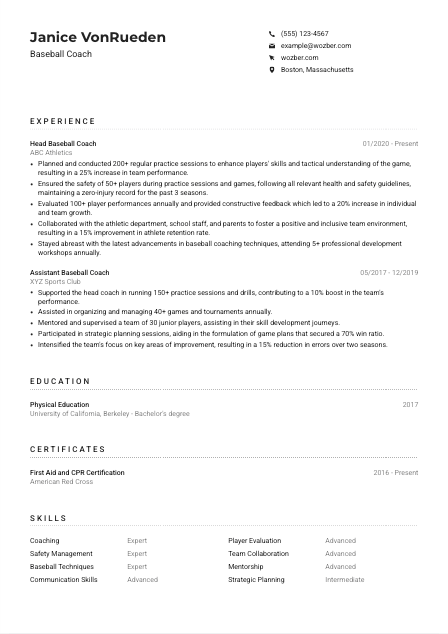
Include your city and state when geography matters to the role. In this example, listing Boston, Massachusetts directly supports the employer's stated location requirement. If you are relocating, make that clear in a way that removes doubt about your availability.
Add a website or LinkedIn profile only if it supports your candidacy with coaching history, program results, player development work, or related athletic experience. If you include a link, make sure the information matches your resume and reflects your current role and achievements.
This section should confirm who you are, how to reach you, and whether you match the basic logistics of the job. Keep it precise so the reader gets to your coaching background without any friction.




Baseball Coach hiring decisions are heavily shaped by what you have run, taught, and improved. Your experience section should show the level of athletes you coached, the volume of training you managed, the standards you enforced, and the results your program produced.
Before writing bullets, identify the work the employer cares about most. For this opening, that includes planning regular practices, ensuring player safety, evaluating performance, collaborating with staff and parents, and staying current with coaching methods. Those priorities should guide which accomplishments you feature first.
List your most recent coaching role first, then work backward. For each position, include your title, organization, and dates. That format makes it easy to track your progression from assistant or developmental roles into broader leadership, player supervision, or head coaching responsibility.
Strong Baseball Coach bullets describe what you actually ran and what changed because of it. Focus on practice design, tactical instruction, player mentoring, game preparation, defensive or offensive improvements, retention, win rate, or reduced errors. In the sample resume, "planned and conducted 200+ regular practice sessions" works well because it pairs coaching workload with a 25% increase in team performance.
Metrics carry weight when they match how coaches are judged. Good examples include number of athletes coached, practices led, games managed, player evaluations completed, retention improvements, injury reduction, or season performance gains. A zero-injury record across multiple seasons or a measurable drop in team errors tells far more than saying you were "results-driven."
Prioritize experience that shows baseball knowledge, athlete development, communication, and safe program management. Cut accomplishments that do not support the role. Even if you have broader sports or teaching experience, frame it through transferable coaching value such as drill design, feedback delivery, supervision, or coordination with school staff and families.
After this section, the employer should understand the level you have coached, the kind of baseball environment you have managed, and the results you have helped produce. That is the core proof behind your application.
Education matters in Baseball Coach hiring when it confirms subject knowledge, athlete development grounding, or alignment with school and athletic program standards. Keep it straightforward and relevant to the role you want.
If the posting asks for a bachelor's degree in Physical Education, Sports Management, or a related field, make sure that information is easy to spot. Do not bury the field of study. In the example, a bachelor's degree in Physical Education directly meets the stated requirement.
List your degree, field of study, school, and graduation year or date range. That is usually enough for coaching roles unless the employer specifically wants more academic detail. Clean formatting works better than overexplaining coursework.
When your degree is closely tied to kinesiology, sports management, physical education, exercise science, or a related area, present it exactly. That helps distinguish you from applicants whose experience is solid but whose academic background is less connected to coaching, athlete development, or program administration.
If you are earlier in your coaching career, relevant coursework, student athlete leadership, team captaincy, internships, or work with sports programs can add useful context. For more experienced coaches, those details are usually less important than your practice, game, and player development record.
Academic honors, coaching-related awards, or leadership distinctions can be worth adding if they reinforce discipline, sports leadership, or credibility with youth, school, or competitive programs. Keep them brief and include only those that support the role.
Your education should confirm that you meet the posted standard and support your coaching credibility. Once that is clear, let your experience and results do the heavier lifting.
For coaching roles, certifications often matter because they affect day-to-day athlete supervision. Safety credentials and recognized coaching certifications show that you can run practices responsibly and meet association or school requirements.
Read the posting carefully for safety or governing-body requirements. Here, valid First Aid and CPR credentials are specifically relevant, along with related sports certifications if the local athletic association requires them. Put required items first so they are easy to find.
List certifications that strengthen your case as a baseball coach, not every course you have ever completed. First Aid, CPR, concussion safety, youth coaching credentials, or sport-specific certifications all support your ability to supervise athletes, respond appropriately, and operate within program standards.
When a credential has renewal cycles, show dates so the employer can tell it is current. The sample resume handles this well by showing ongoing validity for First Aid and CPR. That kind of detail matters because expired safety credentials can delay hiring or sideline eligibility.
Baseball instruction evolves through new training methods, player development approaches, and safety expectations. If you regularly renew credentials or complete coaching education, that supports the job requirement around staying current with coaching techniques and professional development.
This section should reassure the employer that you can supervise athletes safely and meet any formal standards attached to the role. For school and club environments, that practical trust matters.
A Baseball Coach skills section should mirror the way the job is actually done. The most useful skills combine technical baseball instruction, athlete evaluation, safety awareness, communication, and the ability to work across players, staff, and parents.
Start with the language the employer already uses. In this posting, strong knowledge of baseball rules, strategies, and techniques is central, along with interpersonal communication and collaboration. Mirroring those terms helps ATS matching and keeps your resume tied to the actual opening.
Include baseball-specific strengths such as practice planning, hitting and fielding instruction, tactical development, game strategy, player evaluation, and safety management. Then support them with people-facing skills like communication, mentorship, and team collaboration. The sample skills list does this well by pairing baseball techniques and safety management with communication and mentorship.
Do not overload the section with generic traits. Choose skills you can support elsewhere through experience, certifications, or your summary. If "strategic planning" is listed, your bullets should show game plans, season preparation, or measurable team improvement. Every skill should connect to real coaching work.
A short, well-targeted skills section helps the employer understand your coaching toolkit fast. The best lists sound like the work you perform at practice, during games, and across the season.
Communication is a working skill for Baseball Coaches. It shapes how you teach drills, explain game situations, give performance feedback, and build trust with athletes, parents, and staff. List languages in a way that reflects that practical value.
If the role specifies a language requirement, place it first. This posting requires English, so your proficiency in English should be clearly listed. That matters for daily instruction, athlete safety communication, and coordination with the wider school or program community.
Use clear levels such as Native, Fluent, Advanced, or Conversational. Avoid overstating ability. Coaches rely on precision when giving instruction and feedback, so honest language ratings matter more than impressive-sounding labels.
Additional languages can be valuable in baseball programs with diverse athletes and families. In the sample resume, Spanish is a useful secondary language because it can support player rapport, family communication, and a more inclusive team environment, even though it is not listed as a formal requirement here.
List only languages you could comfortably use in real coaching situations, whether that means giving instructions, holding parent conversations, or discussing player development. A short, credible list is stronger than a long one with weak proficiency.
Language skills should reinforce your ability to coach and connect, especially in school, youth, and community-based programs. Include them when they add genuine value to your application, not just to fill space on the page.
For coaching roles, language ability matters when it improves instruction, safety, and relationships. Keep the section practical and tied to the people you work with every day.
The summary should quickly establish your coaching level, the kind of baseball work you have handled, and the results or strengths that make you a credible hire. For this role, that means player development, safe program leadership, communication, and baseball knowledge, all in a few focused lines.
Before writing, identify the themes that appear repeatedly in the posting. Here, those include baseball coaching experience, practice leadership, player evaluation, safety, and communication. Use that mix to shape your summary instead of writing a generic statement about loving sports.
Lead with your title and years of relevant experience, then anchor it in the level or scope you have coached. A phrase like "Baseball Coach with 6+ years of experience coaching competitive athletes" is stronger than a broad claim about leadership because it immediately places you in the right professional context.
Use compact highlights that reflect what the employer needs. Improvements in team performance, athlete retention, player development, or safety outcomes all work well. The sample summary points to player development, stakeholder collaboration, and program improvement, which aligns well with the posting's priorities.
Aim for a short paragraph that can be read in seconds. Focus on baseball coaching, not your full career story. This section should prepare the reader for the details in your experience section, not repeat every accomplishment or drift into general motivational language.
A well-written summary should tell the employer what kind of Baseball Coach you are, how much relevant experience you bring, and where your strongest contribution lies. That sets the tone for everything that follows.
A Baseball Coach resume works best when it shows how you train athletes, manage safety, improve performance, and support the wider team environment. Keep each section tied to real coaching work, from practice planning and game preparation to communication with staff and families.
Use Wozber's free resume builder to organize that experience into an ATS-friendly resume format, then refine the language with the ATS resume scanner so the posting's priorities are reflected clearly. The final result should make it easy to judge your coaching background, program leadership, and readiness to step into the dugout.




